
淋巴母细胞系和细胞系在开发用于纠正白细胞粘附缺陷基因组缺陷的CRISPR-Cas9方法中是有用的替代物。
Lymphoblastoid and cell lines are useful surrogate in developing a CRISPR-Cas9 method to correct leukocyte adhesion deficiency genomic defect.
作者信息
Ramadan Ahmad R, Ben Khalaf Noureddine, Trabelsi Khaled, Bakheit Halla, Ben-Mustapha Imen, Barbouche Mohamed-Ridha, Fathallah M-Dahmani
机构信息
Laboratory of Transmission, Control and Immunobiology of Infections (LR16IPT02), Institut Pasteur de Tunis, University of Tunis El Manar, Tunis, Tunisia.
Department of Life Sciences, King Fahd Chair of Medical Biotechnology, College of Graduate studies Arabian Gulf University, Manama, Bahrain.
出版信息
Front Bioeng Biotechnol. 2025 Mar 21;13:1548227. doi: 10.3389/fbioe.2025.1548227. eCollection 2025.
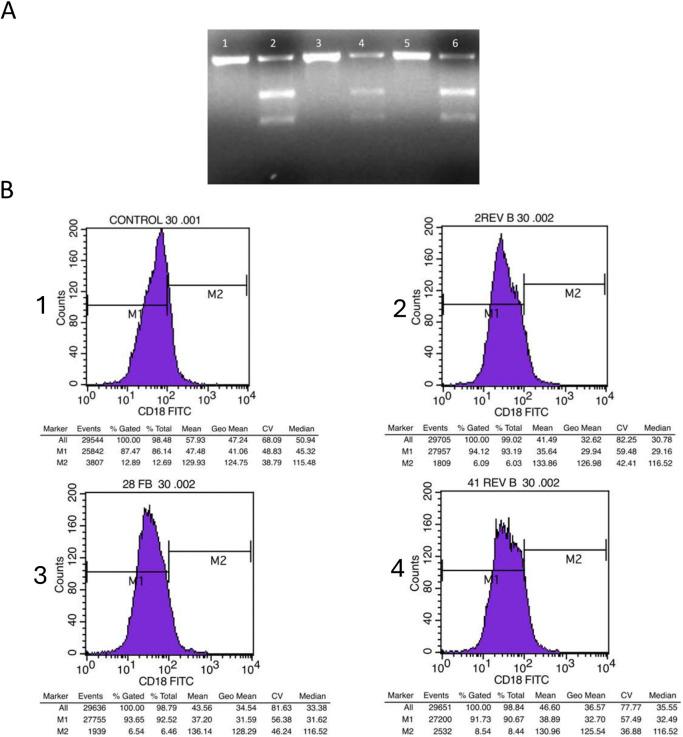
Leukocyte adhesion deficiency type 1 (LAD1) is a severe inborn error of immunity caused by mutations in the ITGB2 gene, which encodes the beta-2 integrin subunit (CD18). These mutations lead to the absence or deficiency of CD18/CD11a, b, and c heterodimers, crucial for leukocyte adhesion and immune function. CRISPR-Cas9 Gene editing technology represents a promising approach for correcting these genomic defects restore the stable expression of CD18 and reverse the disease. We developed a CRISPR-Cas9-based gene correction strategy using cells and patient-derived lymphoblastoid cell lines as surrogates for hematopoietic progenitor cells. Three candidate gRNAs were first predicted in silico using CRISPOR and experimentally tested in wild-type ITGB2-expressing cells to identify the gRNA with the highest genomic DNA cleavage efficiency. The most efficient gRNA was then paired with espCas9 and used alongside five homology-directed repair templates (HDRs) (single-stranded donor oligonucleotides, ssODNs) to repair ITGB2 defects in patient-derived lymphoblastoid cell lines. CD18 expression levels in edited cells were quantified via flow cytometry, and whole-genome sequencing (WGS) was conducted to assess off-target effects and insertion accuracy. Among the three candidate gRNAs, 2-rev gRNA exhibited the highest genomic cleavage rate in cells. Using this gRNA with espCas9 and HDR-2, we achieved a 23% restoration of CD18 expression in LAD1 patient-derived cells, a level sufficient to change the disease course from severe to moderate. Whole-genome sequencing confirmed the absence of off-target mutations or undesired DNA insertions, demonstrating high specificity and precision in gene correction. This CRISPR-Cas9-based method provides a precise and effective approach for correcting ITGB2 mutations in LAD1 patients. The high-fidelity gene editing process, validated through WGS, supports its potential for future applications in CD34+ hematopoietic stem cell therapies. The approach can be further optimized for clinical translation, offering a path toward a stable and long-term cure for LAD1.
1型白细胞黏附缺陷症(LAD1)是一种严重的先天性免疫缺陷病,由ITGB2基因突变引起,该基因编码β-2整合素亚基(CD18)。这些突变导致CD18/CD11a、b和c异二聚体缺失或缺陷,而这些异二聚体对白细胞黏附和免疫功能至关重要。CRISPR-Cas9基因编辑技术是一种有前景的方法,可用于纠正这些基因组缺陷,恢复CD18的稳定表达并逆转疾病。我们开发了一种基于CRISPR-Cas9的基因校正策略,使用细胞和患者来源的淋巴母细胞系作为造血祖细胞的替代物。首先使用CRISPOR在计算机上预测了三种候选引导RNA(gRNA),并在表达野生型ITGB2的细胞中进行了实验测试,以鉴定具有最高基因组DNA切割效率的gRNA。然后将最有效的gRNA与espCas9配对,并与五个同源定向修复模板(HDR)(单链供体寡核苷酸,ssODN)一起使用,以修复患者来源的淋巴母细胞系中的ITGB2缺陷。通过流式细胞术对编辑细胞中的CD18表达水平进行定量,并进行全基因组测序(WGS)以评估脱靶效应和插入准确性。在三种候选gRNA中,2-rev gRNA在细胞中表现出最高的基因组切割率。使用这种gRNA与espCas9和HDR-2,我们在LAD1患者来源的细胞中实现了23%的CD18表达恢复,这一水平足以将疾病进程从严重转变为中度。全基因组测序证实没有脱靶突变或不期望的DNA插入,表明基因校正具有高特异性和精确性。这种基于CRISPR-Cas9的方法为纠正LAD1患者的ITGB2突变提供了一种精确有效的方法。通过WGS验证的高保真基因编辑过程支持其在未来CD34+造血干细胞治疗中的应用潜力。该方法可进一步优化用于临床转化,为LAD1的稳定和长期治愈提供一条途径。



 Zotero 插件