
多靶点、非门控嵌合抗原受体T细胞作为一种保护正常谱系用于血癌治疗的策略。
Multi-targeted, NOT gated CAR-T cells as a strategy to protect normal lineages for blood cancer therapy.
作者信息
DiAndreth Breanna, Nesterenko Pavlo A, Winters Aaron G, Flynn Aaron D, Jette Claudia A, Suryawanshi Vasantika, Shafaattalab Sanam, Martire Sara, Daris Mark, Moore Elizabeth, Elshimali Ryan, Gill Tanveer, Riley Timothy P, Miller Sara, Netirojjanakul Chawita, Hamburger Agnes E, Kamb Alexander
机构信息
A2 Biotherapeutics Discovery Research, Agoura Hills, CA, United States.
出版信息
Front Immunol. 2025 Mar 21;16:1493329. doi: 10.3389/fimmu.2025.1493329. eCollection 2025.
INTRODUCTION
Despite advances in treatment of blood cancers, several-including acute myeloid leukemia (AML)-continue to be recalcitrant. Cell therapies based on chimeric antigen receptors (CARs) have emerged as promising approaches for blood cancers. However, current CAR-T treatments suffer from on-target, off-tumor toxicity, because most familiar blood cancer targets are also expressed in normal lineages. In addition, they face the common problem of relapse due to target-antigen loss. Cell therapeutics engineered to integrate more than one signal, often called logic-gated cells, can in principle achieve greater selectivity for tumors.
METHODS
We applied such a technology, a NOT gated system called Tmod™ that is being developed to treat solid-tumor patients, to the problem of therapeutic selectivity for blood cancer cells.
RESULTS
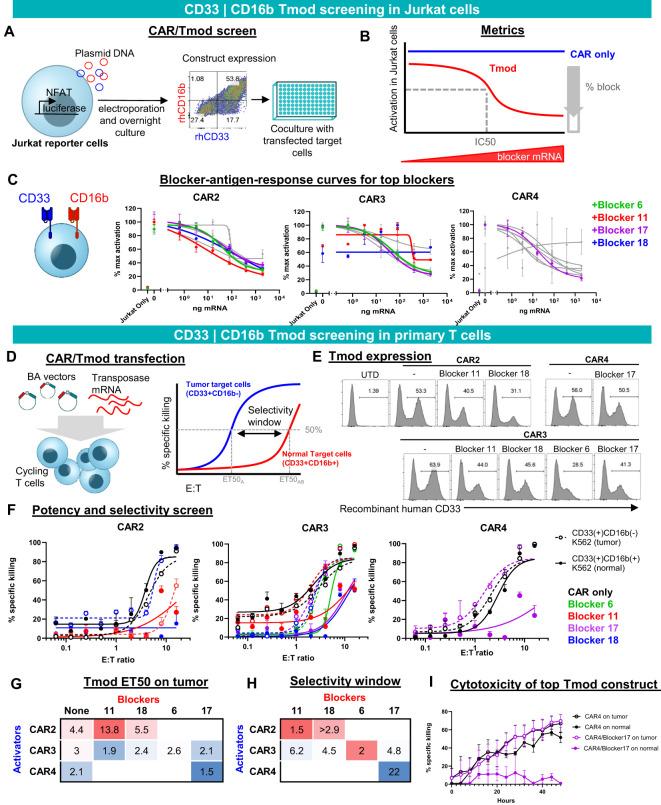
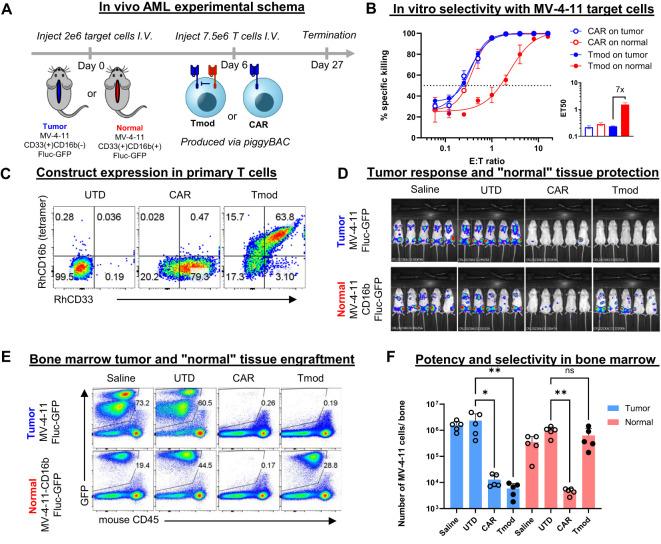
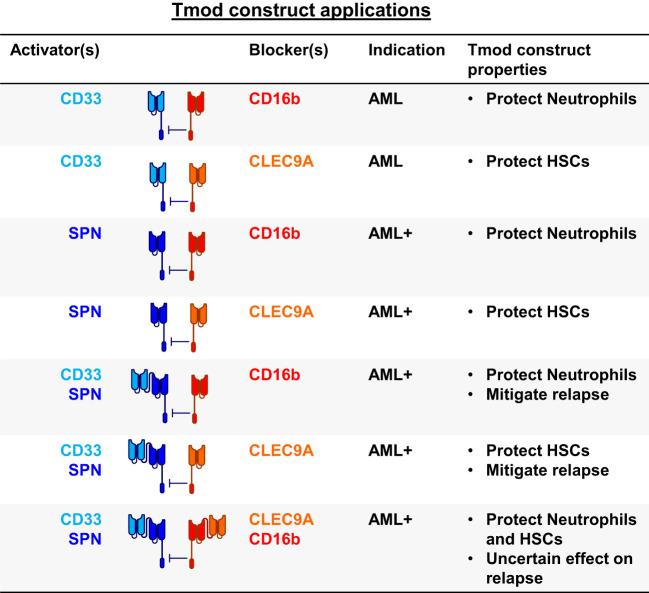
Here we show that Tmod cells can be designed to target 2-4 antigens to provide different practical and conceptual options for a blood cancer therapy: (i) mono- and bispecific activating receptors that target CD33, a well-known AML antigen expressed on the majority of AML tumors (as well as healthy myeloid cells) and CD43 (SPN), an antigen expressed on many hematopoietic cancers (and normal blood lineages); and (ii) mono- and bispecific inhibitory receptors that target CD16b (FCGR3B) and CLEC9A, antigens expressed on key normal blood cells but not on most blood cancers.
DISCUSSION
These results further demonstrate the robust modularity of the Tmod system and generalize the Tmod approach beyond solid tumors.
引言
尽管血液癌症的治疗取得了进展,但包括急性髓系白血病(AML)在内的几种癌症仍然难以治疗。基于嵌合抗原受体(CAR)的细胞疗法已成为治疗血液癌症的有前景的方法。然而,目前的CAR-T治疗存在靶向肿瘤外毒性,因为大多数常见的血液癌症靶点也在正常谱系中表达。此外,它们还面临因靶点抗原丢失而复发的常见问题。经过工程改造以整合多种信号的细胞疗法,通常称为逻辑门控细胞,原则上可以实现对肿瘤更高的选择性。
方法
我们将一种名为Tmod™的非门控系统(正在开发用于治疗实体瘤患者)应用于血液癌细胞的治疗选择性问题。
结果
在这里我们表明,Tmod细胞可以被设计成靶向2至4种抗原,为血液癌症治疗提供不同的实际和概念选择:(i)靶向CD33的单特异性和双特异性激活受体,CD33是大多数AML肿瘤(以及健康髓系细胞)上表达的一种著名的AML抗原,以及CD43(SPN),一种在许多造血癌症(和正常血液谱系)上表达的抗原;(ii)靶向CD16b(FCGR3B)和CLEC9A的单特异性和双特异性抑制受体,这些抗原在关键的正常血细胞上表达,但在大多数血液癌症上不表达。
讨论
这些结果进一步证明了Tmod系统强大的模块化,并将Tmod方法推广到实体瘤之外。



 Zotero 插件