
生物年龄在肠道微生物群饮食指数与肌肉减少症之间关联中的中介作用。
The mediating role of biological age in the association between dietary index for gut microbiota and sarcopenia.
作者信息
Zhang Jingyuan, Guo Jun, Zhang Jing, Liu Heng, Zhou Lin, Cheng Chi, Cao Hong
机构信息
Department of Traumatic Orthopedics, Renmin Hospital, Hubei University of Medicine, Shiyan, China.
The Second Department of Infectious Disease, Shanghai Fifth People's Hospital, Fudan University, Shanghai, China.
出版信息
Front Immunol. 2025 Mar 21;16:1552525. doi: 10.3389/fimmu.2025.1552525. eCollection 2025.
BACKGROUND
Dietary Index of Gut Microbiota (DI-GM) is a newly proposed comprehensive metric for assessing dietary quality in relation to gut microbiota composition. Alterations in muscle structure are closely linked to DNA methylation-based biological age assessments and individual dietary patterns. However, a systematic investigation of the interrelationships among DI-GM, biological age, and sarcopenia remains lacking. We hypothesize that consuming foods beneficial to the gut microbiota may help mitigate the risk of sarcopenia by slowing the aging process.
METHODS
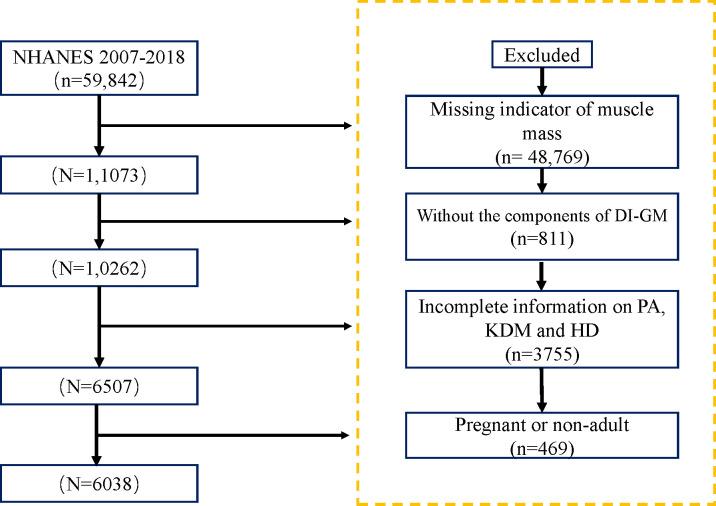
This study analyzed data from NHANES 2007-2018. DI-GM was calculated using two 24-hour dietary recall datasets. Sarcopenia was assessed via dual-energy X-ray absorptiometry (DXA). The association between DI-GM and sarcopenia was evaluated using multivariate logistic regression, subgroup analysis, and restricted cubic splines. This study also investigated the potential mediating effects of three biological age indicators: the Klemera-Doubal Method (KDM), PhenoAge, and Homeostatic Dysregulation (HD).
RESULTS
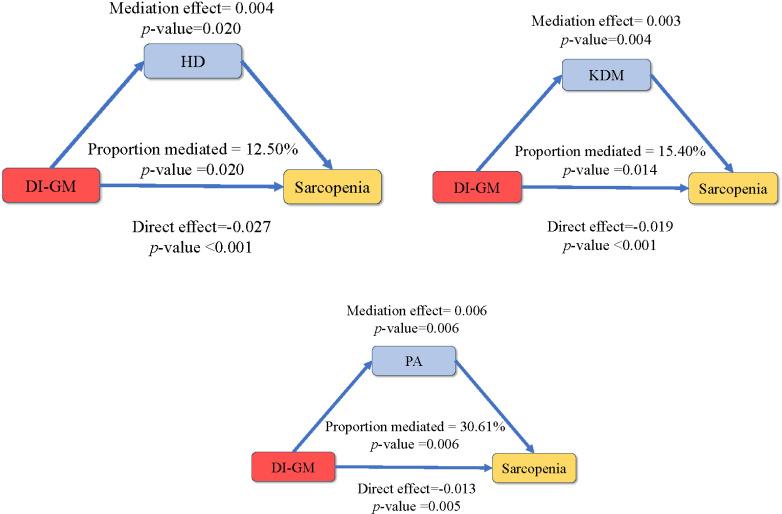
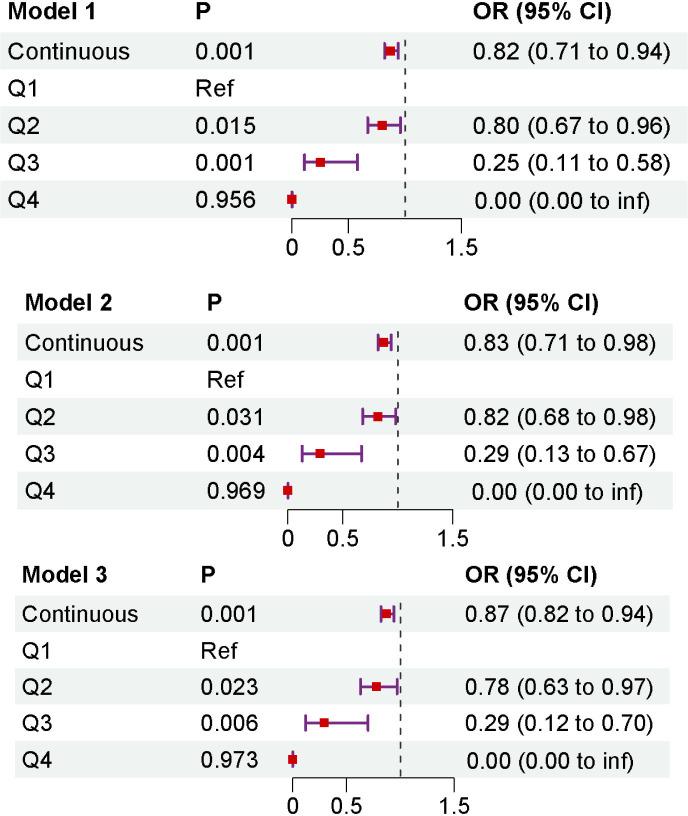
An increase in DI-GM score was significantly associated with a reduced risk of sarcopenia (OR: 0.87, 95% CI: 0.82-0.94).The risk of sarcopenia was significantly lower in the highest quartile group (Q3) (OR: 0.25, 95% CI: 0.11-0.58). The three biological age-related indicators (KDM, PA, and HD) partially mediated the association between DI-GM and sarcopenia, with PhenoAge showing the highest mediation proportion at 30.6%.
CONCLUSION
A higher DI-GM score was significantly associated with a reduced risk of sarcopenia. PhenoAge, HD, and KDM demonstrated significant mediating effects, with PhenoAge showing the highest mediation proportion.
背景
肠道微生物群饮食指数(DI-GM)是一种新提出的综合指标,用于评估与肠道微生物群组成相关的饮食质量。肌肉结构的改变与基于DNA甲基化的生物年龄评估和个体饮食模式密切相关。然而,目前仍缺乏对DI-GM、生物年龄和肌肉减少症之间相互关系的系统研究。我们假设,食用对肠道微生物群有益的食物可能有助于通过减缓衰老过程来降低肌肉减少症的风险。
方法
本研究分析了2007 - 2018年美国国家健康与营养检查调查(NHANES)的数据。使用两个24小时饮食回忆数据集计算DI-GM。通过双能X线吸收法(DXA)评估肌肉减少症。使用多变量逻辑回归、亚组分析和限制立方样条评估DI-GM与肌肉减少症之间的关联。本研究还调查了三个生物年龄指标的潜在中介作用:克莱梅拉-杜巴尔法(KDM)、表型年龄(PhenoAge)和体内稳态失调(HD)。
结果
DI-GM评分的增加与肌肉减少症风险的降低显著相关(比值比:0.87,95%置信区间:0.82 - 0.94)。最高四分位组(Q3)的肌肉减少症风险显著较低(比值比:0.25,95%置信区间:0.11 - 0.58)。三个与生物年龄相关的指标(KDM、PA和HD)部分介导了DI-GM与肌肉减少症之间的关联,其中表型年龄的中介比例最高,为30.6%。
结论
较高的DI-GM评分与肌肉减少症风险的降低显著相关。表型年龄、HD和KDM显示出显著的中介作用,其中表型年龄的中介比例最高。


 Zotero 插件