
纵隔淋巴结与原发性肿瘤标准化摄取值(SUV)比值在肺癌中的诊断价值。
Diagnostic value of the standardised uptake value (SUV) ratio of mediastinal lymph node to primary tumour in lung cancer.
作者信息
Kużdżał Błażej, Kużdżał Adam, Gambuś Karolina, Ćmiel Adam, Moszczyński Konrad, Popovchenko Sofiia, Bryndza Monika, Rudnicka Lucyna, Żanowska Katarzyna, Trybalski Łukasz, Warmus Janusz, Kocoń Piotr
机构信息
Maria Skłodowska-Curie National Institute of Oncology, National Research Institute, Cracow, Poland.
Ludwik Rydygier Hospital, Cracow, Poland.
出版信息
Pol J Radiol. 2025 Feb 18;90:e97-e102. doi: 10.5114/pjr/200009. eCollection 2025.
PURPOSE
This study aimed to determine whether the mediastinal lymph node/tumour ratio (NTR) of the standardised uptake value (SUV) predicts N2 involvement more accurately than node SUV in patients with non-small cell lung cancer (NSCLC).
MATERIAL AND METHODS
We retrospectively analysed consecutive patients with lung cancer at clinical stages I-IVA. All patients underwent positron emission tomography-computed tomography (PET-CT), followed by mediastinal staging using endobronchial ultrasound and endoscopic ultrasound imaging, and curative-intent lung resection with systematic lymph node dissection. Pathological examination of the surgical specimen was performed for confirmation.
RESULTS
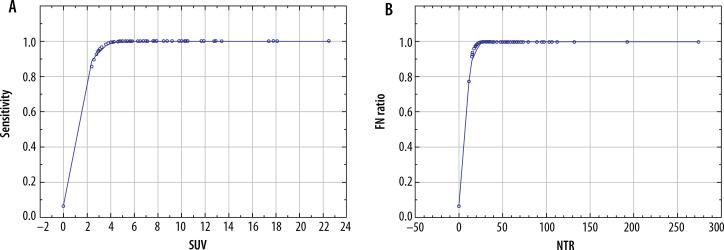
The data from 774 patients were analysed. There was a significant correlation between the risk of false-negative PET results for N2 disease and both the SUV of the mediastinal nodes ( = 0.012) and NTR ( = 0.030). The NTR outperformed node SUV in predictive ability; the Akaike information criterion was 307.268 for NTR compared to 308.498 for node SUV. Three factors were significantly associated with the positive predictive value of PET: patient age ( = 0.021), female sex ( = 0.012), and adenocarcinoma histology ( = 0.036). There were no significant correlations between PET sensitivity, specificity, and negative predictive value (NPV), and age, sex, body mass index (BMI), tumour grade, lobar location, or histological type.
CONCLUSIONS
The NTR may be a useful tool for excluding N2 disease in NSCLC. PET sensitivity and NPV for detecting N2 disease are not influenced by age, sex, BMI, tumour grade, lobar location, or histological type.
目的
本研究旨在确定标准化摄取值(SUV)的纵隔淋巴结/肿瘤比值(NTR)在预测非小细胞肺癌(NSCLC)患者N2受累方面是否比淋巴结SUV更准确。
材料与方法
我们回顾性分析了连续的临床I-IVA期肺癌患者。所有患者均接受正电子发射断层扫描-计算机断层扫描(PET-CT),随后采用支气管内超声和内镜超声成像进行纵隔分期,并进行根治性肺切除及系统性淋巴结清扫。对手术标本进行病理检查以确诊。
结果
分析了774例患者的数据。N2疾病PET假阴性结果的风险与纵隔淋巴结的SUV(=0.012)和NTR(=0.030)均存在显著相关性。NTR在预测能力方面优于淋巴结SUV;NTR的赤池信息准则为307.268,而淋巴结SUV为308.498。三个因素与PET的阳性预测值显著相关:患者年龄(=0.021)、女性(=0.012)和腺癌组织学类型(=0.036)。PET的敏感性、特异性和阴性预测值(NPV)与年龄、性别、体重指数(BMI)、肿瘤分级、叶位置或组织学类型之间无显著相关性。
结论
NTR可能是排除NSCLC患者N2疾病的有用工具。PET检测N2疾病的敏感性和NPV不受年龄、性别、BMI、肿瘤分级、叶位置或组织学类型的影响。

 Zotero 插件