
急性髓系白血病和骨髓增生异常综合征异基因移植后复发的PD-1抑制作用。
PD-1 inhibition for relapse after allogeneic transplantation in acute myeloid leukemia and myelodysplastic syndrome.
作者信息
Magenau John M, Frame David G, Riwes Mary, Maciejewski John, Anand Sarah, Pawarode Attaphol, Perry Anamarija M, Geer Marcus, Braun Thomas, Ghosh Monalisa, Reddy Pavan
机构信息
Transplantation and Cell Therapy Program, Division of Hematology-Oncology, University of Michigan Rogel Cancer Center, Ann Arbor, MI.
Department of Clinical Pharmacy, College of Pharmacy, University of Michigan, Ann Arbor, MI.
出版信息
Blood Adv. 2025 Aug 12;9(15):3878-3886. doi: 10.1182/bloodadvances.2024015200.
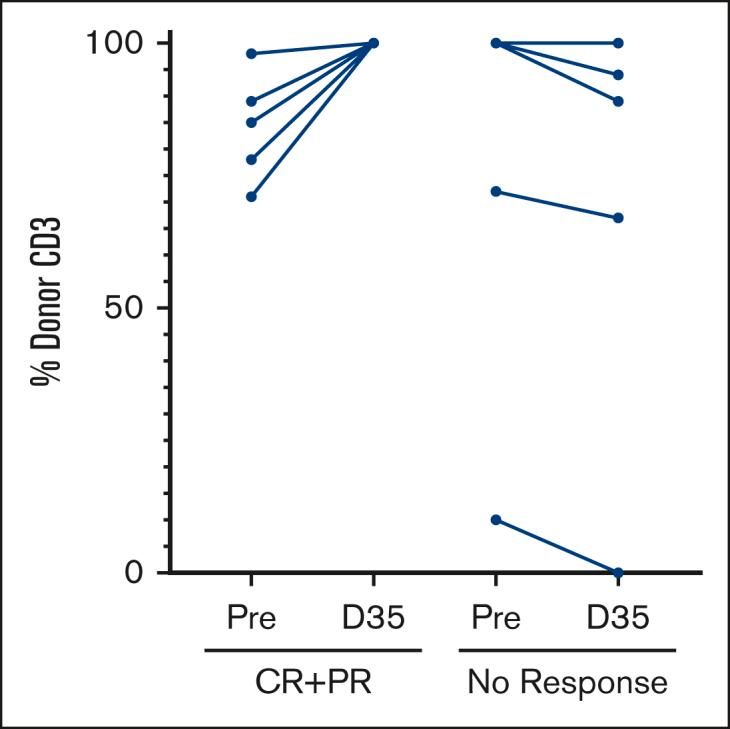
Relapse of acute myeloid leukemia (AML) and myelodysplastic syndrome (MDS) remains the primary source of mortality after allogeneic hematopoietic stem cell transplantation (HCT). Targeting programmed death-1 (PD-1) for reversing T-cell exhaustion and restoring the graft-versus-leukemia (GVL) effect may have logistical advantages over donor lymphocyte infusion. In a prospective phase 1B clinical trial, pembrolizumab was administered every 3 weeks to 16 patients with AML (n = 12) and MDS (n = 4) in relapse after HCT to assess graft-versus-host disease (GVHD), clinical response, and survival. The median time to relapse after HCT was 5.5 months and the median pretreatment bone marrow blast percentage was 21.5%. The overall response rate was 31.3% for patients receiving pembrolizumab, consisting of 3 complete remissions (18.8%) and 2 partial remissions (13.5%). The median duration of response was 610 days. A significantly greater proportion of patients with mixed CD3 chimerism had a clinical response than those with full donor chimerism (50% vs 0%; P = .03). Immune toxicities were frequent, with 37.5% of patients developing severe (grade 3-4) GVHD after pembrolizumab, of which most had resistance to corticosteroids and contributed to death in 4 patients (25%). The 1-year overall survival (OS) was 37.5% and event-free survival was 31.3%. For AML, 1-year OS was 50.0%. In this trial, PD-1 inhibition led to durable remission in one-third of the patients experiencing early relapse after HCT, suggesting that this approach may augment the GVL response. Responses were exclusively observed in the setting of mixed CD3 donor chimerism. Immune toxicities (GVHD) were a barrier to successful treatment outcome. This trial was registered at www.ClinicalTrials.gov as #NCT03286114.
急性髓系白血病(AML)和骨髓增生异常综合征(MDS)复发仍然是异基因造血干细胞移植(HCT)后死亡的主要原因。靶向程序性死亡-1(PD-1)以逆转T细胞耗竭并恢复移植物抗白血病(GVL)效应可能比供体淋巴细胞输注具有更多的后勤优势。在一项前瞻性1B期临床试验中,每3周给16例HCT后复发的AML患者(n = 12)和MDS患者(n = 4)使用派姆单抗,以评估移植物抗宿主病(GVHD)、临床反应和生存率。HCT后复发的中位时间为5.5个月,预处理时骨髓原始细胞百分比中位数为21.5%。接受派姆单抗治疗的患者总缓解率为31.3%,包括3例完全缓解(18.8%)和2例部分缓解(13.5%)。缓解的中位持续时间为610天。混合CD3嵌合体患者的临床反应比例显著高于完全供体嵌合体患者(50%对0%;P = 0.03)。免疫毒性很常见,37.5%的患者在使用派姆单抗后发生严重(3-4级)GVHD,其中大多数对皮质类固醇耐药,导致4例患者(25%)死亡。1年总生存率(OS)为37.5%,无事件生存率为31.3%。对于AML,1年OS为50.0%。在该试验中,PD-1抑制使三分之一HCT后早期复发的患者实现持久缓解,表明这种方法可能增强GVL反应。仅在混合CD3供体嵌合体的情况下观察到反应。免疫毒性(GVHD)是成功治疗结果的一个障碍。该试验在www.ClinicalTrials.gov上注册为#NCT03286114。


 Zotero 插件