
CRISPR-Cas9敲除二酰甘油激酶α/ζ可增强TAG-72嵌合抗原受体T细胞在卵巢癌中的抗肿瘤活性。
CRISPR-Cas9 knockout of DGKα/ζ improves the anti-tumor activities of TAG-72 CAR-T cells in ovarian cancer.
作者信息
Evtimov Vera J, Nguyen Nhu-Y N, Hammett Maree V, Pupovac Aleta, Hudson Peter J, Zhuang Junli, Lee Jae Young, Kim Seokjoong, Trounson Alan O, Boyd Richard L, Shu Runzhe
机构信息
Cartherics Pty Ltd, Notting Hill, VIC 3168, Australia.
Australian Regenerative Medicine Institute, Monash University, Clayton, VIC 3168, Australia.
出版信息
Mol Ther Oncol. 2025 Mar 5;33(2):200962. doi: 10.1016/j.omton.2025.200962. eCollection 2025 Jun 18.
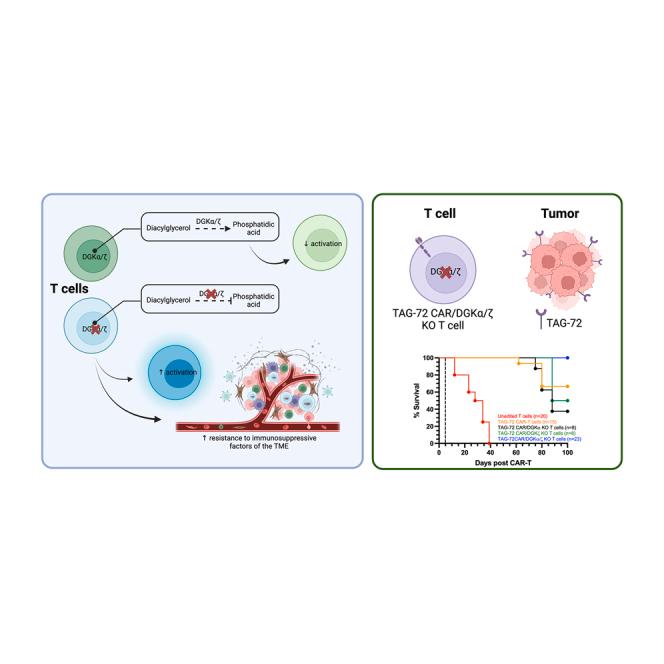
High recurrence and chemoresistance in solid tumors, like ovarian cancer, stress the need for new therapies. Chimeric antigen receptor (CAR)-T cells show promise but face challenges due to tumor heterogeneity and immune suppression in the tumor microenvironment (TME). Thus, novel approaches are needed to further enhance the efficacy of CAR-T cell therapies. In T cell therapies, inhibiting checkpoint molecules is crucial for overcoming exhaustion and boosting anti-tumor activity. Additionally, prioritizing safety by engineering cells to target markers absent on normal healthy cells reduces off-target risks. We targeted tumor-associated glycoprotein 72 (TAG-72), an oncofetal antigen highly expressed in adenocarcinomas like ovarian cancer, by engineering TAG-72 CAR-T cells and used CRISPR-Cas9 to knock out the T cell-inhibitory enzymes diacylglycerol kinase (DGK) α and ζ. DGKα/ζ knockout (KO) did not impact CAR-T cell viability or phenotype. These cells selectively killed TAG-72-expressing cancer cells and ablated established tumors for up to 100 days, whereas non-deleted control TAG-72 CAR-T cells showed tumor relapse around 40 days. These findings highlight the potential of CRISPR-induced DGKα/ζ KO to enhance CAR-T cell efficacy against solid tumors such as ovarian cancer, offering a promising avenue for improved cancer therapies.
实体瘤(如卵巢癌)的高复发率和化疗耐药性凸显了新型疗法的必要性。嵌合抗原受体(CAR)-T细胞显示出前景,但由于肿瘤异质性和肿瘤微环境(TME)中的免疫抑制而面临挑战。因此,需要新的方法来进一步提高CAR-T细胞疗法的疗效。在T细胞疗法中,抑制检查点分子对于克服耗竭和增强抗肿瘤活性至关重要。此外,通过对细胞进行工程改造以靶向正常健康细胞上不存在的标志物来优先考虑安全性,可降低脱靶风险。我们通过构建TAG-72 CAR-T细胞靶向肿瘤相关糖蛋白72(TAG-72),这是一种在卵巢癌等腺癌中高度表达的癌胚抗原,并使用CRISPR-Cas9敲除T细胞抑制酶二酰基甘油激酶(DGK)α和ζ。敲除DGKα/ζ(KO)不影响CAR-T细胞的活力或表型。这些细胞选择性地杀死表达TAG-72的癌细胞,并在长达100天的时间里消除已形成的肿瘤,而未敲除的对照TAG-72 CAR-T细胞在大约40天时显示肿瘤复发。这些发现突出了CRISPR诱导的DGKα/ζ敲除增强CAR-T细胞对卵巢癌等实体瘤疗效的潜力,为改进癌症治疗提供了一条有前景的途径。



 Zotero 插件