
[ARID1B基因缺失促进非小细胞肺癌细胞的增殖、迁移和侵袭]
[ARID1B Gene Deletion Promotes the Proliferation, Migration and Invasion of NSCLC Cells].
作者信息
Zhu Linlin, Zhang Xuchao
机构信息
Guangdong Provincial People's Hospital (Guangdong Academy of Medical Sciences), Southern Medical University, Guangzhou 510080, China.
The Second School of Clinical Medicine, Southern Medical University, Guangzhou 510515, China.
出版信息
Zhongguo Fei Ai Za Zhi. 2025 Mar 20;28(3):165-175. doi: 10.3779/j.issn.1009-3419.2025.101.04.
BACKGROUND
Abnormalities of the switch/sucrose nonfermentable (SWI/SNF) chromatin-remodeling complex are closely related to various cancers, and ARID1B (AT-rich interaction domain 1B) is one of the core subunits of the SWI/SNF complex. Mutations or copy number deletions of the ARID1B gene are associated with impaired DNA damage response and altered chromatin accessibility. However, whether ARID1B deficiency affects the proliferation, migration and invasion abilities of non-small cell lung cancer (NSCLC) cells and its molecular mechanisms remain poorly understood. This study aims to reveal the regulatory role of ARID1B gene deletion on the malignant phenotype of NSCLC cells and its molecular mechanism.
METHODS
Online databases were used to analyze the relationship between ARID1B and the prognosis of patients with lung cancer, and the expression levels of ARID1B in lung cancer tissues. The CRISPR/Cas9 (clustered regularly interspaced short palindromic repeat) technology was employed to construct stable ARID1B gene knockout (KO) cell lines. The plate colony formation assay was used to detect cell proliferation, and the Transwell cell migration and invasion assays were used to detect changes in cell migration ability. RNA-Seq was utilized for the expression and enrichment analysis of differentially expressed genes. Western blot (WB) was used to verify the knockout effect of the ARID1B gene and to detect the expression changes of epithelial-mesenchymal transition (EMT) markers and mitogen-activated protein kinases (MAPK) signaling pathway-related proteins. Nude mouse tumor models were constructed and the tumorigenic abilities of control and ARID1B-deficient cells were compared.
RESULTS
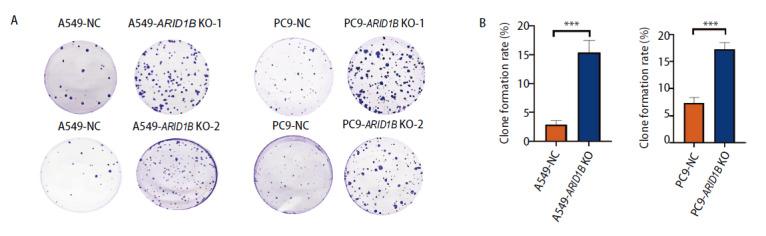
Patients with low ARID1B expression have poor overall survival. ARID1B is differentially expressed in lung cancer and normal tissues, and its expression level being lower in cancer cells. ARID1B-deficient cells had significantly enhanced in vitro proliferation, migration and invasion abilities. In animal experiments, the tumor formation speed of ARID1B gene deficient cells was significantly accelerated. Enrichment analysis of RNA-Seq results revealed that the differentially expressed genes were mainly enriched in MAPK, phosphoinositide 3-kinase-protein kinase B (PI3K/Akt) and other signaling pathways. WB experiments demonstrated that the expressions of E-cadherin, N-cadherin and Vimentin changed in ARID1B gene deficient cells, and the expressions of MAPK and p-MAPK was increased.
CONCLUSIONS
The A549-ARID1B KO and PC9-ARID1B KO cell lines were successfully established. The ARID1B-deficient cell lines demonstrated high migration, invasion and proliferation potential at both in vitro and in vivo biological behavior levels and at the transcriptome sequencing level. The changes in the expression of EMT markers and the activation of the MAPK signaling pathway suggest possible metastasis mechanisms of ARID1B-deficient NSCLC.
背景
开关/蔗糖非发酵(SWI/SNF)染色质重塑复合体异常与多种癌症密切相关,而富含AT交互结构域1B(ARID1B)是SWI/SNF复合体的核心亚基之一。ARID1B基因的突变或拷贝数缺失与DNA损伤反应受损及染色质可及性改变有关。然而,ARID1B缺陷是否影响非小细胞肺癌(NSCLC)细胞的增殖、迁移和侵袭能力及其分子机制仍知之甚少。本研究旨在揭示ARID1B基因缺失对NSCLC细胞恶性表型的调控作用及其分子机制。
方法
利用在线数据库分析ARID1B与肺癌患者预后及肺癌组织中ARID1B表达水平的关系。采用CRISPR/Cas9(成簇规律间隔短回文重复序列)技术构建稳定的ARID1B基因敲除(KO)细胞系。采用平板集落形成试验检测细胞增殖,采用Transwell细胞迁移和侵袭试验检测细胞迁移能力的变化。利用RNA测序(RNA-Seq)进行差异表达基因的表达和富集分析。采用蛋白质免疫印迹法(WB)验证ARID1B基因的敲除效果,并检测上皮-间质转化(EMT)标志物和丝裂原活化蛋白激酶(MAPK)信号通路相关蛋白的表达变化。构建裸鼠肿瘤模型,比较对照细胞和ARID1B缺陷细胞的致瘤能力。
结果
ARID1B表达低的患者总生存期较差。ARID1B在肺癌组织和正常组织中表达存在差异,其在癌细胞中的表达水平较低。ARID1B缺陷细胞的体外增殖、迁移和侵袭能力显著增强。在动物实验中,ARID1B基因缺陷细胞的肿瘤形成速度明显加快。RNA-Seq结果的富集分析显示,差异表达基因主要富集在MAPK、磷酸肌醇3激酶-蛋白激酶B(PI3K/Akt)等信号通路。WB实验表明,ARID1B基因缺陷细胞中E-钙黏蛋白、N-钙黏蛋白和波形蛋白的表达发生变化,MAPK和磷酸化MAPK的表达增加。
结论
成功建立了A549-ARID1B KO和PC9-ARID1B KO细胞系。ARID1B缺陷细胞系在体外和体内生物学行为水平以及转录组测序水平均表现出高迁移、侵袭和增殖潜能。EMT标志物表达的变化和MAPK信号通路的激活提示ARID1B缺陷NSCLC可能的转移机制。




 Zotero 插件