
鼻腔微生物群调节感染新型冠状病毒的风险。
The nasal microbiome modulates risk for SARS-CoV-2 infection.
作者信息
Park Daniel E, Aziz Maliha, Salazar Juan E, Pham Tony, Nelson Sydney G, Villani Jack, Weber Nathan O, Price Lance B, Hungate Bruce A, Liu Cindy M
机构信息
Antibiotic Resistance Action Center, Department of Environmental and Occupational Health, Milken Institute School of Public Health, George Washington University, Washington, DC, 20052, USA.
Center for Ecosystem Science and Society, Northern Arizona University, Flagstaff, AZ, 86011, USA; Department of Biological Sciences, Northern Arizona University, Flagstaff, AZ, 86011, USA.
出版信息
EBioMedicine. 2025 May;115:105660. doi: 10.1016/j.ebiom.2025.105660. Epub 2025 Apr 9.
BACKGROUND
The nasal microbiome may influence host risk for COVID-19 by modulating the expression of key proteins that facilitate SARS-CoV-2 entry, including angiotensin-converting enzyme 2 (ACE2), which binds the virus, and transmembrane serine protease 2 (TMPRSS2), which activates viral entry into nasal epithelial cells. This study examined whether the expression levels of ACE2 and TMPRSS2 in the nasal cavity predict the risk of SARS-CoV-2 infection and whether the host nasal microbiome modulates their expression.
METHODS
Using 1548 self-collected nasal swabs from a population-based surveillance testing of community-dwelling adults in Washington D.C., we conducted two retrospective case-control studies (cross-sectional: n = 111 cases and 343 controls; longitudinal: n = 97 cases, 286 controls) and a nasal microbiome study (n = 428). Cases, defined as individuals with a positive SARS-CoV-2 test, were matched with controls based on age and test date. Pre-infection samples were analysed. We measured nasal ACE2/TMPRSS2 expression using RT-qPCR and characterized the nasal microbiome using 16S rRNA gene-based qPCR and sequencing. We used machine learning and regression analysis to determine if nasal ACE2/TMPRSS2 expression predicts SARS-CoV-2 infection and whether the nasal microbiome influences their expression.
FINDINGS
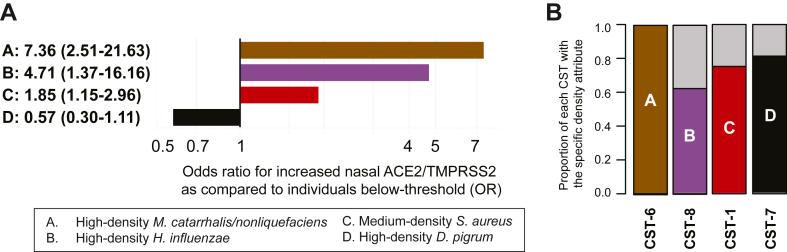
Elevated nasal ACE2/TMPRSS2 expression was associated with 3.6-fold increased risk of contracting COVID-19 (95% CI = 1.71-7.47) compared to those with no detectable levels of ACE2 or TMPRSS2. Before testing positive for SARS-CoV-2, cases also had significantly higher and more unstable ACE2/TMPRSS2 expression in their nasal cavity than controls. Having high densities of Staphylococcus aureus, Haemophilus influenzae, or Moraxella catarrhalis/nonliquefaciens was linked to increased nasal ACE2/TMPRSS2 expression. In contrast, having high densities of Dolosigranulum pigrum was associated with decreased nasal ACE2/TMPRSS2 expression.
INTERPRETATION
These results suggest that natural variation in the nasal microbiome significantly impacts ACE2/TMPRSS2 expression in the nasal cavity and the near-term risk of SARS-CoV-2 infection in adults. Modifying the nasal microbiome could potentially reduce COVID-19 risk.
FUNDING
Research reported in this article was supported by the Milken Institute School of Public Health, the George Washington University and the National Institute of Allergy and Infectious Diseases, National Institutes of Health under award number R01AI168182. The content is solely the responsibility of the authors and does not necessarily represent the official views of the National Institutes of Health.
背景
鼻腔微生物群可能通过调节促进严重急性呼吸综合征冠状病毒2(SARS-CoV-2)进入的关键蛋白的表达来影响宿主感染COVID-19的风险,这些关键蛋白包括与病毒结合的血管紧张素转换酶2(ACE2)和激活病毒进入鼻上皮细胞的跨膜丝氨酸蛋白酶2(TMPRSS2)。本研究调查了鼻腔中ACE2和TMPRSS2的表达水平是否可预测SARS-CoV-2感染风险,以及宿主鼻腔微生物群是否会调节它们的表达。
方法
我们使用从华盛顿特区社区居住成年人的人群监测检测中自我采集的1548份鼻拭子,进行了两项回顾性病例对照研究(横断面研究:111例病例和343例对照;纵向研究:97例病例,286例对照)以及一项鼻腔微生物群研究(428例)。将SARS-CoV-2检测呈阳性的个体定义为病例,根据年龄和检测日期与对照进行匹配。对感染前的样本进行分析。我们使用逆转录定量聚合酶链反应(RT-qPCR)测量鼻腔ACE2/TMPRSS2的表达,并使用基于16S核糖体RNA(rRNA)基因的qPCR和测序对鼻腔微生物群进行特征分析。我们使用机器学习和回归分析来确定鼻腔ACE2/TMPRSS2表达是否可预测SARS-CoV-2感染,以及鼻腔微生物群是否会影响它们的表达。
研究结果
与未检测到ACE2或TMPRSS2水平的人相比,鼻腔ACE2/TMPRSS2表达升高与感染COVID-19的风险增加3.6倍相关(95%置信区间=1.71-7.47)。在SARS-CoV-2检测呈阳性之前,病例鼻腔中ACE2/TMPRSS2的表达也显著高于对照,且更不稳定。金黄色葡萄球菌、流感嗜血杆菌或卡他莫拉菌/非液化莫拉菌的高密度存在与鼻腔ACE2/TMPRSS2表达增加有关。相比之下,嗜盐颗粒菌的高密度存在与鼻腔ACE2/TMPRSS2表达降低有关。
解读
这些结果表明,鼻腔微生物群的自然变异会显著影响鼻腔中ACE2/TMPRSS2的表达以及成年人近期感染SARS-CoV-2的风险。改变鼻腔微生物群可能会降低感染COVID-19的风险。
资金来源
本文所报告的研究得到了米尔肯研究所公共卫生学院、乔治华盛顿大学以及美国国立卫生研究院国家过敏和传染病研究所的支持,资助编号为R01AI168182。内容完全由作者负责,不一定代表美国国立卫生研究院的官方观点。


 Zotero 插件