
子宫癌肉瘤:通过临床特征和肿瘤学结局适应新的国际妇产科联盟(FIGO)2023分期系统
Uterine Carcinosarcoma: Adaptation to New FIGO 2023 Staging System Through Clinical Profile and Oncologic Outcomes.
作者信息
Sağnıç Saliha, Tuncer Serap Fırtına, Iltar Elif, Güner Fatma Ceren, Tuncer Hasan Aykut, Doğan Selen, Şimşek Tayup
机构信息
Division of Gynecologic Oncology, Department of Gynecology Obstetrics, Akdeniz University, Antalya 07070, Turkey.
Department of Obstetrics and Gynecology, Antalya Education & Research Hospital, Antalya 07100, Turkey.
出版信息
J Clin Med. 2025 Mar 27;14(7):2299. doi: 10.3390/jcm14072299.
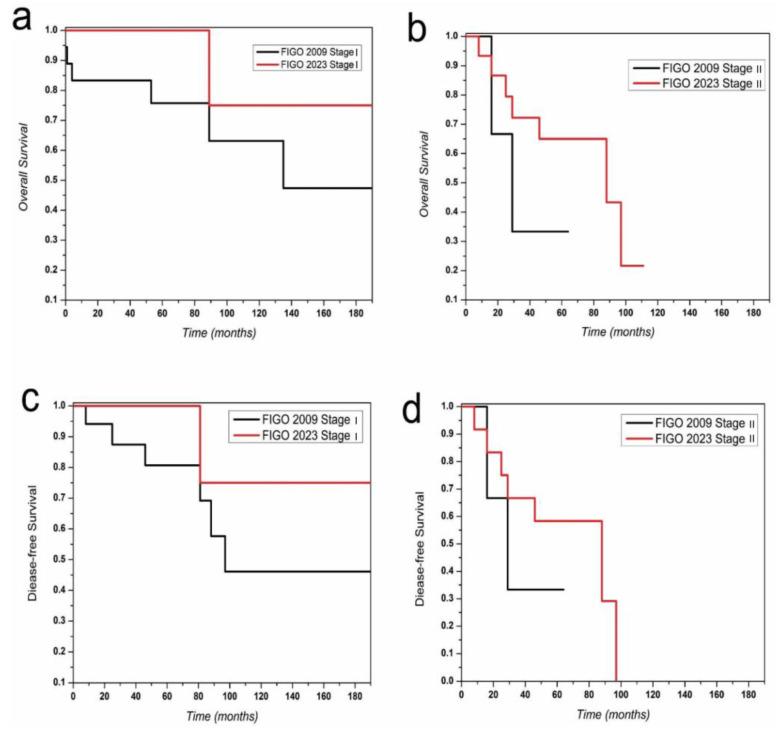
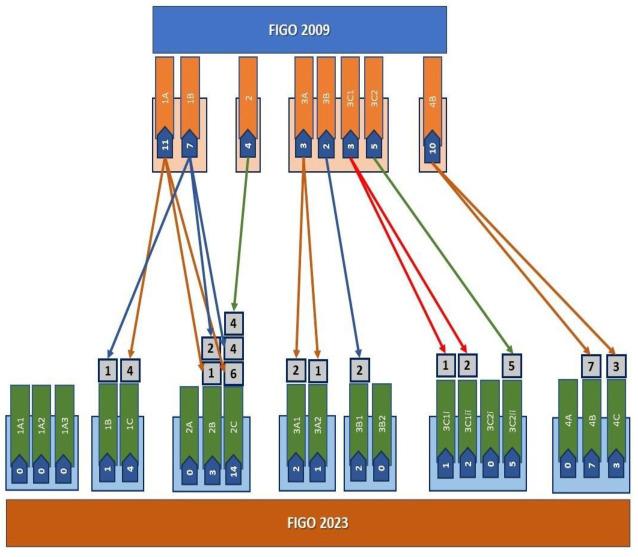
We aimed to analyze the impact of stage shifts on disease-free survival and overall survival in patients with uterine carcinosarcoma stratified based on FIGO 2009 and 2023 staging systems. A total of forty-five patients diagnosed with uterine carcinosarcoma between 2010 and 2024 were included in the study. Patients were classified and analyzed according to both the 2009 and the revised 2023 FIGO staging systems to evaluate the impact of the updated staging criteria on oncologic outcomes. The median disease-free (DFS) and overall survival (OS) rates were calculated and compared when stage shifts occurred. : A total of 17 upstage shifts (37.7%) occurred between the 2009 and 2023 FIGO staging system. All patients with upstage shifts were stage I patients categorized according to the FIGO 2009 classification. Restaging from the FIGO 2009 to the FIGO 2023 criteria resulted in a reduction in the number of stage I cases and an increase in the number of stage II cases. The two main factors leading to upstage were serous histology and LVSI positivity. The 5-year DFS and OS rates for stage I disease were 80% and 75%, respectively, according to the 2009 FIGO staging system, whereas the 2023 FIGO staging system demonstrated significantly higher rates of 100% for both DFS and OS. In stage II patients, the 5-year DFS and OS rates were 33.5% and 33.7%, respectively, according to the 2009 FIGO staging system, while the 2023 FIGO staging system demonstrated higher rates of 58.8% for DFS and 65% for OS. The revised FIGO 2023 staging system has better performance in predicting disease prognosis than the previous version.
我们旨在分析分期变化对根据国际妇产科联盟(FIGO)2009年和2023年分期系统分层的子宫癌肉瘤患者无病生存期和总生存期的影响。本研究纳入了2010年至2024年间共45例诊断为子宫癌肉瘤的患者。根据2009年和修订后的2023年FIGO分期系统对患者进行分类和分析,以评估更新后的分期标准对肿瘤学结局的影响。计算并比较了分期发生变化时的中位无病生存期(DFS)和总生存期(OS)率。在2009年和2023年FIGO分期系统之间共发生了17次分期上调(37.7%)。所有分期上调的患者均为根据FIGO 2009分类法分类的I期患者。从FIGO 2009标准重新分期至FIGO 2023标准导致I期病例数减少,II期病例数增加。导致分期上调的两个主要因素是浆液性组织学和淋巴管血管间隙浸润(LVSI)阳性。根据2009年FIGO分期系统,I期疾病的5年DFS和OS率分别为80%和75%,而2023年FIGO分期系统显示DFS和OS率均显著更高,为100%。在II期患者中,根据2009年FIGO分期系统,5年DFS和OS率分别为33.5%和33.7%,而2023年FIGO分期系统显示DFS率为58.8%,OS率为65%更高。修订后的20

 Zotero 插件