
在全人群慢性肾脏病筛查中平衡效率与公平性
Balancing Efficiency and Equity in Population-Wide CKD Screening.
作者信息
Cusick Marika M, Tisdale Rebecca L, Adams Alyce S, Chertow Glenn M, Owens Douglas K, Salomon Joshua A, Goldhaber-Fiebert Jeremy D
机构信息
Department of Health Policy, School of Medicine, Stanford University, Stanford, California.
Veterans Affairs Palo Alto Health Care System, Palo Alto, California.
出版信息
JAMA Netw Open. 2025 Apr 1;8(4):e254740. doi: 10.1001/jamanetworkopen.2025.4740.
IMPORTANCE
In the era of sodium-glucose cotransporter 2 (SGLT2) inhibitors, population-wide screening for chronic kidney disease (CKD) may provide good value, yet implications across racial and ethnic groups are unknown.
OBJECTIVE
To evaluate the health outcomes, costs, and cost-effectiveness of population-wide CKD screening for 4 racial and ethnic groups.
DESIGN, SETTING, AND PARTICIPANTS: In this cost-effectiveness analysis, a decision-analytic Markov model was separately calibrated to simulate CKD progression among simulated cohorts of US Hispanic adults, non-Hispanic Black adults, non-Hispanic White adults, and adults who belong to additional racial and ethnic groups (ie, Asian and multiracial individuals and those self-reporting other race and ethnicity). Effectiveness of SGLT2 inhibitors was derived from the Dapagliflozin and Prevention of Adverse Outcomes in Chronic Kidney Disease trial. Mortality, quality-of-life weights, and cost estimates were obtained from published cohort studies, randomized clinical trials, and Centers for Medicare & Medicaid Services data. Analyses were conducted from January 1, 2023, to November 6, 2024.
EXPOSURES
One-time or periodic (every 10 or 5 years) screening for albuminuria, initiated between age 35 and 75 years, with and without addition of SGLT2 inhibitors to angiotensin-converting enzyme inhibitor or angiotensin-receptor blocker therapy for CKD.
MAIN OUTCOMES AND MEASURES
Lifetime cumulative incidence of kidney failure requiring kidney replacement therapy (KRT); discounted life-years (LYs), quality-adjusted LYs (QALYs), lifetime health care costs (in 2024 US dollars), and incremental cost-effectiveness ratios.
RESULTS
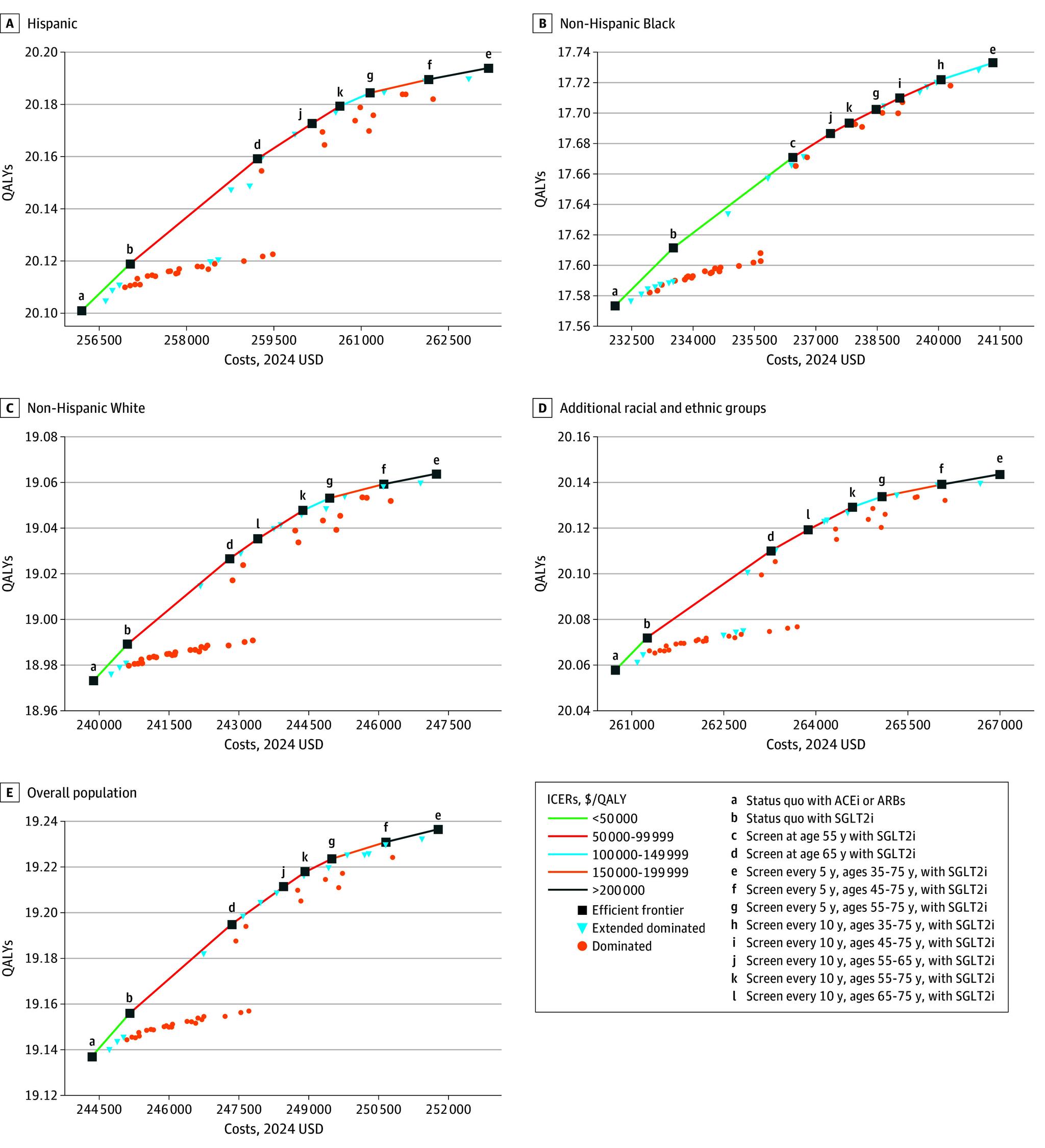
Under the status quo, non-Hispanic Black adults aged 35 years had the highest lifetime incidence of kidney failure requiring KRT (6.2% [95% UI, 2.8%-10.6%]) compared with Hispanic adults (3.6% [95% UI, 1.1%-6.7%]), non-Hispanic White adults (2.3% [95% UI, 0.4%-5.2%]), and adults from additional racial and ethnic groups (3.3% [95% UI, 1.2%-6.5%]). Screening every 5 years from ages 55 to 75 years combined with SGLT2 inhibitors reduced incidence of KRT and increased LYs across all racial and ethnic groups, with the largest average changes observed for non-Hispanic Black adults (0.8-percentage point decrease and 0.19-year increase). Every 5-year screening from age 55 to 75 years cost $99 100/QALY gained for the overall population and less than $150 000/QALY gained across racial and ethnic groups, with the lowest cost observed for non-Hispanic Black adults ($73 400/QALY gained). Screening starting at age 35 years was only cost-effective for non-Hispanic Black adults ($115 000/QALY gained).
CONCLUSIONS AND RELEVANCE
In this cost-effectiveness analysis, population-wide screening for CKD from ages 55 to 75 years was projected to improve population health, was cost-effective, and reduced disparities across 4 racial and ethnic groups. Starting population-wide screening at younger ages was projected to further benefit non-Hispanic Black adults.
重要性
在钠-葡萄糖协同转运蛋白2(SGLT2)抑制剂时代,对慢性肾脏病(CKD)进行全人群筛查可能具有很高价值,但不同种族和族裔群体的情况尚不清楚。
目的
评估对4个种族和族裔群体进行全人群CKD筛查的健康结局、成本及成本效益。
设计、设置和参与者:在这项成本效益分析中,分别校准了一个决策分析马尔可夫模型,以模拟美国西班牙裔成年人、非西班牙裔黑人成年人、非西班牙裔白人成年人以及属于其他种族和族裔群体(即亚洲人和多种族个体以及那些自我报告为其他种族和族裔的人)的模拟队列中的CKD进展情况。SGLT2抑制剂的有效性来自达格列净与慢性肾脏病不良结局预防试验。死亡率、生活质量权重和成本估计值来自已发表的队列研究、随机临床试验以及医疗保险和医疗补助服务中心的数据。分析于2023年1月1日至2024年11月6日进行。
暴露因素
在35至75岁之间开始进行一次性或定期(每10年或5年)的蛋白尿筛查,同时在CKD的血管紧张素转换酶抑制剂或血管紧张素受体阻滞剂治疗中加用或不加用SGLT2抑制剂。
主要结局和指标
需要肾脏替代治疗(KRT)的肾衰竭的终生累积发病率;贴现生命年(LYs)、质量调整生命年(QALYs)、终生医疗保健成本(以2024年美元计)以及增量成本效益比。
结果
在现状下,35岁的非西班牙裔黑人成年人需要KRT的肾衰竭终生发病率最高(6.2%[95%置信区间,2.8%-10.6%]),相比之下,西班牙裔成年人(3.6%[95%置信区间,1.1%-6.7%])、非西班牙裔白人成年人(2.3%[95%置信区间,0.4%-5.2%])以及其他种族和族裔群体的成年人(3.3%[95%置信区间,1.2%-6.5%])发病率较低。从55岁至75岁每5年进行一次筛查并联合使用SGLT2抑制剂可降低所有种族和族裔群体的KRT发病率并增加LYs,其中非西班牙裔黑人成年人的平均变化最大(下降0.8个百分点,增加0.19年)。从55岁至75岁每5年进行一次筛查,总体人群每获得一个QALY的成本为99,100美元,各种族和族裔群体每获得一个QALY的成本均低于150,000美元,其中非西班牙裔黑人成年人的成本最低(每获得一个QALY成本为73,400美元)。从35岁开始筛查仅对非西班牙裔黑人成年人具有成本效益(每获得一个QALY成本为115,000美元)。
结论与意义
在这项成本效益分析中,预计对55至75岁人群进行全人群CKD筛查可改善人群健康状况,具有成本效益,并可减少4个种族和族裔群体之间的差异。预计在较年轻年龄开始进行全人群筛查将使非西班牙裔黑人成年人进一步受益。


 Zotero 插件