
MLKL抑制剂可减轻MPTP诱导的帕金森病小鼠模型中的氧化应激、炎症反应及多巴胺能神经元细胞死亡。
MLKL Inhibitor Reduces Oxidative Stress, Inflammation, and Dopaminergic Neuronal Cell Death in MPTP-Induced Parkinson's Disease Mouse Model.
作者信息
Kim Do-Yeon, Leem Yea-Hyun, Kim Hee-Sun
机构信息
Department of Molecular Medicine and Inflammation-Cancer Microenvironment Research Center, School of Medicine, Ewha Womans University, Seoul 07804, Republic of Korea.
出版信息
Biomol Ther (Seoul). 2025 May 1;33(3):429-437. doi: 10.4062/biomolther.2025.049. Epub 2025 Apr 15.
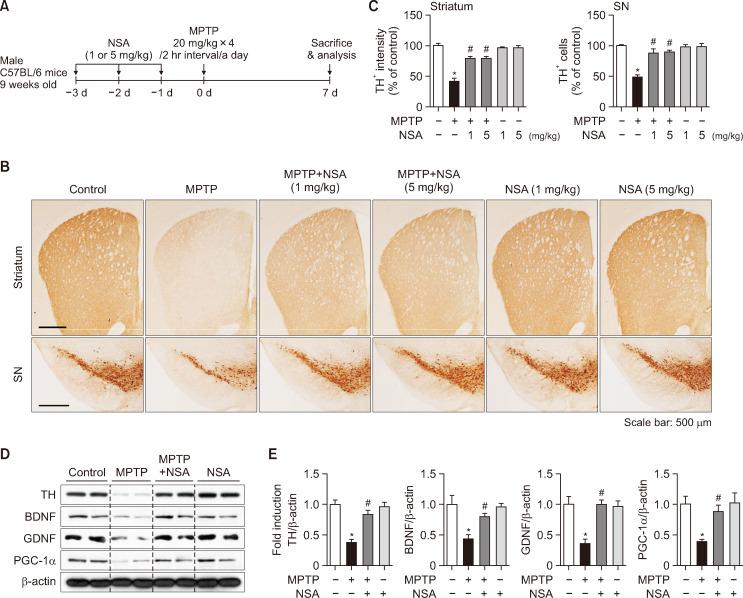
Parkinson's disease (PD) is a movement disorder characterized by the progressive loss of dopaminergic neurons in the substantia nigra (SN). Recent studies have shown that necroptosis is involved in the development of inflammatory and neurodegenerative diseases. Receptor-interacting protein kinase (RIPK)1, RIPK3, and mixed lineage kinase domain-like protein (MLKL) play key roles in necroptosis, with MLKL being the final executor of necroptosis. Necrosulfonamide (NSA) is a specific inhibitor of MLKL, and its therapeutic effects in various inflammatory and neurological disorders have been previously reported. However, its role in PD has not yet been clearly demonstrated. In this study, we examined the effects of NSA in a 1-methyl-4-phenyl-1,2,3,6-tetrahydropyridine (MPTP)-induced mouse model of PD. NSA reduced dopaminergic cell death and restored the expression of neurotrophic factors, such as BDNF, GDNF, and PGC-1α, in the SN region of MPTP mice. In addition, NSA inhibited microglial/astrocyte activation and the expression of proinflammatory markers, such as iNOS, TNF-α, IL-1β, and IL-6. NSA also reduced oxidative stress markers, such as 8-OHdG and 4-HNE, while enhancing Nrf2-driven antioxidant enzymes, including HO-1, catalase, MnSOD, GCLC, and GCLM. We found that NSA inhibited MLKL phosphorylation in dopaminergic neurons and microglia, which may have reduced neuronal cell death and inflammation. Therefore, NSA-mediated suppression of dopaminergic neuronal cell death, inflammation, and oxidative stress may have therapeutic potential in PD.
帕金森病(PD)是一种运动障碍性疾病,其特征是黑质(SN)中多巴胺能神经元进行性丧失。最近的研究表明,坏死性凋亡参与炎症和神经退行性疾病的发展。受体相互作用蛋白激酶(RIPK)1、RIPK3和混合谱系激酶结构域样蛋白(MLKL)在坏死性凋亡中起关键作用,其中MLKL是坏死性凋亡的最终执行者。坏死磺酰胺(NSA)是MLKL的特异性抑制剂,其在各种炎症和神经疾病中的治疗作用此前已有报道。然而,其在PD中的作用尚未得到明确证实。在本研究中,我们检测了NSA在1-甲基-4-苯基-1,2,3,6-四氢吡啶(MPTP)诱导的PD小鼠模型中的作用。NSA减少了多巴胺能细胞死亡,并恢复了MPTP小鼠SN区域中脑源性神经营养因子(BDNF)、胶质细胞源性神经营养因子(GDNF)和过氧化物酶体增殖物激活受体γ共激活因子1α(PGC-1α)等神经营养因子的表达。此外,NSA抑制了小胶质细胞/星形胶质细胞的激活以及诱导型一氧化氮合酶(iNOS)、肿瘤坏死因子-α(TNF-α)、白细胞介素-1β(IL-1β)和白细胞介素-6(IL-6)等促炎标志物的表达。NSA还降低了氧化应激标志物,如8-羟基脱氧鸟苷(8-OHdG)和4-羟基壬烯醛(4-HNE),同时增强了由核因子E2相关因子2(Nrf2)驱动的抗氧化酶,包括血红素加氧酶-1(HO-1)、过氧化氢酶、锰超氧化物歧化酶(MnSOD)、谷氨酸-半胱氨酸连接酶催化亚基(GCLC)和谷氨酸-半胱氨酸连接酶调节亚基(GCLM)。我们发现NSA抑制了多巴胺能神经元和小胶质细胞中MLKL的磷酸化,这可能减少了神经元细胞死亡和炎症。因此,NSA介导的对多巴胺能神经元细胞死亡、炎症和氧化应激的抑制作用可能在PD中具有治疗潜力。



 Zotero 插件