
亚洲伤寒监测项目中新冠疫情期间伤寒流行趋势的变化:一项横断面研究
Changes in enteric fever trends during the COVID-19 pandemic from the Surveillance for Enteric Fever in Asia Project: a cross-sectional study.
作者信息
Munira Sira Jam, Naga Shiva R, Dehraj Irum Fatima, Doyle Kate, Kanon Naito, Yousafzai Mohammad Tahir, Tamrakar Dipesh, Ali Afshan Piyar, Jui Annaya Barman, Carter Alice S, Chandra Das Dipu, Dawani Surrendar, Iqbal Khalid, Irfan Seema, Islam Mohammad Shahidul, Memon Muhammad Ashraf, Khan Tuba, Nahar Shamsun, Rahman Md Hafizur, Saddal Nasir Saleem, Seidman Jessica C, Shrestha Rajeev, Susmita Humaira, Andrews Jason R, Luby Stephen P, Garrett Denise O, Qamar Farah Naz, Saha Samir K, Saha Senjuti
机构信息
Child Health Research Foundation, Dhaka, Bangladesh.
Dhulikhel Hospital, Kavrepalanchok, Nepal.
出版信息
Lancet Reg Health Southeast Asia. 2025 Mar 29;35:100562. doi: 10.1016/j.lansea.2025.100562. eCollection 2025 Apr.
BACKGROUND
The Surveillance for Enteric Fever in Asia Project (SEAP) conducted blood culture surveillance for serotype Typhi (. Typhi) and Paratyphi (. Paratyphi) to provide an evidence base for prevention and control measures in Bangladesh, Nepal, and Pakistan.
METHODS
From October 2020 to September 2022, we conducted prospective clinical surveillance and retrospective laboratory surveillance at health facilities in Dhaka, Bangladesh; Kathmandu and Kavrepalanchok, Nepal; and Karachi, Pakistan. Patients were eligible if they were outpatients with three or more days of fever in the last week. In Nepal and Pakistan, inpatients were eligible if they had suspected or confirmed enteric fever; in Bangladesh, only inpatients with confirmed enteric fever were enrolled. Patients with blood culture-confirmed enteric fever identified by hospital laboratories and laboratory network sites were also enrolled. Patients completed interviews and medical records were reviewed and abstracted. All enrolled patients had blood cultures performed. Antibiograms were performed to characterize drug sensitivity. We summarized the data descriptively.
FINDINGS
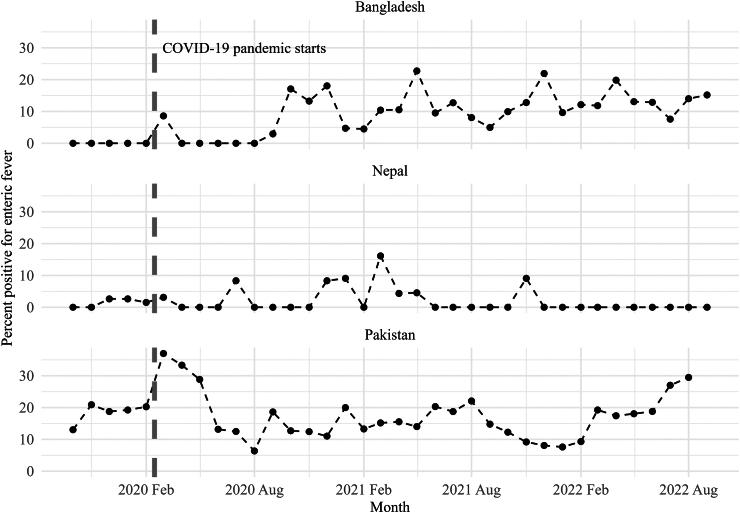
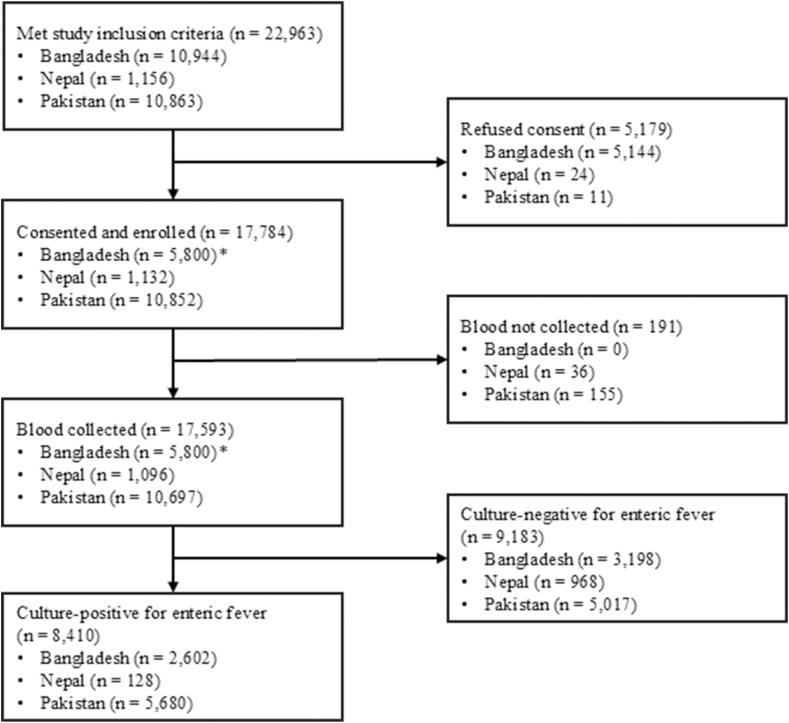
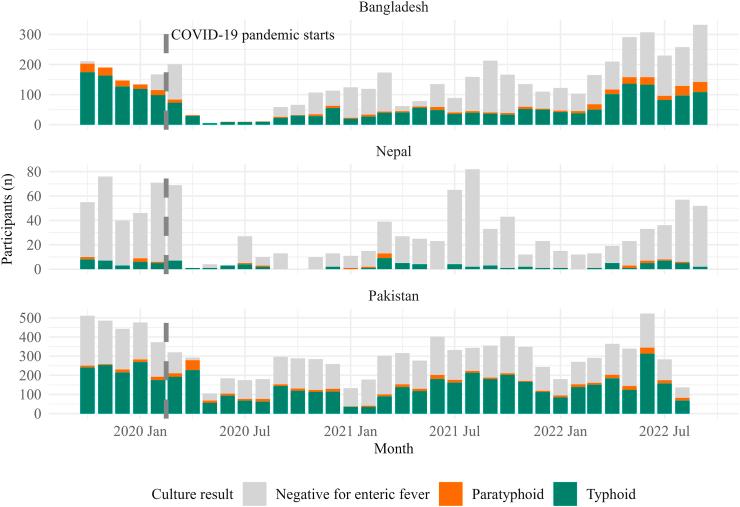
A total of 17,593 patients were enrolled from 19 facilities. Of these, 8410 patients had culture-confirmed enteric fever. Case counts in all countries decreased in the early stages of the COVID-19 pandemic, but increased over time in Bangladesh and Pakistan. Case counts remained low throughout the study period in Nepal. In all countries, typhoid was more common than paratyphoid; the proportion of paratyphoid cases ranged from 8.4% in Pakistan to 16% in Nepal. Extensively drug-resistant typhoid was common in Pakistan (69%), but was not detected in Bangladesh or Nepal.
INTERPRETATION
Cases of enteric fever decreased during the COVID-19 pandemic, though it is not clear how much of this decrease relates to true changes in transmission versus health-seeking behavior.
FUNDING
This project was funded by the Gates Foundation through INV-008335.
背景
亚洲伤寒监测项目(SEAP)对伤寒血清型(伤寒杆菌)和副伤寒血清型(副伤寒杆菌)进行血培养监测,以为孟加拉国、尼泊尔和巴基斯坦的预防和控制措施提供证据基础。
方法
2020年10月至2022年9月,我们在孟加拉国达卡、尼泊尔加德满都和卡夫雷巴兰乔克以及巴基斯坦卡拉奇的医疗机构开展了前瞻性临床监测和回顾性实验室监测。如果患者是过去一周内发热三天或以上的门诊患者,则符合入选条件。在尼泊尔和巴基斯坦,如果住院患者疑似或确诊为伤寒热,则符合入选条件;在孟加拉国,仅入选确诊为伤寒热的住院患者。医院实验室和实验室网络站点确定血培养确诊为伤寒热的患者也被纳入。患者完成访谈,并对病历进行审查和摘要。所有入选患者均进行血培养。进行药敏试验以表征药物敏感性。我们对数据进行了描述性总结。
结果
共从19个机构招募了17593名患者。其中,8410名患者血培养确诊为伤寒热。在新冠疫情早期,所有国家的病例数均有所下降,但在孟加拉国和巴基斯坦,病例数随时间增加。在整个研究期间,尼泊尔的病例数一直较低。在所有国家,伤寒比副伤寒更常见;副伤寒病例的比例在巴基斯坦为8.4%,在尼泊尔为16%。广泛耐药伤寒在巴基斯坦很常见(69%),但在孟加拉国或尼泊尔未检测到。
解读
在新冠疫情期间,伤寒热病例有所减少,不过尚不清楚这种减少在多大程度上与传播的真实变化与就医行为有关。
资金来源
该项目由盖茨基金会通过INV-008335资助。
 Zotero 插件