
具有依赖烷基链的热致相变的动态分子共晶体
Dynamic Molecular Cocrystals with Alkyl Chain Dependent Thermosalient Phase Transitions.
作者信息
Meng Jiantao, Su Yuan, Zhu Hang, Zhang Jie, Cai Ting
机构信息
Department of Pharmaceutics, School of Pharmacy, China Pharmaceutical University, Nanjing, 211198, P. R. China.
Department of Pharmaceutical Engineering, School of Engineering, China Pharmaceutical University, Nanjing, 211198, P. R. China.
出版信息
Adv Sci (Weinh). 2025 Jul;12(26):e2502692. doi: 10.1002/advs.202502692. Epub 2025 Apr 15.
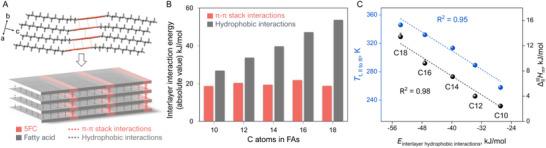
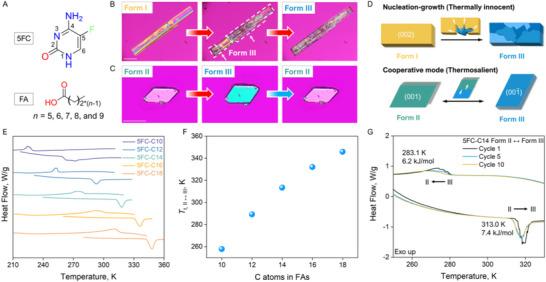
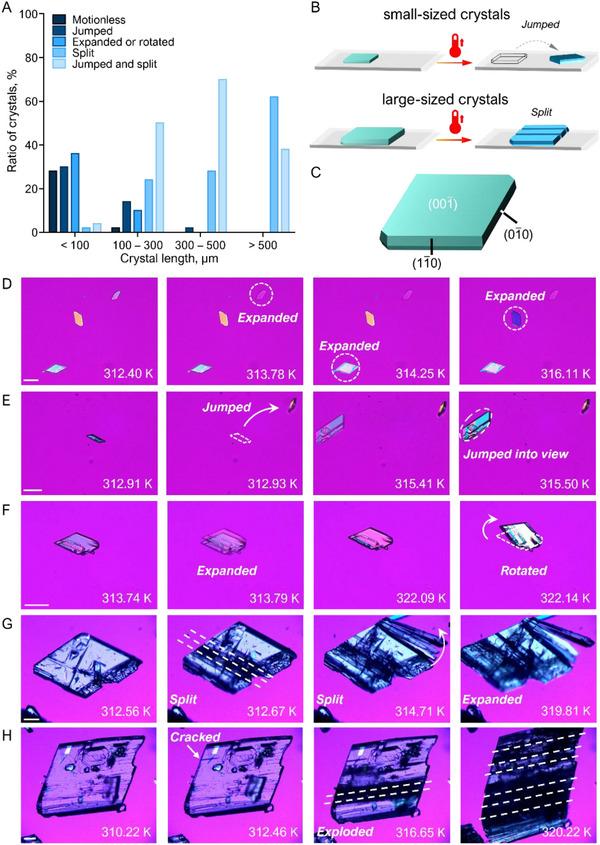
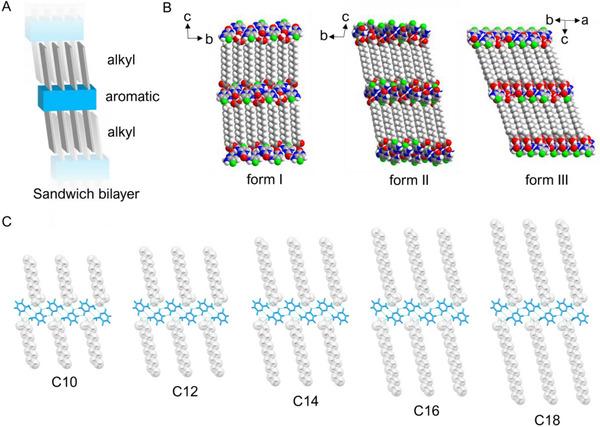
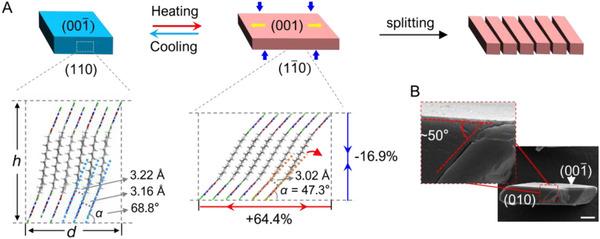
Thermally responsive molecular crystals exhibiting programmable mechanical motions hold significant promise for applications in smart actuators, sensors, and drug delivery systems. However, achieving precise control over their phase transition thermodynamics remains a fundamental challenge. A series of isomorphic 5-fluorocytosine/fatty acid cocrystals is reported where the phase transition temperatures vary across an interval of 100 K with increasing alkyl chain. Two distinct transition pathways are unveiled: i) a cooperative single-crystal-to-single-crystal transition (II-III) accompanied by explosive mechanical motions, and ii) a reconstructive transition (I-III) following classical nucleation-growth mechanisms. The cooperative phase transition (II-III) induces remarkable expansion, with a striking +64.4% expansion along the layer stacking direction and a -16.9% contraction perpendicular to the (001) plane, leading to dynamic phenomena such as jumping, rotating, and splitting. Notably, the transition temperatures (T) exhibit linear dependence on coformer chain length (from C10 to C18), a correlation attributed to interlayer hydrophobic interactions. This work provides a versatile approach for designing molecular crystals with tunable thermo-mechanical properties, offering new opportunities for advanced applications in dynamic functional materials.
表现出可编程机械运动的热响应分子晶体在智能致动器、传感器和药物输送系统中的应用具有重大前景。然而,实现对其相变热力学的精确控制仍然是一个基本挑战。本文报道了一系列同构的5-氟胞嘧啶/脂肪酸共晶体,随着烷基链的增加,其相变温度在100 K的区间内变化。揭示了两种不同的转变途径:i)伴随爆炸性机械运动的协同单晶到单晶转变(II-III),以及ii)遵循经典成核-生长机制的重构转变(I-III)。协同相变(II-III)会引起显著的膨胀,沿层堆积方向有惊人的+64.4%的膨胀,垂直于(001)平面有-16.9%的收缩,导致跳跃、旋转和分裂等动态现象。值得注意的是,转变温度(T)与共形成物链长度(从C10到C18)呈线性关系,这种相关性归因于层间疏水相互作用。这项工作为设计具有可调热机械性能的分子晶体提供了一种通用方法,为动态功能材料的先进应用提供了新的机会。
 Zotero 插件