
与阿莫西林相比,孕早期暴露于大环内酯类药物与主要先天性畸形风险的关系:一项法国全国队列研究。
First-trimester exposure to macrolides and risk of major congenital malformations compared with amoxicillin: A French nationwide cohort study.
作者信息
Tran Anh, Zureik Mahmoud, Sibiude Jeanne, Miranda Sara, Drouin Jérôme, Marty Lise, Weill Alain, Dray-Spira Rosemary, Duval Xavier, Tubiana Sarah
机构信息
Université Paris Cité et Université Sorbonne Paris Nord, IAME, INSERM, Paris, France.
EPI-PHARE, epidemiology of health products (French National Agency for the Safety of Medicines and Health Products, and French National Health Insurance), Saint-Denis, France.
出版信息
PLoS Med. 2025 Apr 15;22(4):e1004576. doi: 10.1371/journal.pmed.1004576. eCollection 2025 Apr.
BACKGROUND
While macrolides are among the frequently prescribed antibiotics for pregnant women, evidence of their fetal safety remains conflicting. This study aimed to evaluate the risk of major congenital malformations (MCM) after first-trimester exposure to macrolides compared with amoxicillin, focusing on specific MCM subtypes.
METHODS AND FINDINGS
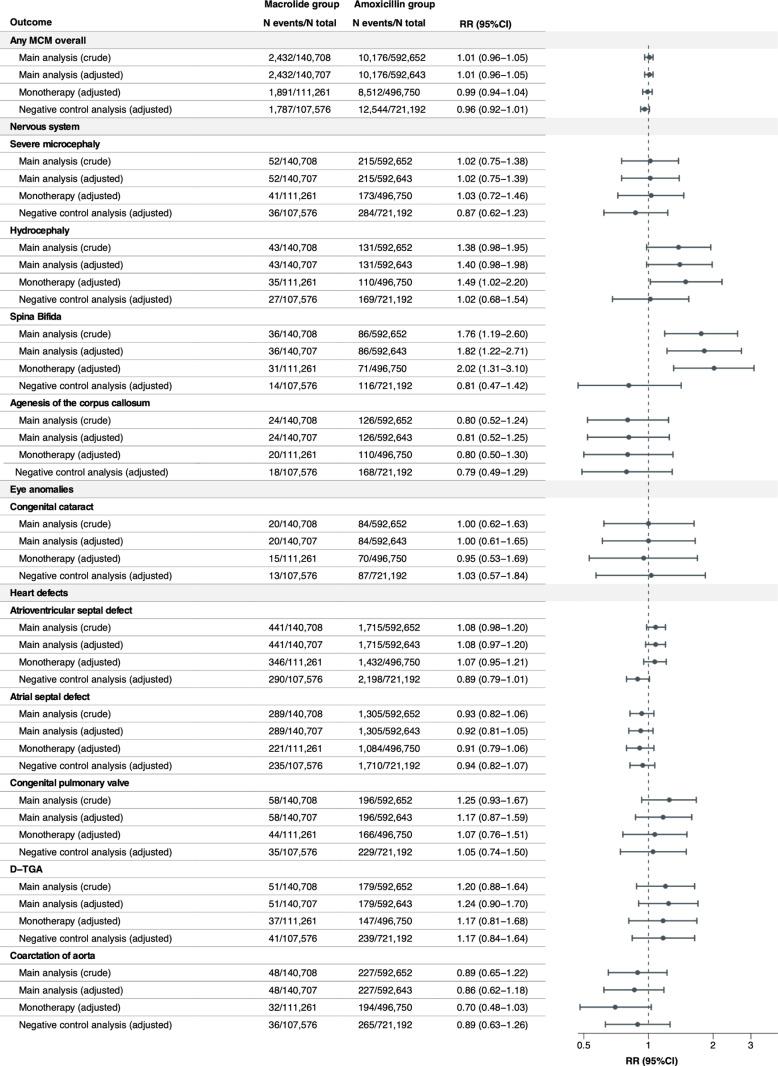
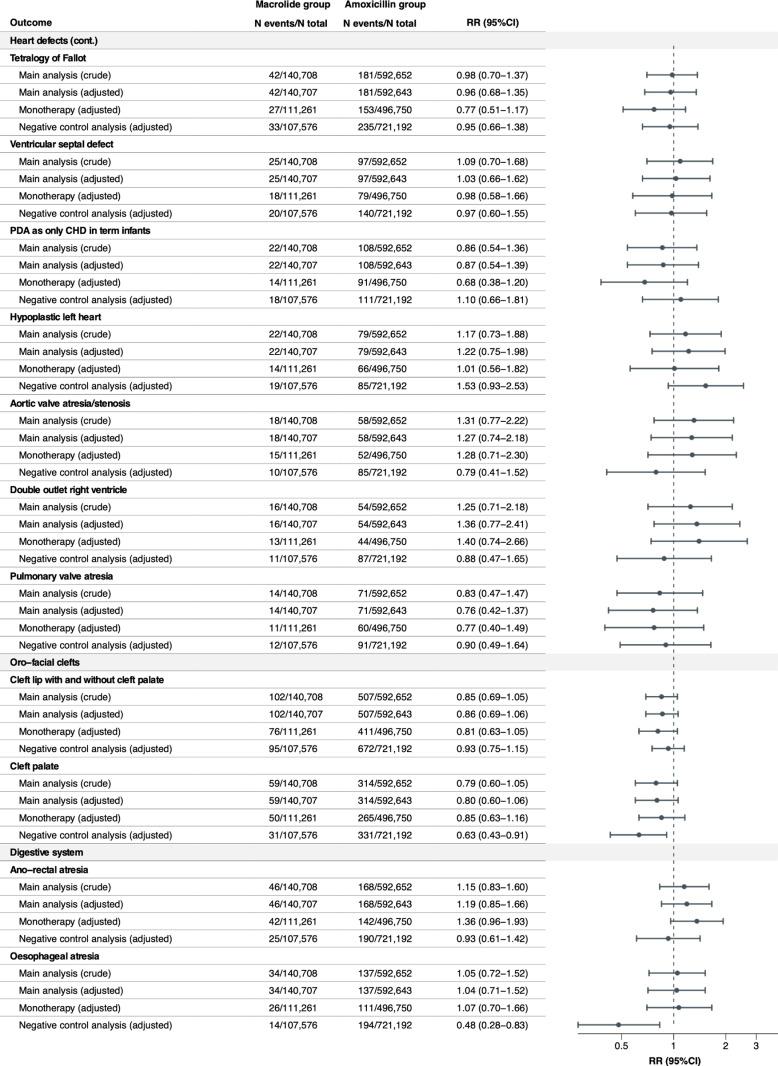
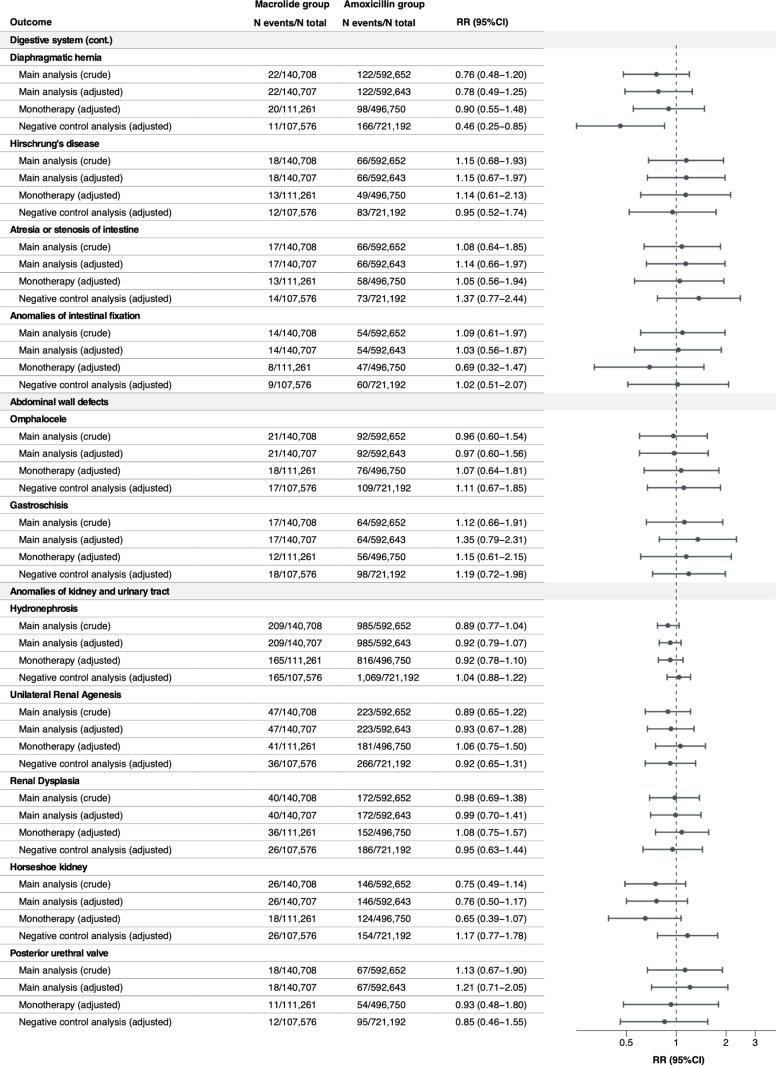
This nationwide cohort study used data from the Mother-Child EPI-MERES Register nested in the French Health Data System (SNDS). Pregnancies linked with their singleton live-born infants from January 1, 2010, and December 31, 2020, were included. The macrolide exposure group comprised pregnancies with one or more prescriptions filled for systemic macrolides (erythromycin, spiramycin, roxithromycin, josamycin, clarithromycin, and azithromycin) during the first trimester. The comparator group comprised pregnancies exposed to amoxicillin during the first trimester. Adjusted relative risks (aRR) and 95% CI were estimated by log-binomial regression for any MCM overall and individual MCMs with a prevalence of at least one per 10,000 live-born infants in the macrolide exposure group. Among 7,644,579 eligible pregnancies, 140,708 exposed to macrolides and 592,652 exposed to amoxicillin were included. After adjustment for measured confounders, macrolide exposure during the first trimester was not associated with any MCM overall (aRR 1.00, 95% CI 0.96 to 1.05) compared with amoxicillin. Specifically, no increased risk was found for most individual MCMs. However, an increase in the risk for spina bifida (aRR 1.82, 95% CI 1.22 to 2.71) and syndactyly (aRR 1.65, 95% CI 1.06 to 2.58) was observed. The adjusted risk difference per 10,000 live-born infants was 1.15 (95% CI 0.26 to 2.05) for spina bifida and 0.87 (95% CI 0.01 to 1.72) for syndactyly. Sensitivity analyses consistently yielded elevated point estimates for these two MCMs, despite wide confidence intervals and small numbers of events. Residual confounding by indication is possible.
CONCLUSIONS
The findings indicate that macrolide exposure during the first trimester is not strongly associated with an increased risk for most individual MCMs, which is reassuring. However, an increased risk of spina bifida and syndactyly remains possible. Future studies are required to investigate these observations further as evidence continues to grow.
背景
虽然大环内酯类药物是孕妇常用的抗生素之一,但其对胎儿安全性的证据仍存在矛盾。本研究旨在评估孕早期暴露于大环内酯类药物与阿莫西林相比,发生主要先天性畸形(MCM)的风险,重点关注特定的MCM亚型。
方法与结果
这项全国性队列研究使用了法国健康数据系统(SNDS)中嵌套的母婴EPI - MERES登记册的数据。纳入了2010年1月1日至2020年12月31日期间与其单胎活产婴儿相关的妊娠。大环内酯类药物暴露组包括孕早期有一张或多张全身用大环内酯类药物(红霉素、螺旋霉素、罗红霉素、交沙霉素、克拉霉素和阿奇霉素)处方的妊娠。对照组包括孕早期暴露于阿莫西林的妊娠。通过对数二项回归估计总体任何MCM以及大环内酯类药物暴露组中每10,000例活产婴儿中至少有1例患病率的个体MCM的调整相对风险(aRR)和95%置信区间(CI)。在7,644,579例符合条件的妊娠中,纳入了140,708例暴露于大环内酯类药物的妊娠和592,652例暴露于阿莫西林的妊娠。在对测量的混杂因素进行调整后,与阿莫西林相比,孕早期暴露于大环内酯类药物总体上与任何MCM均无关联(aRR 1.00,95% CI 0.96至1.05)。具体而言,大多数个体MCM未发现风险增加。然而,观察到脊柱裂风险增加(aRR 1.82,95% CI 1.22至2.71)和并指风险增加(aRR 1.65,95% CI 1.06至2.58)。每10,000例活产婴儿中脊柱裂的调整风险差异为1.15(95% CI 0.26至2.05),并指为0.87(95% CI从0.01至1.72)。尽管置信区间宽且事件数量少,但敏感性分析始终得出这两种MCM的点估计值升高。可能存在因指征导致的残余混杂。
结论
研究结果表明,孕早期暴露于大环内酯类药物与大多数个体MCM风险增加没有强烈关联,这令人放心。然而,脊柱裂和并指风险仍有可能增加。随着证据不断增加,未来需要进一步研究这些观察结果。

 Zotero 插件