
牙周炎患者即刻种植的短期临床评估
A short-term clinical evaluation of immediate implant placement in periodontitis patients.
作者信息
Li Guojiang, Chen Xufeng, Feng Yujia, Lu Ying, Liao Wanlin, Huang Rui, Yang Ejiao, Lai Renfa, Feng Zhiqiang
机构信息
Hospital of Stomatology, the First Affiliated Hospital of Jinan University, Guangzhou, China.
School of Stomatology, Jinan University, Guangzhou, China.
出版信息
Front Cell Infect Microbiol. 2025 Apr 1;15:1555964. doi: 10.3389/fcimb.2025.1555964. eCollection 2025.
BACKGROUND
With the advancement of oral implant technology, immediate implant placement is believed to be feasible for periodontitis patients. However, there is a lack of high-quality clinical studies regarding this approach. This study aimed to observe the short-term implant survival rate and conditions of peri-implant tissues in periodontitis patients who received immediate implants without systematic periodontal treatment.
METHODS
This retrospective study included 95 patients and 234 implants treated at the Stomatological Hospital of Jinan University from June 2017 to December 2022. Patients were classified according to the 2018 AAP/EFP periodontal classification system, with Stage determined by CBCT-assessed marginal bone loss (MBL) and Grade estimated based on annual bone loss rate, smoking status, and diabetes history. Immediate implant placement was performed following atraumatic tooth extraction, with bone defects augmented using Bio-Oss bone graft and covered with Bio-Gide collagen membrane as needed. Patients were followed up for 12 months, during which implant survival, modified sulcus bleeding index (mSBI), modified plaque index (mPLI), marginal bone loss (MBL), and peri-implant probing depth (PPD) were assessed.
RESULTS
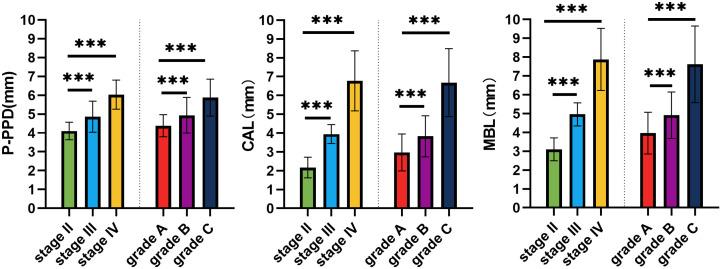
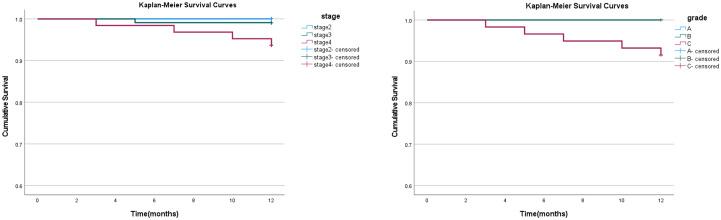
A total of 95 patients (234 implants) were included, with a mean age of 58.59 years. The distribution of Stage II-IV and Grade A-C periodontitis was recorded. Preoperative assessments showed a significant increase in P-PDD, CAL, and MBL with greater disease severity (p < 0.001). One-year follow-up data indicated an implant survival rate of 97.86%, with Kaplan-Meier survival analysis revealing significantly lower survival rates in Stage IV and Grade C patients (p < 0.05). Postoperative soft tissue health assessment showed significant differences in mSBI and mPLI between stages (p = 0.002, p = 0.007) but not grades (p > 0.05). PPD did not differ significantly among groups (p > 0.05), whereas MBL was significantly higher in Stage IV than in Stage II and III (p < 0.001), though no significant differences were observed across grades (p > 0.05). Clinical and radiographic evaluations demonstrated favorable implant outcomes, with most patients reporting high satisfaction. These findings reinforce the viability of immediate implant placement in periodontitis patients, demonstrating high short-term success rates across different disease severities. While disease severity and progression rate may influence clinical outcomes, appropriate case selection, meticulous surgical techniques, and comprehensive postoperative care can lead to predictable and favorable implant success, even in patients with periodontitis.
背景
随着口腔种植技术的进步,即刻种植被认为对牙周炎患者是可行的。然而,关于这种方法缺乏高质量的临床研究。本研究旨在观察未接受系统性牙周治疗的牙周炎患者即刻种植后的短期种植体存活率及种植体周围组织状况。
方法
这项回顾性研究纳入了2017年6月至2022年12月在暨南大学附属口腔医院接受治疗的95例患者和234颗种植体。根据2018年美国牙周病学会(AAP)/欧洲牙周病学会(EFP)牙周分类系统对患者进行分类,分期由CBCT评估的边缘骨丢失(MBL)确定,分级根据年骨丢失率、吸烟状况和糖尿病史进行估计。在无创拔牙后即刻进行种植体植入,根据需要使用Bio-Oss骨粉填充骨缺损,并覆盖Bio-Gide胶原膜。对患者进行12个月的随访,在此期间评估种植体存活率、改良龈沟出血指数(mSBI)、改良菌斑指数(mPLI)、边缘骨丢失(MBL)和种植体周围探诊深度(PPD)。
结果
共纳入95例患者(234颗种植体),平均年龄58.59岁。记录了II-IV期和A-C级牙周炎的分布情况。术前评估显示,随着疾病严重程度增加,P-PDD、附着丧失(CAL)和MBL显著增加(p<0.001)。一年的随访数据显示种植体存活率为97.86%,Kaplan-Meier生存分析显示IV期和C级患者的存活率显著较低(p<0.05)。术后软组织健康评估显示,各阶段之间mSBI和mPLI存在显著差异(p=0.002,p=0.007),但各分级之间无显著差异(p>0.05)。各组间PPD无显著差异(p>0.05),而IV期的MBL显著高于II期和III期(p<0.001),但各分级之间未观察到显著差异(p>0.05)。临床和影像学评估显示种植效果良好,大多数患者表示满意度高。这些发现证实了即刻种植在牙周炎患者中的可行性,表明在不同疾病严重程度下短期成功率都很高。虽然疾病严重程度和进展速度可能会影响临床结果,但即使是牙周炎患者,通过适当的病例选择、细致的手术技术和全面的术后护理,也可以实现可预测的良好种植成功。



 Zotero 插件