
仿生阳离子抗菌聚合物
Bioinspired Cationic Antimicrobial Polymers.
作者信息
Javadi Heliya, Lehnen Anne-Catherine, Hartlieb Matthias
机构信息
Institute of Chemistry, University of Potsdam, Karl-Liebknecht-Straße 24-25, 14476, Potsdam, Germany.
Fraunhofer Institute for Applied Polymer Research (IAP), Geiselbergstraße 69, 14476, Potsdam, Germany.
出版信息
Angew Chem Int Ed Engl. 2025 Jun 10;64(24):e202503738. doi: 10.1002/anie.202503738. Epub 2025 May 15.
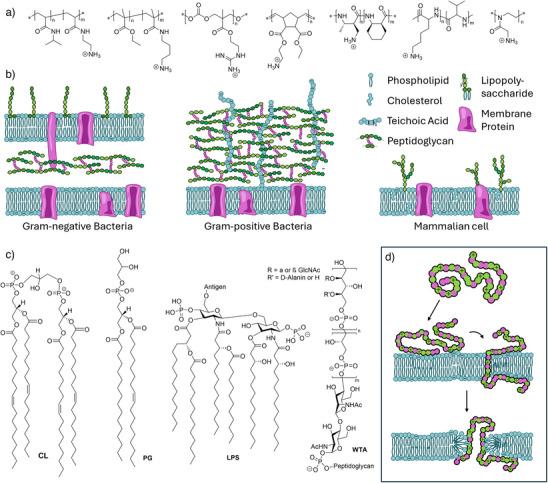
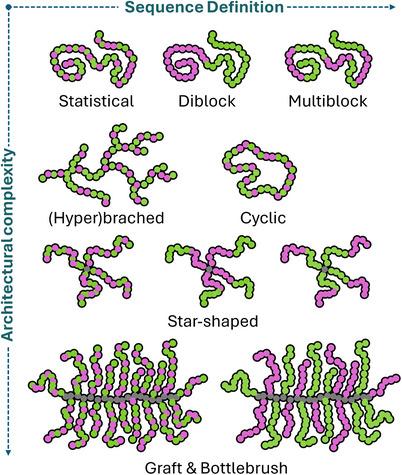
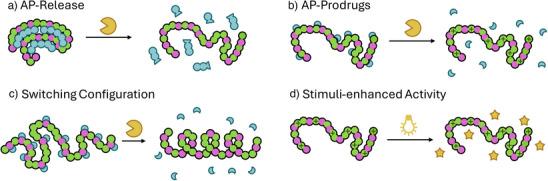
Antibiotics are an essential tool of modern medicine, which is critically endangered by the spread of antimicrobial resistance (AMR). Without effective antibiotics, a number of medical advancements from the last century are in jeopardy, threatening our global public health and leading to a high death toll. To counteract this development, new therapeutic strategies, that are insusceptible to resistance development have to be established. Among them, antimicrobial polymers (AP)s are a promising class of materials. Their mode-of-action is highly unspecific as they kill bacteria by membrane permeabilization or precipitation of intracellular components. As such, it is unlikely for APs to be affected by AMR. This review highlights recent advances in AP design and understanding of structure-property relationships of these cationic macromolecules. One spotlight is on the polymeric architecture and how it influences AP bioactivity. A second highlight is stimuli-responsive APs and their potential to increase AP selectivity. Moreover, synergistic effects, e.g., between polymer and antibiotics are reviewed. The last focus is on in vivo applications of APs, which could pave a way toward clinical applications.
抗生素是现代医学的一项重要工具,但抗菌药物耐药性(AMR)的传播正使其面临严重威胁。没有有效的抗生素,上个世纪的许多医学进步都将受到威胁,危及全球公共卫生并导致高死亡率。为应对这一发展趋势,必须建立不易产生耐药性的新治疗策略。其中,抗菌聚合物(AP)是一类很有前景的材料。它们的作用方式高度非特异性,通过使细胞膜通透或使细胞内成分沉淀来杀死细菌。因此,AP不太可能受到AMR的影响。本综述重点介绍了AP设计方面的最新进展以及对这些阳离子大分子结构-性质关系的理解。一个重点是聚合物结构及其如何影响AP的生物活性。另一个重点是刺激响应性AP及其提高AP选择性的潜力。此外,还综述了协同效应,例如聚合物与抗生素之间的协同效应。最后一个重点是AP的体内应用,这可能为临床应用铺平道路。

 Zotero 插件