
精准医学时代未知原发灶癌症的诊断与治疗进展
Advancements in Diagnostics and Therapeutics for Cancer of Unknown Primary in the Era of Precision Medicine.
作者信息
Zhao Ting, Zhang Xiaowei, Liu Xin, Wang Qifeng, Hu Xichun, Luo Zhiguo
机构信息
Department of Medical Oncology Fudan University Shanghai Cancer Center Shanghai China.
Department of Oncology Shanghai Medical College Fudan University Shanghai China.
出版信息
MedComm (2020). 2025 Apr 16;6(5):e70161. doi: 10.1002/mco2.70161. eCollection 2025 May.
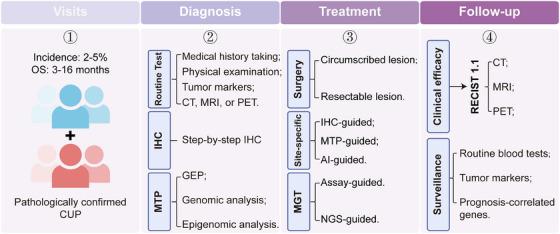
Cancer of unknown primary (CUP), a set of histologically confirmed metastases that cannot be identified or traced back to its primary despite comprehensive investigations, accounts for 2-5% of all malignancies. CUP is the fourth leading cause of cancer-related deaths worldwide, with a median overall survival (OS) of 3-16 months. CUP has long been challenging to diagnose principally due to the occult properties of primary site. In the current era of molecular diagnostics, advancements in methodologies based on cytology, histology, gene expression profiling (GEP), and genomic and epigenomic analysis have greatly improved the diagnostic accuracy of CUP, surpassing 90%. Our center conducted the world's first phase III trial and demonstrated improved progression-free survival and favorable OS by GEP-guided site-specific treatment of CUP, setting the foundation of site-specific treatment in first-line management for CUP. In this review, we detailed the epidemiology, etiology, pathogenesis, as well as the histologic, genetic, and clinical characteristics of CUP. We also provided an overview of the advancements in the diagnostics and therapeutics of CUP over the past 50 years. Moving forward, we propose optimizing diagnostic modalities and exploring further-line treatment regimens as two focus areas for future studies on CUP.
原发灶不明的癌症(CUP)是一组经组织学证实的转移瘤,尽管进行了全面检查,但仍无法确定或追溯其原发部位,占所有恶性肿瘤的2%-5%。CUP是全球癌症相关死亡的第四大主要原因,总体中位生存期(OS)为3-16个月。长期以来,CUP的诊断一直具有挑战性,主要是由于原发部位隐匿。在当前的分子诊断时代,基于细胞学、组织学、基因表达谱(GEP)以及基因组和表观基因组分析的方法取得了进展,大大提高了CUP的诊断准确性,超过了90%。我们中心开展了全球首个III期试验,并通过GEP指导的CUP部位特异性治疗证明了无进展生存期的改善和良好的OS,为CUP一线治疗中的部位特异性治疗奠定了基础。在本综述中,我们详细介绍了CUP的流行病学、病因、发病机制以及组织学、遗传学和临床特征。我们还概述了过去50年中CUP诊断和治疗方面的进展。展望未来,我们建议将优化诊断方式和探索后续治疗方案作为CUP未来研究的两个重点领域。


 Zotero 插件