
细小病毒科衣壳组装与进化的结构研究:对新型腺相关病毒载体设计的启示
Structural studies of Parvoviridae capsid assembly and evolution: implications for novel AAV vector design.
作者信息
Noriega Heather A, Wang Qizhao, Yu Daozhan, Wang Xiang Simon
机构信息
Department of Pharmaceutical Sciences, Artificial Intelligence and Drug Discovery Core Laboratory for District of Columbia Center for AIDS Research (DC CFAR), College of Pharmacy, Howard University, Washington, DC, United States.
AAVnerGene Inc., Rockville, MD, United States.
出版信息
Front Artif Intell. 2025 Apr 2;8:1559461. doi: 10.3389/frai.2025.1559461. eCollection 2025.
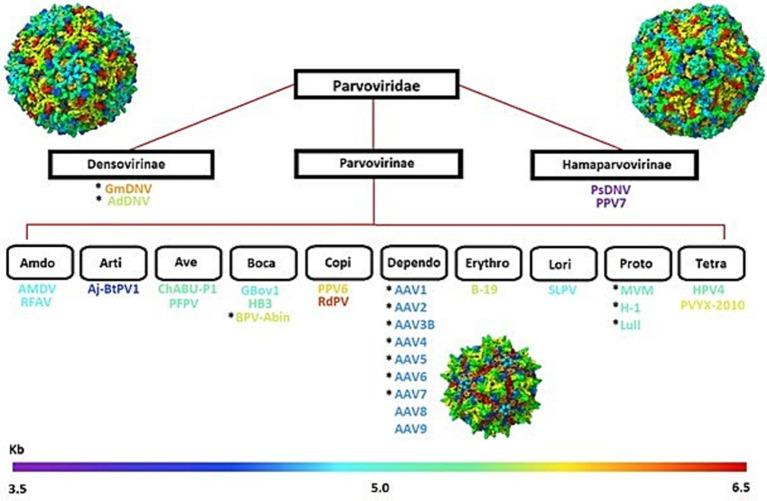
Adeno-associated virus (AAV) vectors have emerged as powerful tools in gene therapy, potentially treating various genetic disorders. Engineering the AAV capsids through computational methods enables the customization of these vectors to enhance their effectiveness and safety. This engineering allows for the development of gene therapies that are not only more efficient but also personalized to unique genetic profiles. When developing, it is essential to understand the structural biology and the vast techniques used to guide vector designs. This review covers the fundamental biology of the Parvoviridae capsids, focusing on modern structural study techniques, including (a) Cryo-electron microscopy and X-ray Crystallography studies and (b) Comparative analysis of capsid structures across different Parvoviridae species. Along with the structure and evolution of the Parvoviridae capsids, computational methods have provided significant insights into the design of novel AAV vector techniques, which include (a) Structure-guided design of AAV capsids with improved properties, (b) Directed Evolution of AAV capsids for specific applications, and (c) Computational prediction of AAV capsid-receptor interactions. Further discussion addressed the ongoing challenges in the AAV vector design and proposed future directions for exploring enhanced computational tools, such as artificial intelligence/machine learning and deep learning.
腺相关病毒(AAV)载体已成为基因治疗中的强大工具,有望治疗各种遗传疾病。通过计算方法对AAV衣壳进行工程改造,能够定制这些载体,以提高其有效性和安全性。这种工程改造有助于开发不仅更高效而且能针对独特基因谱进行个性化定制的基因疗法。在开发过程中,了解结构生物学以及用于指导载体设计的众多技术至关重要。本综述涵盖了细小病毒科衣壳的基础生物学,重点介绍现代结构研究技术,包括(a)冷冻电子显微镜和X射线晶体学研究,以及(b)不同细小病毒科物种衣壳结构的比较分析。除了细小病毒科衣壳的结构和进化,计算方法还为新型AAV载体技术的设计提供了重要见解,这些技术包括(a)具有改进特性的AAV衣壳的结构导向设计,(b)针对特定应用的AAV衣壳的定向进化,以及(c)AAV衣壳-受体相互作用的计算预测。进一步的讨论涉及AAV载体设计中当前面临的挑战,并提出了探索增强计算工具(如人工智能/机器学习和深度学习)的未来方向。
 Zotero 插件