
针对lecanemab的FDA不良事件报告系统(FAERS)事件的真实世界不均衡性分析。
A real-world disproportionality analysis of FDA adverse event reporting system (FAERS) events for lecanemab.
作者信息
Yan Linlin, Zhang Linhai, Xu Zucai, Luo Zhong
机构信息
Department of Neurology, Affiliated Hospital of Zunyi Medical University, Zunyi, Guizhou, China.
出版信息
Front Pharmacol. 2025 Apr 2;16:1559447. doi: 10.3389/fphar.2025.1559447. eCollection 2025.
BACKGROUND
Lecanemab is a humanized murine IgG1 antibody. Recent Phase 3 clinical trials have demonstrated its ability to reduce brain amyloid-β (Aβ) load and slow cognitive decline in patients with early Alzheimer's disease (AD). However, since its approval, reports on adverse effects (AEs) associated with lecanemab have been limited. To better understand the AEs related to lecanemab and provide guidance for future clinical use, we analyzed lecanemab-associated AEs using data from the United States Food and Drug Administration (FDA) Adverse Event Reporting System (FAERS).
METHODS
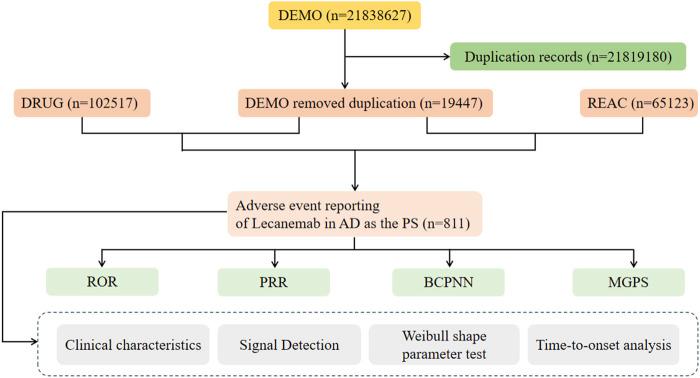
We extracted all AEs reports from the FAERS database for the period from the first quarter of 2023 to the third quarter of 2024. Using the Reporting Odds Ratio (ROR), Proportional Reporting Ratio (PRR), Bayesian Confidence Propagation Neural Network (BCPNN), and Multi-item Gamma Poisson Shrinker (MGPS) algorithms, we conducted a comprehensive analysis of lecanemab-related AEs, restricting the analysis to AEs with the role code of primary suspect (PS).
RESULTS
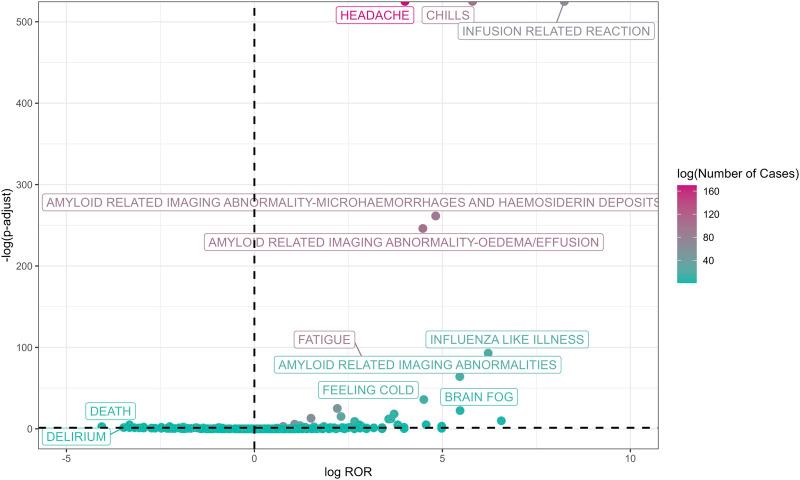
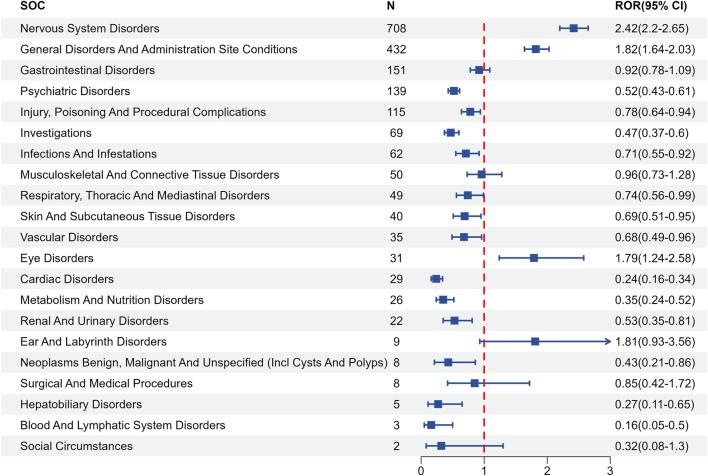
A total of 811 AEs reports related to lecanemab used in AD patients and 506 AEs in Non-AD patients were included. The preferred terms (PTs) identified as positive across all four algorithms included headache, Amyloid Related Imaging Abnormalities-oedema/effusion (ARIA-E), chills, Amyloid Related Imaging Abnormalities-haemosiderosis/microhaemorrhage (ARIA-H), fatigue, infusion-related reaction, nausea, pyrexia, pain, influenza like illness, and so on. Among these, ARIA-E, ARIA-H, brain oedema and status epilepticus were associated with Important Medical Events (IMEs) for AD patients, and brain oedema, cerebral haemorrhage, cerebral microhaemorrhage, subdural haematoma, ischaemic stroke, cerebral infarction were associated with IMEs for Non-AD patients. At the system organ class (SOC) level, the highest signal detection for lecanemab was observed in nervous system disorders among AD and Non-AD patients [ROR for AD: 2.42 (2.2-2.65); ROR for Non-AD: 6.97 (6.12-7.95)]. The median time to the occurrence of these AEs was 44 days after administration in AD patients and 30 days for Non-AD patients.
CONCLUSION
This study utilized the FAERS database to evaluate lecanemab-associated AEs in AD and non-AD patients, along with their temporal patterns post-marketing authorization, thereby establishing a foundation for subsequent clinical pharmacovigilance. A biweekly 10 mg/kg was identified as the optimal therapeutic dosage. ARIA emerged as frequent treatment-related AEs, with APOEɛ4 carriers demonstrating heightened susceptibility. This necessitates serial brain MRI surveillance for all patients during treatment, aimed not only at early ARIA detection but also vigilant monitoring of IMEs including cerebral haemorrhage, cerebral microhaemorrhages, subdural haematoma, cerebral edema, ischaemic stroke, and cerebral infarction. While AD patients predominantly exhibited non-specific clinical manifestations, non-AD cohorts showed elevated risks of stroke-related complications. Consequently, dynamic neurological deficit monitoring is indispensable for non-AD populations receiving lecanemab to mitigate adverse outcomes. Finally, comprehensive reassessment of anticoagulant or antiplatelet therapy indications is warranted in both AD and non-AD patients to reduce hemorrhagic risks.
背景
仑卡奈单抗是一种人源化鼠IgG1抗体。近期的3期临床试验已证明其有能力降低早期阿尔茨海默病(AD)患者的脑淀粉样蛋白-β(Aβ)负荷并减缓认知衰退。然而,自其获批以来,与仑卡奈单抗相关的不良反应(AE)报告有限。为了更好地了解与仑卡奈单抗相关的AE并为未来临床应用提供指导,我们使用美国食品药品监督管理局(FDA)不良事件报告系统(FAERS)的数据分析了与仑卡奈单抗相关的AE。
方法
我们从FAERS数据库中提取了2023年第一季度至2024年第三季度期间的所有AE报告。使用报告比值比(ROR)、比例报告比值比(PRR)、贝叶斯置信传播神经网络(BCPNN)和多项目伽马泊松收缩器(MGPS)算法,我们对与仑卡奈单抗相关的AE进行了全面分析,将分析限制在角色代码为主要怀疑对象(PS)的AE上。
结果
共纳入了811份与AD患者使用的仑卡奈单抗相关的AE报告和506份非AD患者的AE报告。在所有四种算法中均被确定为阳性的首选术语(PT)包括头痛、淀粉样蛋白相关影像异常 - 水肿/渗出(ARIA - E)、寒战、淀粉样蛋白相关影像异常 - 含铁血黄素沉着/微出血(ARIA - H)、疲劳、输液相关反应、恶心、发热、疼痛、流感样疾病等。其中,ARIA - E、ARIA - H、脑水肿和癫痫持续状态与AD患者的重要医学事件(IME)相关,而脑水肿、脑出血、脑微出血、硬膜下血肿、缺血性中风、脑梗死与非AD患者的IME相关。在系统器官分类(SOC)层面,在AD和非AD患者中,仑卡奈单抗的最高信号检测出现在神经系统疾病中[AD的ROR:2.42(2.2 - 2.65);非AD的ROR:6.97(6.12 - 7.95)]。这些AE发生的中位时间在AD患者中为给药后44天,在非AD患者中为30天。
结论
本研究利用FAERS数据库评估了AD和非AD患者中与仑卡奈单抗相关的AE及其上市后授权的时间模式,从而为后续临床药物警戒奠定了基础。确定每两周10mg/kg为最佳治疗剂量。ARIA成为常见的与治疗相关的AE,APOEɛ4携带者表现出更高的易感性。这就需要在治疗期间对所有患者进行系列脑MRI监测,不仅旨在早期检测ARIA,还要警惕监测包括脑出血、脑微出血、硬膜下血肿、脑水肿、缺血性中风和脑梗死在内的IME。虽然AD患者主要表现为非特异性临床表现,但非AD队列显示出与中风相关并发症的风险升高。因此,对于接受仑卡奈单抗的非AD人群,动态神经功能缺损监测对于减轻不良后果是必不可少的。最后,有必要对AD和非AD患者的抗凝或抗血小板治疗指征进行全面重新评估,以降低出血风险。


 Zotero 插件