
解读RNA在神经元中的复杂历程。
Decoding the complex journeys of RNAs along neurons.
作者信息
Wingfield Jenna L, Puthanveettil Sathyanarayanan V
机构信息
Department of Neuroscience, The Herbert Wertheim UF Scripps Institute for Biomedical Innovation & Technology, Jupiter, FL, United States.
出版信息
Nucleic Acids Res. 2025 Apr 10;53(7). doi: 10.1093/nar/gkaf293.
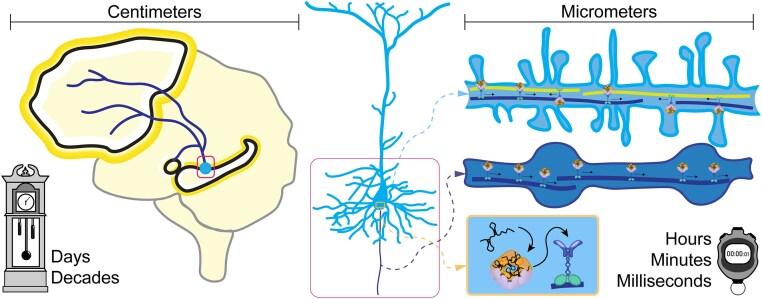
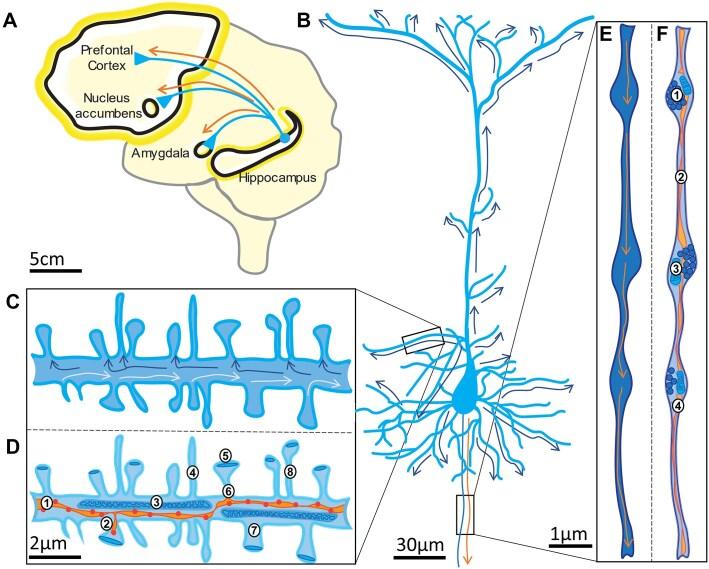
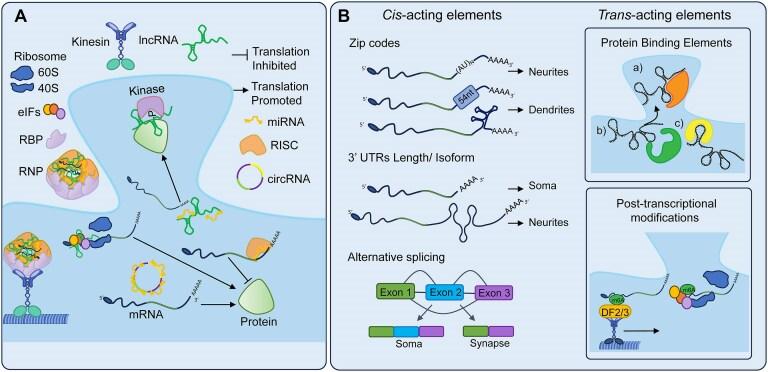
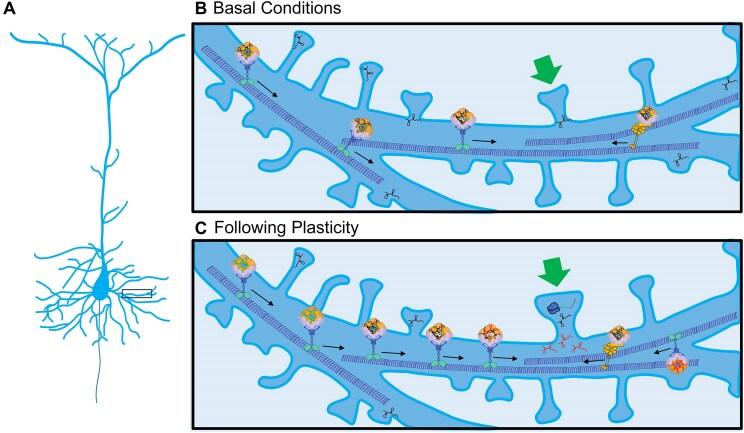
Neurons are highly polarized, specialized cells that must overcome immense challenges to ensure the health and survival of the organism in which they reside. They can spread over meters and persist for decades yet communicate at sub-millisecond and millimeter scales. Thus, neurons require extreme levels of spatial-temporal control. Neurons employ molecular motors to transport coding and noncoding RNAs to distal synapses. Intracellular trafficking of RNAs enables neurons to locally regulate protein synthesis and synaptic activity. The way in which RNAs get loaded onto molecular motors and transported to their target locations, particularly following synaptic plasticity, is explored below.
神经元是高度极化的特殊细胞,它们必须克服巨大挑战,以确保其所驻留机体的健康和生存。它们可以延伸数米并持续数十年,但却能在亚毫秒和毫米尺度上进行通信。因此,神经元需要极高水平的时空控制。神经元利用分子马达将编码和非编码RNA运输到远端突触。RNA的细胞内运输使神经元能够局部调节蛋白质合成和突触活动。以下将探讨RNA如何加载到分子马达上并运输到其目标位置,特别是在突触可塑性之后。

 Zotero 插件