
ULBP2通过抑制NKG2D介导的抗肿瘤免疫促进肿瘤进展。
ULBP2 Promotes Tumor Progression by Suppressing NKG2D-Mediated Anti-Tumor Immunity.
作者信息
Yamane Kohei, Yamaguchi Kosuke, Teruya Yasuhiko, Miyake Naomi, Nakayama Yuji, Nonaka Takafumi, Chikumi Hiroki, Yamasaki Akira
机构信息
Division of Respiratory Medicine and Rheumatology, Department of Multidisciplinary Internal Medicine, Faculty of Medicine, Tottori University, 36-1 Nishi-cho, Yonago 683-8504, Japan.
Division of Radioisotope Science, Research Initiative Center, Organization for Research Initiative and Promotion, Tottori University, 86 Nishi-cho, Yonago 683-8503, Japan.
出版信息
Int J Mol Sci. 2025 Mar 24;26(7):2950. doi: 10.3390/ijms26072950.
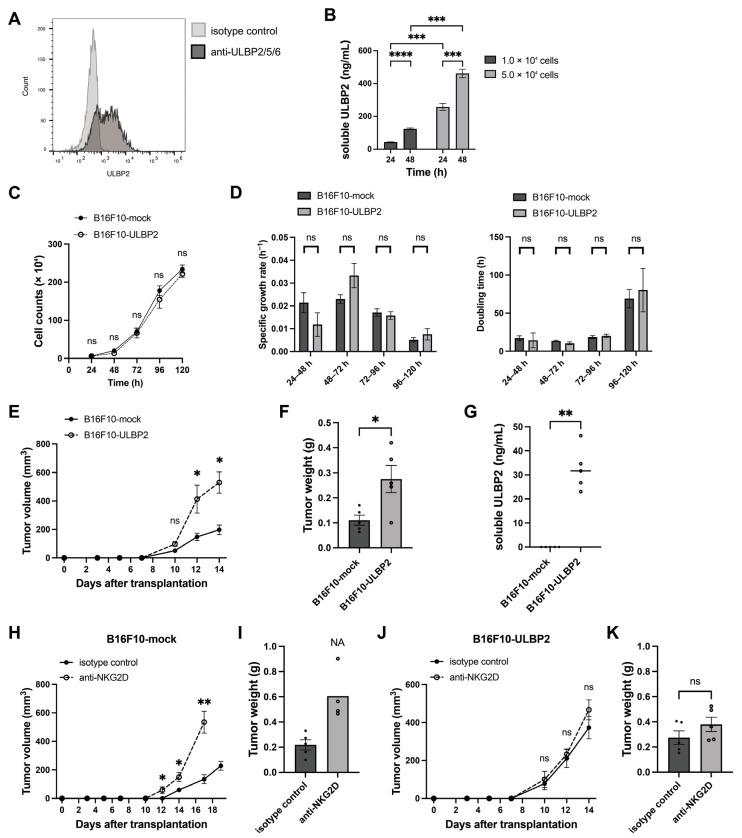
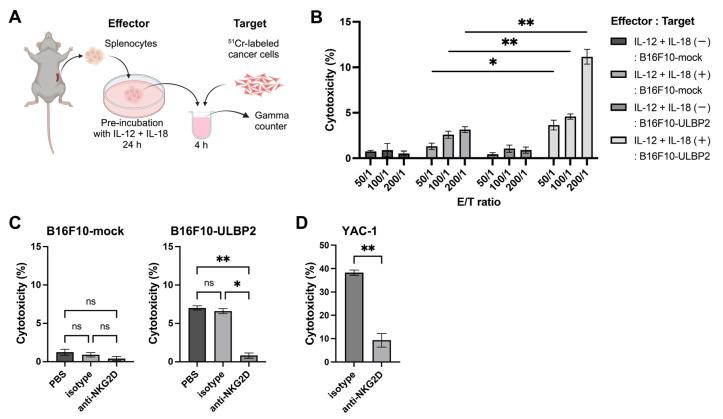
UL-16 binding protein 2 (ULBP2), a human NKG2D ligand, has been identified as a poor prognostic factor in several cancers based on recent comprehensive analyses of immune-related genes using the Cancer Genome Atlas datasets. Despite its clinical significance, the functional role of ULBP2 in vivo remains largely unknown. In this study, we investigated the role of ULBP2 in modulating anti-tumor immunity using murine melanoma cell lines engineered to stably express surface-expressed or soluble ULBP2. Subcutaneous transplantation of ULBP2-expressing melanoma cells into syngeneic mice resulted in accelerated tumor growth, mediated by surface-expressed ULBP2, through the suppression of NKG2D-dependent immune responses. In vitro experiments revealed that sustained exposure to tumor-expressed ULBP2 reduced NKG2D expression and cytotoxic activity of splenocytes. In contrast, soluble ULBP2 did not significantly affect tumor growth or immune responses. These findings suggest that surface-expressed ULBP2 plays a pivotal role in tumor immune evasion and highlight its potential as a therapeutic target to enhance anti-tumor immunity.
UL-16结合蛋白2(ULBP2)是一种人类NKG2D配体,基于使用癌症基因组图谱数据集对免疫相关基因的最新综合分析,它已被确定为多种癌症的不良预后因素。尽管其具有临床意义,但ULBP2在体内的功能作用仍 largely unknown。在本研究中,我们使用工程改造为稳定表达表面表达或可溶性ULBP2的小鼠黑色素瘤细胞系,研究了ULBP2在调节抗肿瘤免疫中的作用。将表达ULBP2的黑色素瘤细胞皮下移植到同基因小鼠中,通过表面表达的ULBP2介导,通过抑制NKG2D依赖性免疫反应,导致肿瘤生长加速。体外实验表明,持续暴露于肿瘤表达的ULBP2会降低NKG2D表达和脾细胞的细胞毒性活性。相比之下,可溶性ULBP2对肿瘤生长或免疫反应没有显著影响。这些发现表明,表面表达的ULBP2在肿瘤免疫逃逸中起关键作用,并突出了其作为增强抗肿瘤免疫的治疗靶点的潜力。



 Zotero 插件