
推进法医人类年龄推断:过去15年的生化、遗传和表观遗传方法:系统综述
Advancing Forensic Human Chronological Age Estimation: Biochemical, Genetic, and Epigenetic Approaches from the Last 15 Years: A Systematic Review.
作者信息
Marcante Beatrice, Marino Laura, Cattaneo Narjis Elisa, Delicati Arianna, Tozzo Pamela, Caenazzo Luciana
机构信息
Legal Medicine Unit, Department of Cardiac, Thoracic, Vascular Sciences and Public Health, University of Padova, 35122 Padova, Italy.
Unit of Biostatistics, Epidemiology and Public Health, Department of Cardiac, Thoracic, Vascular Sciences and Public Health, University of Padova, 35121 Padova, Italy.
出版信息
Int J Mol Sci. 2025 Mar 28;26(7):3158. doi: 10.3390/ijms26073158.
UNLABELLED
Forensic age estimation is crucial for identifying unknown individuals and narrowing suspect pools in criminal investigations. Over the past 15 years, significant progress has been made in using biochemical, genetic, and epigenetic markers to estimate chronological age.
METHODS
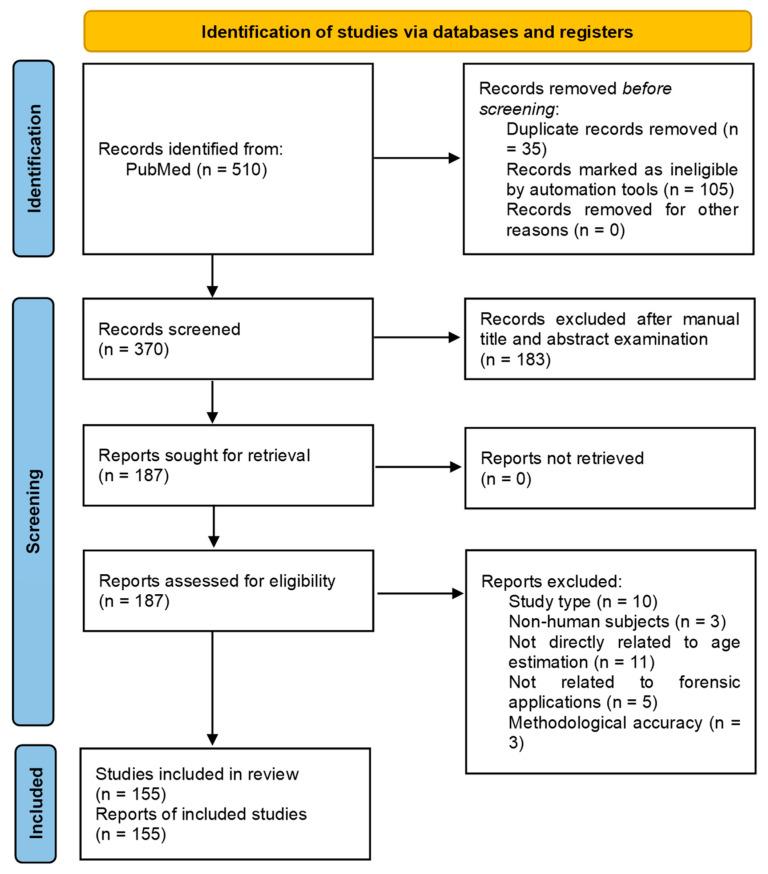
From research on PubMed a total of 155 studies, related to advancements in age prediction techniques, were selected following PRISMA guidelines. Studies considered eligible dealt with radiocarbon dating, aspartic acid racemization, mitochondrial DNA analysis, signal joint T-cell receptor excision circles, RNA analysis, telomeres, and DNA methylation in the last 15 years and were summarized in a table.
RESULTS
Despite these advancements, challenges persist, including variability in prediction accuracy, sample degradation, and the lack of standardization and reproducibility. DNA methylation emerged as the most promising approach capable of high accuracy across diverse populations and age ranges. Multimodal methods integrating several biomarkers show promise in improving reliability and addressing these limitations.
CONCLUSION
While significant progress has been made, further standardization, validation, and technological integration are needed to enhance forensic age estimation. These efforts are essential for meeting the growing demands of forensic science while addressing ethical and legal considerations.
未标注
法医年龄估计对于刑事调查中识别身份不明的个体和缩小嫌疑人范围至关重要。在过去15年中,利用生化、遗传和表观遗传标记来估计实际年龄方面取得了重大进展。
方法
根据PRISMA指南,从PubMed上的研究中总共筛选出155项与年龄预测技术进展相关的研究。符合条件的研究涉及过去15年中的放射性碳年代测定、天冬氨酸消旋、线粒体DNA分析、信号联合T细胞受体切除环、RNA分析、端粒和DNA甲基化,并汇总在一个表格中。
结果
尽管有这些进展,但挑战依然存在,包括预测准确性的变异性、样本降解以及缺乏标准化和可重复性。DNA甲基化成为最有前景的方法,能够在不同人群和年龄范围内实现高精度。整合多种生物标志物的多模态方法在提高可靠性和解决这些局限性方面显示出前景。
结论
虽然已取得重大进展,但仍需要进一步的标准化、验证和技术整合,以加强法医年龄估计。这些努力对于满足法医学不断增长的需求同时解决伦理和法律考量至关重要。
 Zotero 插件