
针对致病威胁的行为适应性。
Behavioral adaptations of against pathogenic threats.
作者信息
Zhao Xin, Li Xinyu, Gao Jiayi, Shen Shi, Zou Wei
机构信息
Kunming Medical University, School of Public Health, Kunming, Yunnan, China.
Xi'an Public Health Center, Infection Control Office, Xi'an, Shaanxi, China.
出版信息
PeerJ. 2025 Apr 14;13:e19294. doi: 10.7717/peerj.19294. eCollection 2025.
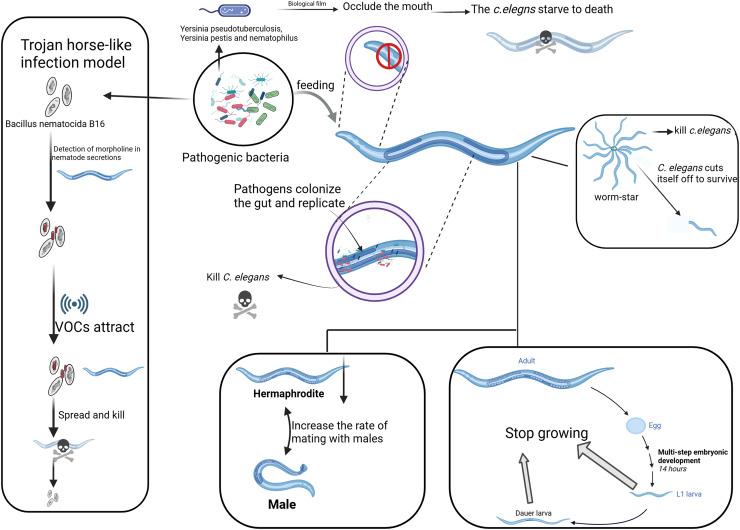
This review examines the behavioral adaptation mechanisms of in response to pathogenic bacterial threats, emphasizing their ecological significance. It systematically explores how mechanisms such as avoidance behavior, transgenerational learning, and forgetting enable to optimize its survival and reproductive strategies within dynamic microbial environments. detects harmful signals through chemosensation and initiates avoidance behaviors. Simultaneously, it manages environmental adaptation and energy allocation through transgenerational memory and forgetting, allowing to cope with selective pressures from environmental fluctuations. In contrast, pathogenic bacteria such as and influence behavior through strategies such as toxin release and biofilm formation, highlighting the complex co-evolutionary dynamics between hosts and pathogens. Additionally, these pathogens employ "Trojan Horse-like" and "Worm Star" mechanisms to kill , further complicating host-pathogen interactions. These processes are driven by behavioral adaptations, biochemical signaling, and evolutionary pressures, which emphasize the ecological niche of within microbial ecosystems. serves as a valuable model for studying host-pathogen interactions. This study provides crucial theoretical insights into adaptive evolution and ecosystem dynamics, offering valuable guidance for the development of biocontrol strategies and the effective management of microbial ecosystems.
本综述探讨了[具体研究对象]对病原菌威胁的行为适应机制,强调了它们的生态意义。它系统地研究了诸如回避行为、跨代学习和遗忘等机制如何使[具体研究对象]在动态微生物环境中优化其生存和繁殖策略。[具体研究对象]通过化学感应检测有害信号并启动回避行为。同时,它通过跨代记忆和遗忘来管理环境适应和能量分配,使[具体研究对象]能够应对环境波动带来的选择压力。相比之下,诸如[病原菌名称1]和[病原菌名称2]等病原菌通过毒素释放和生物膜形成等策略影响[具体研究对象]的行为,突出了宿主与病原体之间复杂的共同进化动态。此外,这些病原菌采用“特洛伊木马样”和“蠕虫之星”机制来杀死[具体研究对象],进一步使宿主 - 病原体相互作用复杂化。这些过程由行为适应、生化信号传导和进化压力驱动,强调了[具体研究对象]在微生物生态系统中的生态位。[具体研究对象]是研究宿主 - 病原体相互作用的宝贵模型。本研究为适应性进化和生态系统动态提供了关键的理论见解,为生物防治策略的开发和微生物生态系统的有效管理提供了有价值的指导。

 Zotero 插件