
ctDNA检测在非小细胞肺癌微小残留病检测中的临床应用:一项叙述性综述
Clinical application of minimal residual disease detection by ctDNA testing in non-small cell lung cancer: a narrative review.
作者信息
Wang Yishan, Shao Wenjun, Li Hui, Zhao Peiyan, Tian Lin, Zhang Liang, Lan Shaowei, Zhong Rui, Zhang Shuang, Cheng Ying
机构信息
College of Traditional Chinese Medicine, Changchun University of Chinese Medicine, Changchun, China.
Postdoctoral Research Workstation, Jilin Cancer Hospital, Changchun, China.
出版信息
Transl Lung Cancer Res. 2025 Mar 31;14(3):1007-1020. doi: 10.21037/tlcr-24-942. Epub 2025 Mar 27.
BACKGROUND AND OBJECTIVE
In recent years, significant advancements have been achieved in the treatment of non-small cell lung cancer (NSCLC), leading to prolonged patient survival; however, a subset of NSCLC patients may experience recurrence or distant metastasis following initial successful treatment. This phenomenon may be attributed to the presence of minimal residual disease (MRD) that remains undetectable by conventional imaging or laboratory techniques post-treatment. The potential sources of tumor recurrence (MRD), are significantly associated with adverse patient prognosis; therefore, the monitoring of these lesions is critically important in the management of NSCLC. This review seeks to examine the current evidence regarding the application of MRD in NSCLC clinical practice, as well as the challenges encountered in its role as a biomarker.
METHODS
We performed a narrative review by systematically searching the PubMed and Web of Science databases for pertinent literature published from 2005 to 2024, with the objective of identifying significant literature related to clinical research and detection techniques for MRD in NSCLC.
KEY CONTENT AND FINDINGS
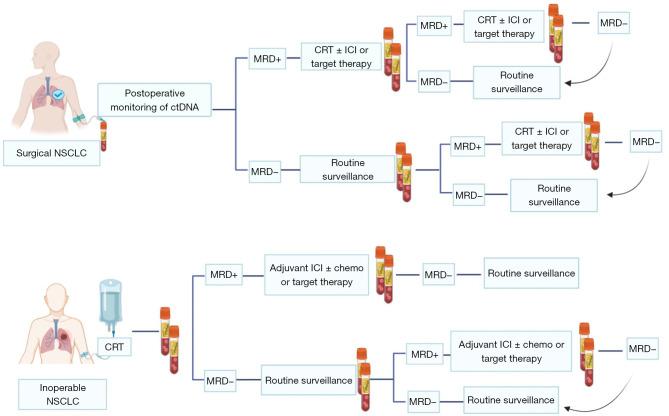
The detection of circulating tumor DNA (ctDNA) for MRD has emerged as a significant focus in high-sensitivity genetic testing for monitoring NSCLC. This method may facilitate the assessment of recurrence risk in NSCLC and inform clinical decision-making to identify high-risk patients who are likely to benefit from treatment, thereby providing a rationale for treatment escalation or de-escalation. Nevertheless, the clinical application of ctDNA MRD continues to encounter several challenges, among which improving detection sensitivity and selecting the best detection timing are urgent issues that need to be addressed.
CONCLUSIONS
ctDNA MRD testing offers robust evidence to assist clinicians in the early identification of NSCLC recurrence and in guiding clinical treatment. We recommend integrating ctDNA MRD with traditional biomarkers and imaging modalities for a comprehensive evaluation aiming at optimizing treatment strategies.
背景与目的
近年来,非小细胞肺癌(NSCLC)的治疗取得了显著进展,患者生存期得以延长;然而,一部分NSCLC患者在初始成功治疗后可能会出现复发或远处转移。这种现象可能归因于存在微小残留病(MRD),在治疗后通过传统成像或实验室技术无法检测到。肿瘤复发的潜在来源(MRD)与患者不良预后显著相关;因此,监测这些病灶在NSCLC的管理中至关重要。本综述旨在探讨关于MRD在NSCLC临床实践中的应用的现有证据,以及其作为生物标志物所面临的挑战。
方法
我们通过系统检索PubMed和Web of Science数据库,对2005年至2024年发表的相关文献进行叙述性综述,目的是确定与NSCLC中MRD的临床研究和检测技术相关的重要文献。
关键内容与发现
检测循环肿瘤DNA(ctDNA)用于MRD已成为监测NSCLC的高灵敏度基因检测的一个重要焦点。这种方法可能有助于评估NSCLC的复发风险,并为临床决策提供信息,以识别可能从治疗中获益的高危患者,从而为治疗升级或降级提供依据。然而,ctDNA MRD的临床应用仍面临若干挑战,其中提高检测灵敏度和选择最佳检测时机是亟待解决的紧迫问题。
结论
ctDNA MRD检测提供了有力证据,可协助临床医生早期识别NSCLC复发并指导临床治疗。我们建议将ctDNA MRD与传统生物标志物和成像方式相结合进行综合评估,以优化治疗策略。
 Zotero 插件