
补充营养援助计划(SNAP)受助者获取授权零售商的情况与饮食质量
Access to SNAP-Authorized Retailers and Diet Quality Among SNAP Recipients.
作者信息
Li Qingxiao, Zhao Shuoli
机构信息
Department of Agricultural Economics & Agribusiness, Louisiana State University and LSU AgCenter, Baton Rouge.
Department of Agricultural Economics, University of Kentucky, Lexington.
出版信息
JAMA Health Forum. 2025 Apr 4;6(4):e250677. doi: 10.1001/jamahealthforum.2025.0677.
IMPORTANCE
Poor food environments are known to affect diet quality and health outcomes. In the US, the Supplemental Nutrition Assistance Program (SNAP) serves as a critical nutrition safety-net for millions of low-income residents; however, whether there is an association between access to SNAP-authorized retailers and diet quality among SNAP recipients remains unclear.
OBJECTIVE
To evaluate the association of SNAP-authorized retailer access with diet quality among SNAP recipients.
DESIGN, SETTING, AND PARTICIPANTS: This was a serial cross-sectional study using 24-hour dietary recall data from a nationally representative sample of SNAP-participating adults from 6 cycles of the restricted-use and public-access National Health and Nutrition Examination Survey from 2007 through 2008 to 2017 through 2018. Participants' residential locations were linked to SNAP-authorized retailers at the coordinate-date level using the Historical SNAP Retailer Locator dataset. Generalized linear models were used that accounted for the complex survey design and adjusted for age, sex, race and ethnicity, education, and family poverty income ratio. Data analyses were performed from February to October 2024.
EXPOSURES
Availability of SNAP-authorized retailers within 1 mile (5 increments: ≤0.10, >0.10-0.25, >0.25-0.50, >0.50-1.00, and >1.00 mile) from the SNAP recipient's residence, and the distance to the nearest SNAP-authorized retailer.
MAIN OUTCOMES AND MEASURES
Daily dietary quality assessed using the Healthy Eating Index-2015 (HEI-2015), a validated measure of adherence to the 2015-2020 Dietary Guidelines for Americans. HEI-2015 scores range from 0 (no adherence) to 100 (full adherence) to the guidelines.
RESULTS
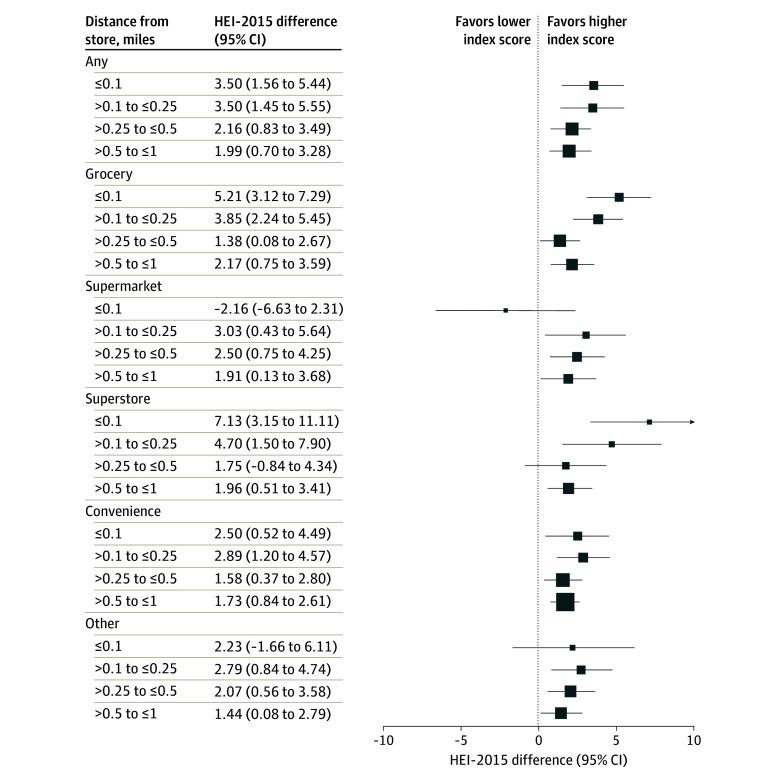
The study analysis included 5041 participants (mean age, 43.0 years; [weighted] 58% female and 42% male), with a mean (SD) HEI-2015 score of 46.88 (25.46). Residing closer to any SNAP-authorized retailer was associated with a 3.50 higher HEI-2015 (95% CI, 1.56-5.44) for those living within 0.10 miles, and 3.50 higher (95% CI, 1.46-5.55) for those living more than 0.10 to 0.25 miles compared to those living more than 1.00 miles away. Availability of superstores and grocery stores showed a positive association, with HEI-2015 scores of 7.09 (95% CI, 3.51-11.11) and 5.21 (95% CI, 3.12-7.29) higher for those within 0.10 miles, respectively. Each additional mile from any SNAP-authorized store was associated with a HEI-2015 score decrease of 0.99 (95% CI, 0.42-1.57). Subgroup analyses showed significant associations between store access and diet quality among participants with normal weight and prediabetes, whereas associations were not statistically significant for those with diabetes.
CONCLUSIONS AND RELEVANCE
This cross-sectional study found that access to SNAP-authorized retailers was associated with better diet quality among SNAP recipients, with the most substantial differences observed for proximity to superstores and grocery stores. These findings highlight the potential impact of food access on diet quality, and suggest that improving the availability of SNAP-authorized retailers in low-access areas may be an important strategy for enhancing public health and reducing diet-related conditions.
重要性
不良的食物环境会影响饮食质量和健康结果。在美国,补充营养援助计划(SNAP)是数百万低收入居民至关重要的营养安全网;然而,SNAP受益者获得SNAP授权零售商的机会与饮食质量之间是否存在关联仍不明确。
目的
评估SNAP受益者获得SNAP授权零售商的机会与饮食质量之间的关联。
设计、背景和参与者:这是一项系列横断面研究,使用了来自2007年至2008年到2017年至2018年的6个周期的受限使用和公众可及的国家健康和营养检查调查中具有全国代表性的SNAP参与成年人样本的24小时饮食回忆数据。参与者的居住地点通过历史SNAP零售商定位数据集在坐标日期层面与SNAP授权零售商相联系。使用了广义线性模型,该模型考虑了复杂的调查设计,并对年龄、性别、种族和民族、教育程度以及家庭贫困收入比进行了调整。数据分析于2024年2月至10月进行。
暴露因素
距离SNAP受益者住所1英里范围内(5个增量:≤0.10英里、>0.10 - 0.25英里、>0.25 - 0.50英里、>0.50 - 1.00英里和>1.00英里)SNAP授权零售商的可及性,以及到最近的SNAP授权零售商的距离。
主要结局和测量指标
使用健康饮食指数 - 2015(HEI - 2015)评估每日饮食质量,这是一种验证过的衡量对2015 - 2020年美国饮食指南遵守情况的指标。HEI - 2015分数范围从0(完全不遵守)到100(完全遵守)指南。
结果
研究分析纳入了5041名参与者(平均年龄43.0岁;[加权后]女性占58%,男性占42%),HEI - 2015平均(标准差)分数为46.88(25.46)。对于居住在0.10英里以内的人,居住得离任何SNAP授权零售商更近与HEI - 2015分数高出3.50(95%置信区间,1.56 - 5.44)相关,对于居住在超过0.10到0.25英里的人,与居住在超过1.00英里以外的人相比,HEI - 2015分数高出3.50(95%置信区间,1.46 - 5.55)。超市和杂货店的可及性显示出正相关,居住在0.10英里以内的人HEI - 2015分数分别高出7.09(95%置信区间,3.51 - 11.11)和5.21(95%置信区间,3.12 - 7.29)。距离任何SNAP授权商店每增加1英里,与HEI - 2015分数降低0.99(95%置信区间,0.42 - 1.57)相关。亚组分析显示,体重正常和患有糖尿病前期的参与者中,商店可及性与饮食质量之间存在显著关联,而对于患有糖尿病的参与者,这种关联在统计学上不显著。
结论和相关性
这项横断面研究发现,SNAP受益者获得SNAP授权零售商的机会与更好的饮食质量相关,在距离超市和杂货店较近时观察到的差异最为显著。这些发现凸显了食物可及性对饮食质量的潜在影响,并表明改善低可及地区SNAP授权零售商的可及性可能是促进公众健康和减少与饮食相关疾病的重要策略。



 Zotero 插件