
巴西南部成年人及老年人中长新冠与功能残疾之间的关系。
Relationship between long covid and functional disability in adults and the seniors in the south of Brazil.
作者信息
Vieira Yohana Pereira, da Silva Luan Nascimento, Nunes Bruno Pereira, Gonzalez Tatiane Nogueira, Duro Suele Manjourany Silva, de Oliveira Saes Mirelle
机构信息
Federal University of Rio Grande, rio Grande, Rio Grande, Rio Grande do Sul, Brazil.
Institute/University/Hospital, Universidade Federal do Rio Grande, Country: Centro, St. General Osório, 102, 3º andar, Rio Grande, 96203-900, RS, Brasil.
出版信息
BMC Public Health. 2025 Apr 19;25(1):1458. doi: 10.1186/s12889-025-22208-2.
BACKGROUND
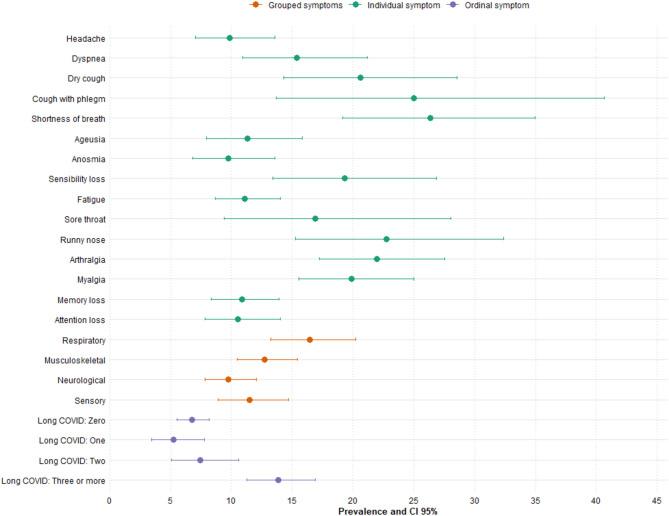
Individuals living with long COVID experience a range of symptoms that affect their ability to carry out daily activities or participate in social and community life. This study aimed to analyze association between functional disability and the occurrence of long COVID symptoms, as well as to analyze the effect of symptom persistence time on functional disability.
METHODS
This is a cross-sectional study using data from the SulCovid-19 study, which interviewed individuals who had COVID-19 between December 2020 and March 2021. The functional disability outcome was assessed using the Basic Activities of Daily Living (BADL) and Instrumental Activities of Daily Living (IADL) scales, while the exposures were the symptoms of long COVID. Adjusted analyses between outcomes and exposures, stratified by time after the acute phase of infection, were performed using Poisson regression with robust variance adjustment.
RESULTS
The prevalence of BADL disability was 4.8% (95%CI 4.0;5.6), and for IADL disability, it was 8.4% (95%CI 7.4;9.4). The main symptoms associated with BADL disability were dyspnea, dry cough and sore throat, while for IADL, they were joint pain, muscle pain, loss of sensation, nasal congestion, sore throat and runny nose. When stratified by tertiles of time after the acute phase of infection, a relationship was found between BADL disability and dyspnea, ageusia and, nasal congestion in the 3rd tertile, while only ageusia was found to be related to IADL disability in the 3rd tertile.
CONCLUSIONS
Long COVID symptoms were associated wiht limitations in the functional capacity of adults and the seniors. The findings can be used to guide the care and rehabilitation of individuals with disabilities who have had COVID-19, particularly for referral to appropriate health professionals.
背景
长期新冠病毒感染患者会出现一系列症状,这些症状影响他们开展日常活动或参与社交及社区生活的能力。本研究旨在分析功能残疾与长期新冠病毒感染症状发生之间的关联,以及分析症状持续时间对功能残疾的影响。
方法
这是一项横断面研究,使用来自SulCovid-19研究的数据,该研究对2020年12月至2021年3月期间感染新冠病毒的个体进行了访谈。使用日常生活基本活动(BADL)量表和日常生活工具性活动(IADL)量表评估功能残疾结果,而暴露因素是长期新冠病毒感染症状。采用稳健方差调整的泊松回归,对感染急性期后不同时间分层的结果与暴露因素进行校正分析。
结果
BADL残疾的患病率为4.8%(95%CI 4.0;5.6),IADL残疾的患病率为8.4%(95%CI 7.4;9.4)。与BADL残疾相关的主要症状是呼吸困难、干咳和喉咙痛,而与IADL残疾相关的主要症状是关节疼痛、肌肉疼痛、感觉丧失、鼻塞、喉咙痛和流鼻涕。按感染急性期后时间的三分位数分层时,在第3三分位数中发现BADL残疾与呼吸困难、味觉丧失和鼻塞之间存在关联,而在第3三分位数中仅发现味觉丧失与IADL残疾有关。
结论
长期新冠病毒感染症状与成年人及老年人的功能能力受限有关。这些发现可用于指导新冠病毒感染后残疾个体的护理和康复,特别是用于转介至合适的卫生专业人员。

 Zotero 插件