
全免疫炎症值与睾酮缺乏风险增加之间的相关性。
Correlation between pan immune inflammation value and testosterone deficiency risk increase.
作者信息
Tong Ling, Chen Gang
机构信息
Nursing Department, Sir Run Run Shaw Hospital, Zhejiang University School of Medicine, Hangzhou, China.
Department of Laboratory Medicine, The Children's Hospital, Zhejiang University School of Medicine, National Clinical Research Center for Child Health, National Children's Regional Medical Center, Hangzhou, 310052, China.
出版信息
Sci Rep. 2025 Apr 20;15(1):13632. doi: 10.1038/s41598-025-98517-8.
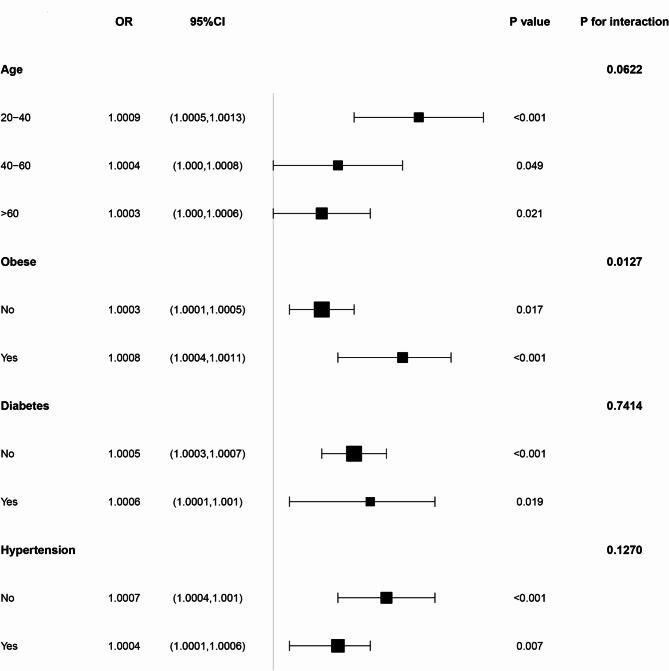
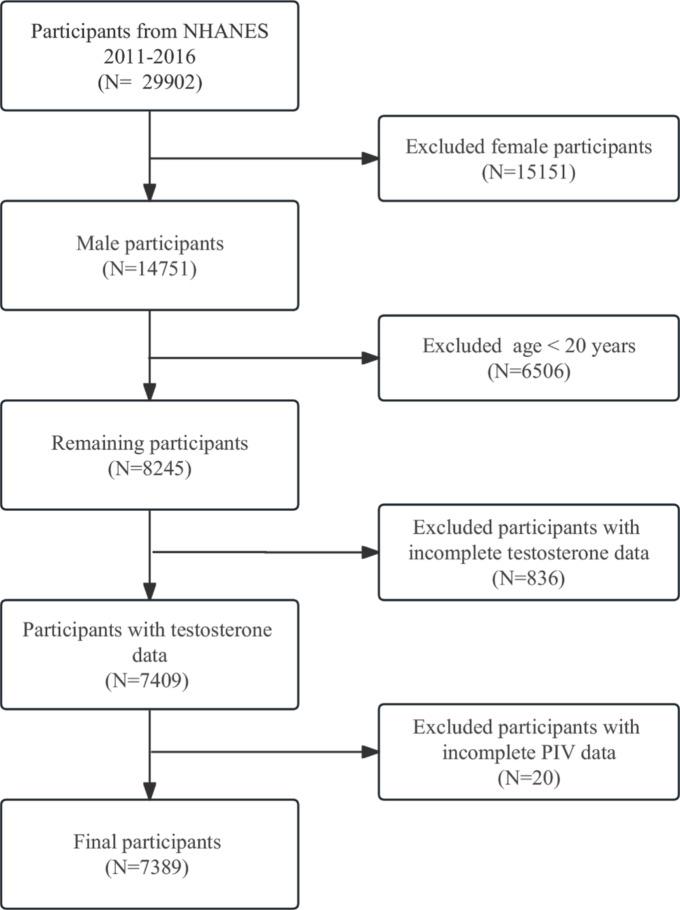
Testosterone deficiency seriously affects male reproductive function, growth and development, and quality of life. There is a certain association between inflammation and testosterone. PIV, a novel immune-inflammatory biomarker, has emerged. However, little is known about the relationship between PIV and serum testosterone. This study aims to investigate the relationship between PIV and serum testosterone. In this cross-sectional study, we analyzed data from 7389 participants in the National Health and Nutrition Examination Survey (NHANES) from 2011 to 2016. Serum total testosterone levels were measured using precise isotope dilution liquid chromatography and tandem mass spectrometry. PIV was calculated as (neutrophil count × monocyte count × platelet count)/lymphocyte count. Weighted t tests or chi-square tests were utilized to analyze the basic characteristics of the population. Weighted logistic regression analysis, smooth-fit curves, threshold effects, and subgroup analysis were conducted to investigate the correlation between the PIV and testosterone deficiency. Using PIV Quartile 1 as the reference, in the fully adjusted model, the odds ratios (OR) and 95% confidence intervals (CI) for Quartile 2 to Quartile 4 participants were 1.14 (0.93, 1.40), 1.28 (0.99, 1.65), and 1.51 (1.18, 1.95), respectively (P for trend < 0.001), with participants in the highest quartile of PIV having a 51% increased risk of testosterone deficiency compared to those in the lowest quartile of PIV. Smooth-fit curves and threshold effect analysis revealed a nonlinear relationship between PIV and testosterone deficiency, with a turning point at 565.89. The subgroup analysis results showed that, except for obesity, there was no statistically significant difference in the relationship between PIV and testosterone deficiency among different subgroups (P > 0.05). Our study results indicate a positive correlation between PIV and the risk of testosterone deficiency. This suggests that PIV may serve as a potential indicator for testosterone deficiency.
睾酮缺乏严重影响男性生殖功能、生长发育及生活质量。炎症与睾酮之间存在一定关联。一种新型免疫炎症生物标志物——外周免疫炎症指数(PIV)已出现。然而,关于PIV与血清睾酮之间的关系却知之甚少。本研究旨在探讨PIV与血清睾酮之间的关系。在这项横断面研究中,我们分析了2011年至2016年美国国家健康与营养检查调查(NHANES)中7389名参与者的数据。采用精确同位素稀释液相色谱和串联质谱法测量血清总睾酮水平。PIV计算公式为(中性粒细胞计数×单核细胞计数×血小板计数)/淋巴细胞计数。运用加权t检验或卡方检验分析人群的基本特征。进行加权逻辑回归分析、平滑拟合曲线分析、阈值效应分析及亚组分析,以研究PIV与睾酮缺乏之间的相关性。以PIV四分位数第1组为参照,在完全调整模型中,四分位数第2组至第4组参与者的比值比(OR)及95%置信区间(CI)分别为1.14(0.93,1.40)、1.28(0.99,1.65)和1.51(1.18,1.95)(趋势P<0.001),PIV最高四分位数组的参与者相较于PIV最低四分位数组的参与者,睾酮缺乏风险增加51%。平滑拟合曲线和阈值效应分析显示,PIV与睾酮缺乏之间呈非线性关系,转折点为565.89。亚组分析结果表明,除肥胖外,不同亚组中PIV与睾酮缺乏之间的关系无统计学显著差异(P>0.05)。我们的研究结果表明PIV与睾酮缺乏风险呈正相关。这表明PIV可能作为睾酮缺乏的一个潜在指标。

 Zotero 插件