
神经胶质瘤治疗中的纳米纤维:进展、应用及挑战应对
Nanofibers in Glioma Therapy: Advances, Applications, and Overcoming Challenges.
作者信息
Zhou Shangjun, Zhang Mingcheng, Wang Jiayu, Chen Xi, Xu Zhijie, Yan Yuanliang, Li Yong
机构信息
Department of Pediatric Surgery, Hunan Children's Hospital, Changsha, Hunan, People's Republic of China.
Department of Pharmacy, Xiangya Hospital, Central South University, Changsha, Hunan, People's Republic of China.
出版信息
Int J Nanomedicine. 2025 Apr 14;20:4677-4703. doi: 10.2147/IJN.S510363. eCollection 2025.
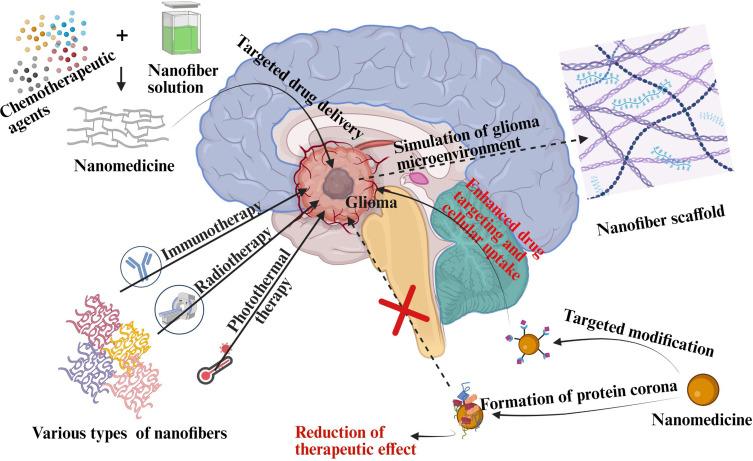
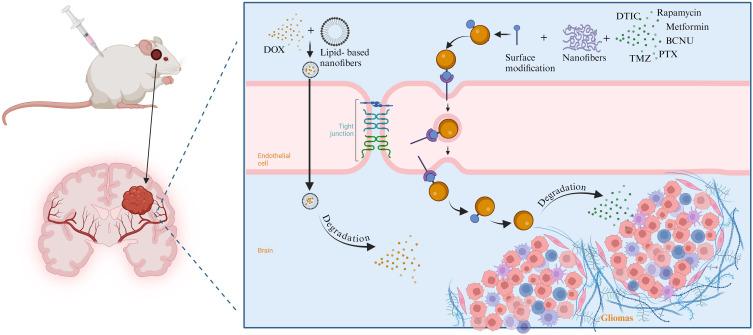
Despite relentless effort to study glioma treatment, the prognosis for glioma patients remains poor. The main obstacles include the high rate of recurrence and the difficulty of passing the blood-brain barrier (BBB) for therapeutic drugs. Nanomaterials owing to their special physicochemical properties have been used in a wide range of fields thus far. The nanodrug delivery system (NDDS) with the ability of crossing the BBB, targeting glioma site, maintaining drug stability and controlling drug release, has significantly enhanced the anti-tumor therapeutic effect, improving the prognosis of glioma patients. Aligned nanofibers (NFs) are ideal materials to establish in vitro models of glioma microenvironment (GME), enabling the exploration of the mechanism of glioma cell migration and invasion to discover novel therapeutic targets. Moreover, NFs are now widely used in glioma applications such as radiotherapy, phototherapy, thermotherapy and immunotherapy. Despite the absolute dominance of NFs in anti-glioma applications, there are still some problems such as the further optimization of NDDS, and the impact of interactions between nanofibers and the protein corona (PC) on glioma therapy. This paper will shed light on the latest glioma applications of NFs in drug delivery systems and mimicking the tumor microenvironment (TME), and discuss how to further optimize the NDDS and eliminate or utilize the nanomedicine-PC interactions.
尽管在研究神经胶质瘤治疗方面付出了不懈努力,但神经胶质瘤患者的预后仍然很差。主要障碍包括高复发率以及治疗药物难以通过血脑屏障(BBB)。由于其特殊的物理化学性质,纳米材料迄今为止已在广泛领域得到应用。具有穿越血脑屏障、靶向神经胶质瘤部位、维持药物稳定性和控制药物释放能力的纳米药物递送系统(NDDS),显著增强了抗肿瘤治疗效果,改善了神经胶质瘤患者的预后。排列的纳米纤维(NFs)是建立神经胶质瘤微环境(GME)体外模型的理想材料,能够探索神经胶质瘤细胞迁移和侵袭的机制以发现新的治疗靶点。此外,纳米纤维现在广泛应用于神经胶质瘤的放疗、光疗、热疗和免疫治疗等领域。尽管纳米纤维在抗神经胶质瘤应用中占据绝对主导地位,但仍存在一些问题,如纳米药物递送系统的进一步优化,以及纳米纤维与蛋白冠(PC)之间的相互作用对神经胶质瘤治疗的影响。本文将阐明纳米纤维在药物递送系统和模拟肿瘤微环境(TME)方面神经胶质瘤的最新应用,并讨论如何进一步优化纳米药物递送系统以及消除或利用纳米药物 - 蛋白冠相互作用。



 Zotero 插件