
骨少肌少症、骨关节炎与衰弱:一项双样本孟德尔随机化研究
Osteosarcopenia, osteoarthritis and frailty: a two-sample Mendelian randomization study.
作者信息
Liu Jili, Xia Xin, Wang Zhaolin, Wang Yanqin, Qin Gang
机构信息
Department of Geriatrics, The First Hospital, Shanxi Medical University, Taiyuan, Shanxi Province, 030001, China.
The Center of Gerontology and Geriatrics and National Clinical Research Center for Geriatrics, West China Hospital, Sichuan University, Chengdu, Sichuan Province, 610041, China.
出版信息
Aging Clin Exp Res. 2025 Apr 21;37(1):132. doi: 10.1007/s40520-025-03012-9.
BACKGROUND
Musculoskeletal disease, which has a complicated relationship with frailty, is a common clinical problem among elderly individuals.
AIMS
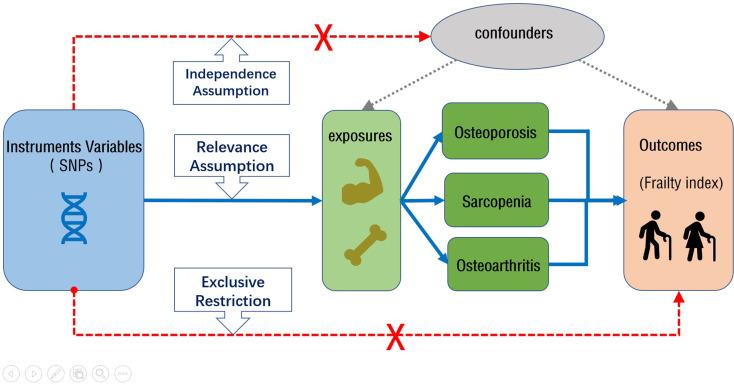
This study evaluated the potential causal relationships between osteosarcopenia, osteoarthritis and frailty by Mendelian Randomization (MR) analysis.
METHODS
This study employed a two-sample MR approach to investigate the causal relationships among osteosarcopenia, osteoarthritis and frailty. Published summary statistics were used to obtain instrumental variables at the genome-wide significance level.
RESULTS
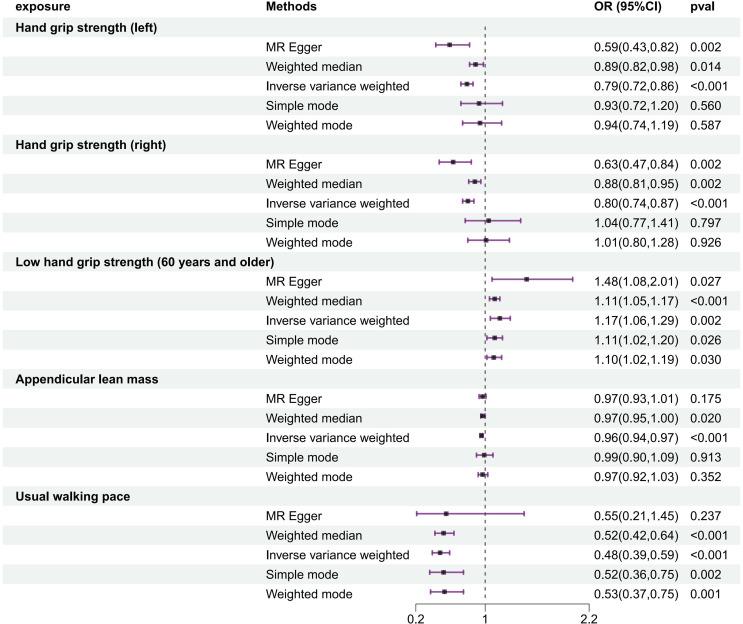
Among the age groups with osteoporosis, high total bone mineral density (TBMD) (45-60, OR = 0.966, 95% CI 0.940-0.993, P = 0.013) and TBMD (over 60, OR = 0.974, 95% CI 0.954-0.994, P = 0.011) reduced the risk of frailty. Similarly, high forearm BMD (FA-BMD), high ultradistal forearm BMD (UFA-BMD), and high Heel-BMD at different sites also reduced the risk of frailty (OR = 0.966, 95% CI 0.936-0.996, P = 0.028; OR = 0.975, 95% CI 0.953-0.997, P = 0.029; OR = 0.981, 95% CI 0.967-0.995, P = 0.008). Among the characteristics related to sarcopenia, grip strength in the left hand, grip strength in the right hand, appendicular lean mass, and walking pace were all protective factors for frailty (OR = 0.788, 95% CI 0.721-0.862, P < 0.001; OR = 0.800, 95% CI 0.737-0.869, P < 0.001; OR = 0.955, 95% CI 0.937-0.974, P = 0.000; OR = 0.480, 95% CI 0.388-0.593, P < 0.001), with low grip strength in those over 60 years of age significantly positively correlated with frailty (OR = 1.168, 95% CI 1.059-1.289, P = 0.002). The MR results of osteoarthritis and frailty revealed a causal relationship between specific joint sites and frailty, including KOA (OR = 1.086, 95% CI 1.017-1.160, P = 0.014), HOA (OR = 1.028, 95% CI 1.007-1.049, P = 0.009), and KOA/HOA (OR = 1.082, 95% CI 1.053-1.113, P = 0.000), increasing the risk of frailty.
CONCLUSION
Osteosarcopenia, osteoarthritis and frailty exhibit significant causal effects, rendering them risk factors for frailty. Therefore, in clinical practice, patients with osteosarcopenia and osteoarthritis should be required to undergo relevant interventions to reduce the risk of frailty.
背景
肌肉骨骼疾病与衰弱之间存在复杂关系,是老年人群中常见的临床问题。
目的
本研究通过孟德尔随机化(MR)分析评估骨质疏松症、骨关节炎与衰弱之间的潜在因果关系。
方法
本研究采用两样本MR方法来研究骨质疏松症、骨关节炎与衰弱之间的因果关系。使用已发表的汇总统计数据在全基因组显著性水平上获取工具变量。
结果
在患有骨质疏松症的年龄组中,高总骨矿物质密度(TBMD)(45 - 60岁,OR = 0.966,95%CI 0.940 - 0.993,P = 0.013)和TBMD(60岁以上,OR = 0.974,95%CI 0.954 - 0.994,P = 0.011)降低了衰弱风险。同样,不同部位的高前臂骨密度(FA - BMD)、高尺骨远端前臂骨密度(UFA - BMD)和高足跟骨密度也降低了衰弱风险(OR = 0.966,95%CI 0.936 - 0.996,P = 0.028;OR = 0.975,95%CI 0.953 - 0.997,P = 0.029;OR = 0.981,95%CI 0.967 - 0.995,P = 0.008)。在与肌肉减少症相关的特征中,左手握力、右手握力、四肢瘦体重和步行速度都是衰弱的保护因素(OR = 0.788,95%CI 0.721 - 0.862,P < 0.001;OR = 0.800,95%CI 0.737 - 0.869,P < 0.001;OR = 0.955,95%CI 0.937 - 0.974,P = 0.000;OR = 0.480,95%CI 0.388 - 0.593,P < 0.001),60岁以上人群中低握力与衰弱显著正相关(OR = 1.168,95%CI 1.059 - 1.289,P = 0.002)。骨关节炎与衰弱的MR结果显示特定关节部位与衰弱之间存在因果关系,包括膝关节骨关节炎(KOA,OR = 1.086,95%CI 1.017 - 1.160,P = 0.014)、髋关节骨关节炎(HOA,OR = 1.028,95%CI 1.007 - 1.049,P = 0.009)以及KOA/HOA(OR = 1.082,95%CI 1.053 - 1.113,P = 0.000),增加了衰弱风险。
结论
骨质疏松症、骨关节炎与衰弱表现出显著的因果效应,使其成为衰弱的危险因素。因此,在临床实践中,应要求患有骨质疏松症和骨关节炎的患者接受相关干预以降低衰弱风险。


 Zotero 插件