
血清中基于长链非编码RNA的ProsRISK评分作为提高前列腺癌检测准确性的潜在生物标志物的发现。
Discovery of lncRNA-Based ProsRISK Score in Serum as Potential Biomarkers for Improved Accuracy of Prostate Cancer Detection.
作者信息
Jiang Xiumei, Liu Zhongchao, Wang Hongxing, Wang Lishui
机构信息
Department of Clinical Laboratory, Qilu Hospital, Shandong University, Jinan, Shandong Province, People's Republic of China.
出版信息
J Cell Mol Med. 2025 Apr;29(8):e70555. doi: 10.1111/jcmm.70555.
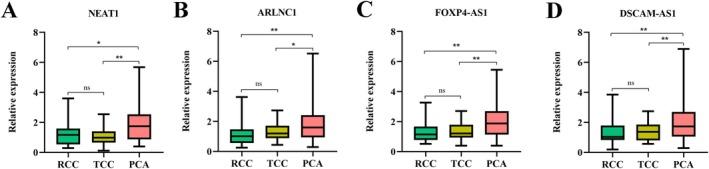
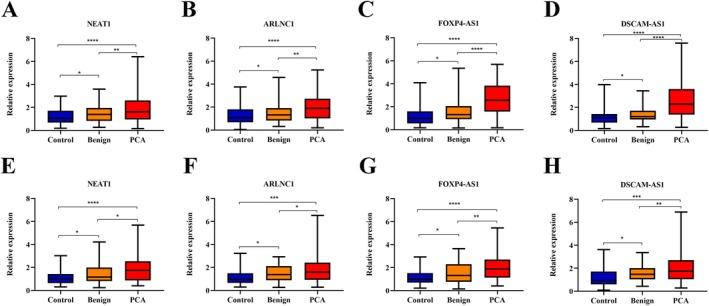
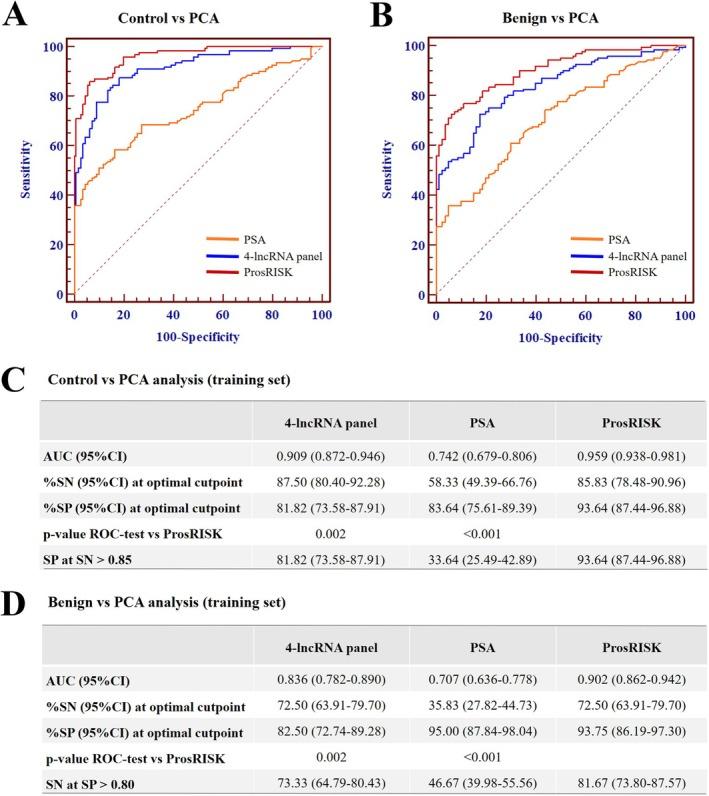
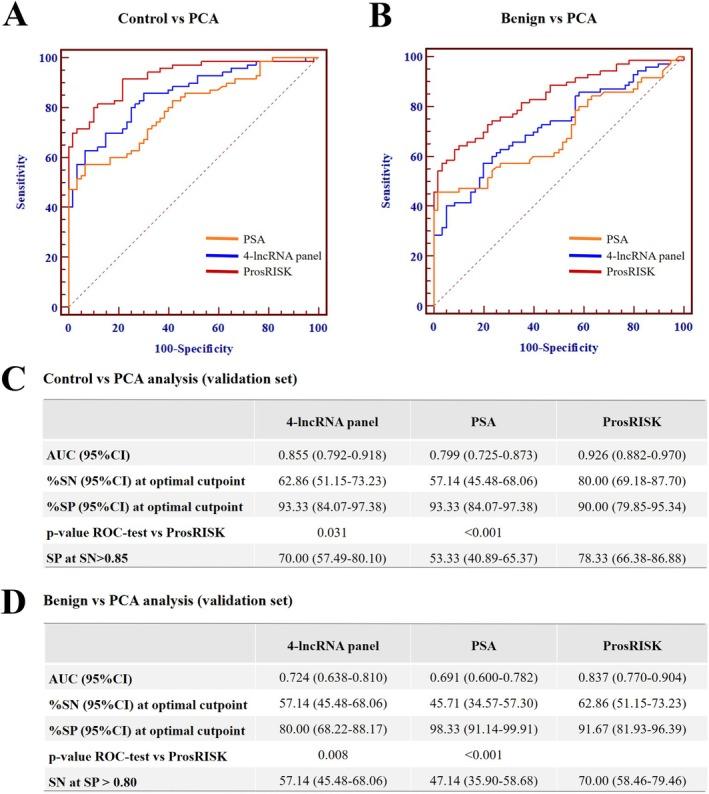
Circulating lncRNAs have emerged as promising biomarkers for the diagnosis of various cancers. This study aimed to establish an accurate risk prediction model based on serum lncRNAs to facilitate the detection of prostate cancer (PCA). RT-qPCR was used to analyse the levels of candidate lncRNAs, and four lncRNAs (NEAT1, ARLNC1, FOXP4-AS1 and DSCAM-AS1) were identified to be differently expressed in serum from 190 PCA patients, 140 benign controls, and 170 healthy controls. A ProsRISK score based on four lncRNAs and prostate-specific antigen (PSA) was established in the training set. ROC analysis in the validation set revealed that the ProsRISK demonstrated more powerful capacity in discriminating PCA from healthy and benign controls, with an AUC of 0.926 (95% CI: 0.882-0.970) and 0.837 (95% CI: 0.770-0.904), which were significantly higher than those of the lncRNA panel or PSA alone (all at p < 0.05). Moreover, the ProsRISK showed good diagnostic performance for PCA I-II patients compared with healthy and benign controls, and the corresponding AUCs were 0.905 (95% CI: 0.843-0.968) and 0.819 (95% CI: 0.732-0.907). Our findings indicated that the constructed ProsRISK could be a reliable risk stratification model and have great potential for clinical use to improve the precision surveillance for PCA.
循环长链非编码RNA(lncRNAs)已成为各种癌症诊断中很有前景的生物标志物。本研究旨在建立一种基于血清lncRNAs的准确风险预测模型,以促进前列腺癌(PCA)的检测。采用逆转录-定量聚合酶链反应(RT-qPCR)分析候选lncRNAs的水平,并鉴定出4种lncRNAs(NEAT1、ARLNC1、FOXP4-AS1和DSCAM-AS1)在190例PCA患者、140例良性对照和170例健康对照的血清中表达存在差异。在训练集中建立了基于4种lncRNAs和前列腺特异性抗原(PSA)的ProsRISK评分。验证集的受试者工作特征(ROC)分析显示,ProsRISK在区分PCA与健康对照和良性对照方面具有更强的能力,其曲线下面积(AUC)分别为0.926(95%置信区间:0.882-0.970)和0.837(95%置信区间:0.770-0.904),显著高于单独的lncRNA组合或PSA(均p<0.05)。此外,与健康对照和良性对照相比,ProsRISK对PCA I-II期患者具有良好的诊断性能,相应的AUC分别为0.905(95%置信区间:0.843-0.968)和0.819(95%置信区间:0.732-0.907)。我们的研究结果表明,构建的ProsRISK可能是一个可靠的风险分层模型,在临床应用中具有很大潜力,可提高PCA的精准监测。


 Zotero 插件