
探索1型糖尿病儿童护理模式及社会经济地位的影响。
Exploring patterns in pediatric type 1 diabetes care and the impact of socioeconomic status.
作者信息
Nussbaum Christopher, Novelli Anna, Flothow Amelie, Sundmacher Leonie
机构信息
Department of Health Economics, School of Medicine and Health, Technical University of Munich, Georg-Brauchle-Ring 60/62, Munich, 80992, Germany.
Munich Center for Health Economics and Policy (M-CHEP), Georg-Brauchle-Ring 60/62, Munich, 80992, Germany.
出版信息
BMC Med. 2025 Apr 23;23(1):229. doi: 10.1186/s12916-025-04049-3.
BACKGROUND
Managing pediatric type 1 diabetes is complex and requires substantial parental involvement. Adherence to clinical guidelines is often inconsistent, and lower parental socioeconomic status is associated with worse outcomes in affected children. However, few studies have examined these children's care pathways multidimensionally over time. This study aims to identify latent clusters in the care pathways of pediatric patients with type 1 diabetes mellitus, evaluate guideline adherence and disease management within these clusters, and assess the influence of socioeconomic status on cluster membership.
METHODS
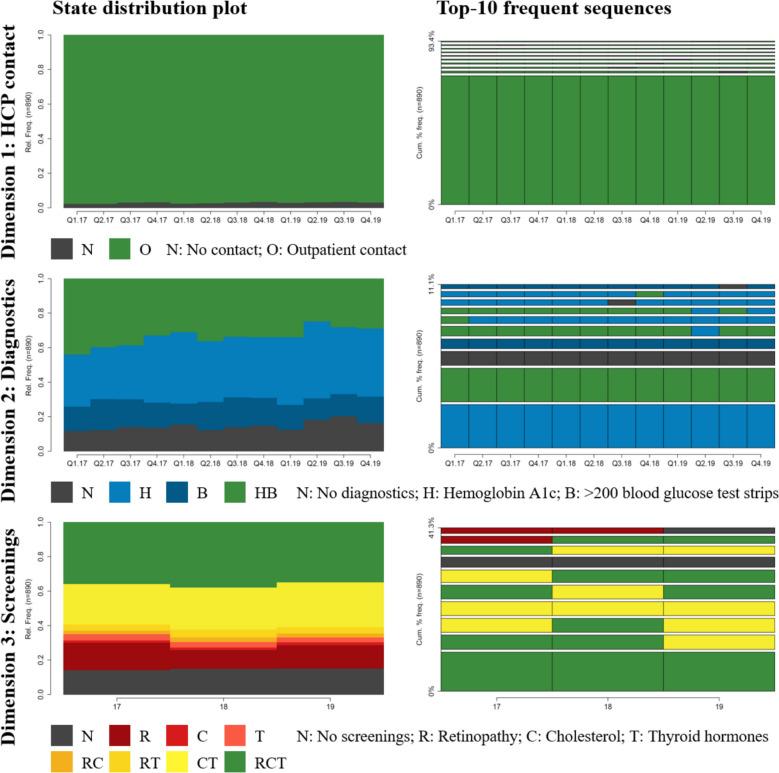
We analyzed care pathways for pediatric patients with type 1 diabetes from 2017 to 2019 in the German health system, which provides universal coverage. Using state sequence analysis and clustering algorithms from the TraMineR R package, we identified patient clusters based on healthcare utilization patterns. To assess care quality within these clusters, we compared observed care patterns to clinical guideline recommendations. Our analysis was based on health insurance claims data from Techniker Krankenkasse, a statutory health insurer. From the dataset, which encompassed more than three million patients under the age of 25 years, we derived an age-homogeneous cohort of continuously insured children aged 11 to 14 years with type 1 diabetes in 2017 and extracted relevant healthcare events over a 3-year period.
RESULTS
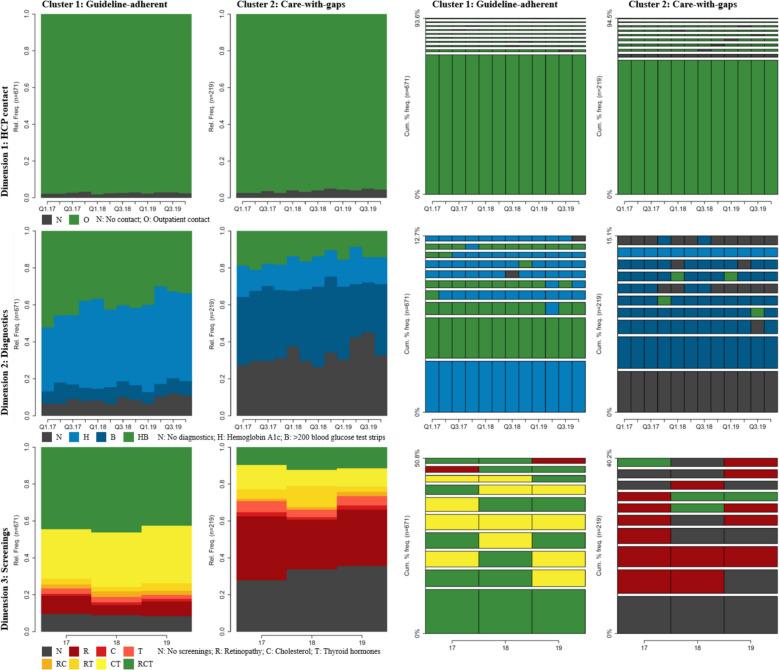
Based on care patterns, we identified two clusters of children, which we designated as the "guideline-adherent" and "care-with-gaps" clusters. Roughly 25% of our cohort (n = 890) fell into the latter cluster, consistently receiving care that fell short of guideline recommendations. For example, these patients had less than half as many quarters with hemoglobin A1c measurement. Lower parental educational attainment and unemployment were predictors of this suboptimal care. We also found that the average number of hospitalizations per child was almost 40% higher in the cluster with less guideline-adherent care.
CONCLUSIONS
Despite universal health coverage and frequent contact with the outpatient healthcare system, a substantial proportion of pediatric type 1 diabetes patients in Germany experience suboptimal care, particularly in glycemic diagnostics and screening for complications, leading to worse health outcomes. Higher socioeconomic status is associated with care that more closely adheres to clinical guidelines.
背景
管理儿童1型糖尿病很复杂,需要家长大量参与。对临床指南的遵循往往不一致,且家长社会经济地位较低与患病儿童的不良预后相关。然而,很少有研究对这些儿童的护理路径进行长期的多维度研究。本研究旨在识别1型糖尿病患儿护理路径中的潜在类别,评估这些类别中的指南遵循情况和疾病管理情况,并评估社会经济地位对类别归属的影响。
方法
我们分析了德国医疗系统中2017年至2019年1型糖尿病患儿的护理路径,该系统提供全民医保。使用TraMineR R包中的状态序列分析和聚类算法,我们根据医疗服务利用模式识别出患者类别。为了评估这些类别中的护理质量,我们将观察到的护理模式与临床指南建议进行了比较。我们的分析基于法定健康保险公司Techniker Krankenkasse的医疗保险理赔数据。从包含超过300万名25岁以下患者的数据集,我们得出了一个年龄均匀的队列,即2017年11至14岁持续参保的1型糖尿病患儿,并提取了3年期间的相关医疗事件。
结果
基于护理模式,我们识别出两类儿童,我们将其分别命名为“遵循指南”和“护理有缺口”类别。我们队列中约25%(n = 890)属于后一类,持续接受未达指南建议的护理。例如,这些患者进行糖化血红蛋白测量的季度数不到一半。家长教育程度较低和失业是这种护理不佳的预测因素。我们还发现,在护理遵循指南程度较低的类别中,每个儿童的平均住院次数高出近40%。
结论
尽管有全民医保且与门诊医疗系统频繁接触,但德国相当一部分1型糖尿病患儿接受的护理不佳,尤其是在血糖诊断和并发症筛查方面,导致健康结局较差。较高的社会经济地位与更严格遵循临床指南的护理相关。
 Zotero 插件