
促进儿童人乳头瘤病毒疫苗接种的多层次目标:对高收入国家和低收入及中等收入国家以家长为中心、以提供者为中心和以实践为中心干预措施的系统评价
Multilevel Targets for Promoting Pediatric HPV Vaccination: A Systematic Review of Parent-Centered, Provider-Centered, and Practice-Centered Interventions in HIC and LMIC Settings.
作者信息
Gray Aaliyah, Fisher Celia B
机构信息
Center for Women's and Gender Studies, Florida International University, Miami, FL 33199, USA.
Department of Psychology, Fordham University, Bronx, NY 10458, USA.
出版信息
Vaccines (Basel). 2025 Mar 11;13(3):300. doi: 10.3390/vaccines13030300.
BACKGROUND/OBJECTIVES: Human papillomavirus (HPV) is a predominant cause of cervical cancer globally in women. HPV-related cancers in men are also on the rise. Immunization against HPV infection is a highly effective preventative against these cancers. However, HPV vaccine programs are not easily implemented globally. The objective of this systematic review was to identify multilevel strategies associated with improved pediatric HPV vaccination in high-income countries (HICs) and low- and middle-income countries (LMICs) that target parent, provider, and practice points of interventions.
METHODS
Through a systematic search of electronic databases, we identified 159 peer-reviewed articles published between the years 2011 and 2023.
RESULTS
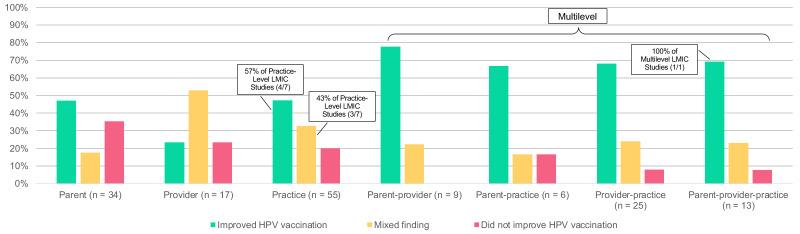
Ninety-five percent of the included studies were conducted in HICs. Just eight studies were set in LMICs. A variety of HPV vaccination outcomes were assessed including uptake, initiation of the series, continuation of the series, missed opportunities, time, and refusal. Eighty percent of studies reported improved pediatric HPV vaccination, including a third of studies with mixed findings. Parent-centered strategies included education programs and reminder/recall procedures. Provider-centered strategies also included education programs and training in communication. Practice-centered strategies included vaccine access programs, vaccine bundling protocols, provider prompts, standing orders, vaccine messaging, and lowering the initiation age to 9 years. Multilevel, multi-component programs were highly effective.
CONCLUSIONS
Multilevel strategies can be adopted in a variety of settings to promote HPV vaccination among youth globally. However, this research is disproportionately conducted in high resource environments. Further work is needed in LMIC settings as more countries begin to adopt HPV immunization programs.
背景/目的:人乳头瘤病毒(HPV)是全球女性宫颈癌的主要病因。男性中与HPV相关的癌症也在增加。针对HPV感染进行免疫接种是预防这些癌症的高效方法。然而,HPV疫苗接种计划在全球范围内难以推行。本系统评价的目的是确定在高收入国家(HICs)以及低收入和中等收入国家(LMICs)中,与改善针对家长、医护人员和干预实践点的儿科HPV疫苗接种相关的多层次策略。
方法
通过系统检索电子数据库,我们识别出2011年至2023年间发表的159篇同行评议文章。
结果
纳入研究的95%在高收入国家开展。仅有8项研究在低收入和中等收入国家进行。评估了多种HPV疫苗接种结果,包括接种率、系列接种起始率、系列接种持续率、错失机会情况、时间以及拒绝接种情况。80%的研究报告儿科HPV疫苗接种情况得到改善,其中三分之一的研究结果不一。以家长为中心的策略包括教育项目和提醒/召回程序。以医护人员为中心的策略还包括教育项目和沟通培训。以实践为中心的策略包括疫苗获取项目、疫苗捆绑方案、医护人员提示、常规医嘱、疫苗宣传以及将起始接种年龄降至9岁。多层次、多组成部分的项目非常有效。
结论
可在各种环境中采用多层次策略来促进全球青少年的HPV疫苗接种。然而,这项研究在高资源环境中的开展比例过高。随着更多国家开始采用HPV免疫接种计划,低收入和中等收入国家环境中还需要进一步开展工作。


 Zotero 插件