
20:4-花生四烯酸乙醇胺诱导的机械敏感性和背根神经节神经元兴奋性变化呈浓度依赖性,并通过NAPE-磷脂酶D介导。
20:4-NAPE induced changes of mechanical sensitivity and DRG neurons excitability are concentration dependent and mediated via NAPE-PLD.
作者信息
Bhattacharyya Anirban, Vasconcelos Daniel, Spicarova Diana, Palecek Jiri
机构信息
Laboratory of Pain Research, Institute of Physiology of the Czech Academy of Sciences, Prague, Czech Republic.
出版信息
Sci Rep. 2025 Apr 23;15(1):14131. doi: 10.1038/s41598-025-98567-y.
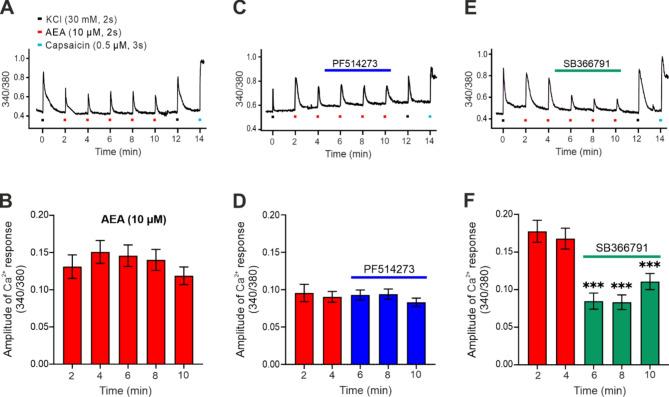
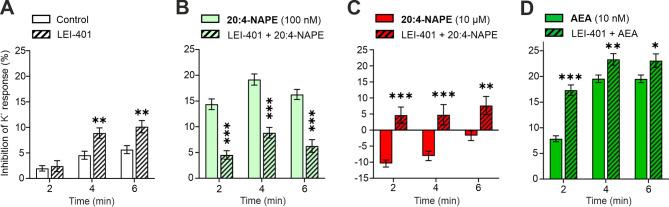
Alterations in the excitability of dorsal root ganglion (DRG) neurons are critical in the pathogenesis of acute and chronic pain. Neurotransmitter release from the terminals of DRG neurons is regulated by cannabinoid receptor 1 (CB) and transient receptor potential vanilloid 1 (TRPV1), both activated by anandamide (AEA). In our experiments, the AEA precursor N-arachidonoylphosphatidylethanolamine (20:4-NAPE) was used to study the modulation of nociceptive DRG neurons excitability using K-evoked Ca transients. Intrathecal administration was used to evaluate in vivo effects. Application of 20:4-NAPE at lower concentrations (10 nM - 1 µM) decreased the excitability of DRG neurons, whereas the higher (10 µM) increased it. Both effects of 20:4-NAPE were blocked by the N-acylphosphatidylethanolamine phospholipase D (NAPE-PLD) inhibitor LEI-401. Similarly, lower concentrations of externally applied AEA (1 nM - 10 nM) inhibited DRG neurons, whereas higher concentration (100 nM) did not change it. High AEA concentration (10 µM) evoked Ca transients dependent on TRPV1 activation in separate experiments. Inhibition of the CB receptor by PF514273 (400 nM) prevented the 20:4-NAPE- and AEA-induced inhibition, whereas TRPV1 inhibition by SB366791 (1 µM) prevented the increased DRG neuron excitability. In behavioral tests, lower 20:4-NAPE concentration caused hyposensitivity, while higher evoked mechanical allodynia. Intrathecal LEI-401 prevented both in vivo effects of 20:4-NAPE. These results highlight anti- and pro-nociceptive effects of 20:4-NAPE mediated by CB and TRPV1 in concentration-dependent manner. Our study underscores the complexity of endocannabinoid signaling in pain transmission modulation and highlights 20:4-NAPE as a potential therapeutic target, offering new insights for developing analgesic strategies.
背根神经节(DRG)神经元兴奋性的改变在急慢性疼痛的发病机制中起关键作用。DRG神经元终末的神经递质释放受大麻素受体1(CB)和瞬时受体电位香草酸受体1(TRPV1)调节,二者均可被花生四烯乙醇胺(AEA)激活。在我们的实验中,使用AEA前体N - 花生四烯酰磷脂酰乙醇胺(20:4 - NAPE),通过钾离子诱发的钙瞬变来研究伤害性DRG神经元兴奋性的调节。采用鞘内给药来评估其体内效应。较低浓度(10 nM - 1 µM)的20:4 - NAPE应用可降低DRG神经元的兴奋性,而较高浓度(10 µM)则使其升高。20:4 - NAPE的这两种效应均被N - 酰基磷脂酰乙醇胺磷脂酶D(NAPE - PLD)抑制剂LEI - 401阻断。同样,较低浓度的外源性AEA(1 nM - 10 nM)可抑制DRG神经元,而较高浓度(100 nM)则无变化。在单独实验中,高浓度AEA(10 µM)诱发的钙瞬变依赖于TRPV1的激活。PF514273(400 nM)对CB受体的抑制可阻止20:4 - NAPE和AEA诱导的抑制作用,而SB366791(1 µM)对TRPV1的抑制可阻止DRG神经元兴奋性的升高。在行为学测试中,较低浓度的20:4 - NAPE引起感觉减退,而较高浓度则诱发机械性异常性疼痛。鞘内注射LEI - 401可阻止20:4 - NAPE的两种体内效应。这些结果突出了20:4 - NAPE通过CB和TRPV1以浓度依赖方式介导的抗伤害性和促伤害性效应。我们的研究强调了内源性大麻素信号在疼痛传递调节中的复杂性,并突出了20:4 - NAPE作为潜在治疗靶点的作用,为开发镇痛策略提供了新的见解。



 Zotero 插件