
人胚胎干细胞来源的免疫与基质调节细胞促进宫腔粘连大鼠子宫内膜修复及生育力恢复
Human embryonic stem cell-derived immunity-and-matrix-regulatory cells promote endometrial repair and fertility restoration in IUA rats.
作者信息
Cao Yuting, Wu Jianhong, Huang Jinyuan, Fan Xiaoyin, Zhang Yi, Li Lin, Dai Yinmei
机构信息
Department of Gynecology, Beijing Obstetrics and Gynecology Hospital, Capital Medical University/Beijing Maternal and Child Health Care Hospital, No. 251, Yaojiayuan Road, Chaoyang District, Beijing, 100026, China.
State Key Laboratory of Female Fertility Promotion, Center for Reproductive Medicine, Department of Obstetrics and Gynecology, Peking University Third Hospital / National Clinical Research Center for Obstetrics and Gynecology (Peking University Third Hospital) / Key Laboratory of Assisted Reproduction (Peking University), Ministry of Education / Beijing Key Laboratory of Reproductive Endocrinology and Assisted Reproductive Technology / National Clinical Key Specialty Construction Program, P. R. China (2023), Beijing, 100191, China.
出版信息
Stem Cell Res Ther. 2025 Apr 23;16(1):204. doi: 10.1186/s13287-025-04298-2.
BACKGROUND
Intrauterine adhesion (IUA) refers to endometrial fibrosis resulting from endometrial injury and infection. In promoting the repair of the endometrium, mesenchymal stem cells therapy has shown great potential. However, adult-derived mesenchymal stem cells (MSCs) are associated with several challenges, including invasive manipulation, susceptibility to contamination, and low proliferative capacity. Immunity-and-matrix-regulatory cells (IMRCs) derived from human embryonic stem cells exhibit enhanced immunomodulatory and anti-fibrotic capabilities. Despite their success in treating lung injury and fibrosis, membranous nephropathy, and acute liver failure, their therapeutic potential in IUA remains undetermined.
METHODS
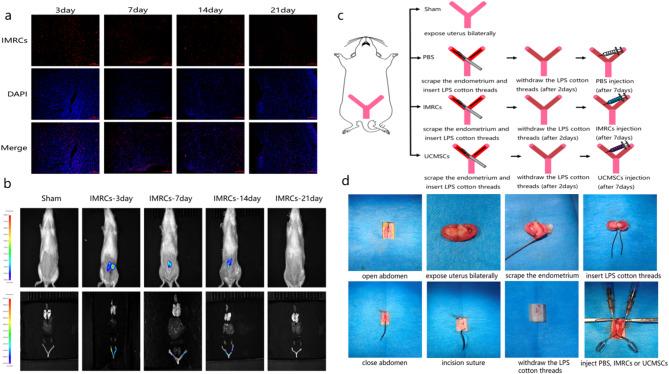
TGF-β1-induced human endometrial stromal cells (HESCs) were utilized to construct the IUA cell model and were treated with IMRCs conditioned medium. Morphological changes in the cells were observed, and RT-qPCR and Western blot analyses were employed to detect the expression of relevant markers during the process of epithelial-mesenchymal transition (EMT) in vitro. The IUA rat model was established using the dual injury method and subsequently treated with intrauterine infusion of IMRCs. HE and Masson staining were used to assess endometrial damage, repair and the extent of fibrosis. Fertility assays were performed to compare the effectiveness of IMRCs and umbilical cord mesenchymal stem cells (UCMSCs) in improving endometrial function in IUA rats. Sequencing analysis of IMRCs-derived exosomes (Exos) was conducted to identify specific miRNAs and the pathways they target.
RESULTS
TGF-β1 treatment induced HESCs to undergo fibrotic transformation and express fibrosis-related markers, while treatment with IMRCs conditioned medium inhibited TGF-β1-induced fibrosis. IUA rats were treated with intrauterine infusion of IMRCs. IMRCs facilitated the repair of damaged endometrium, restored the structure of the uterine cavity, and reduced collagen deposition. IMRCs reversed the process of endometrial EMT in rats with IUA, upregulated the expression of epithelial markers, and downregulated the expression of mesenchymal markers. IMRCs further exerted antifibrotic effects by reducing inflammatory responses. Fertility recovery in rats receiving intrauterine infusion of IMRCs was superior to that in rats receiving intrauterine infusion of UCMSCs. Specific miRNAs in Exos, including miR-27b-3p, miR-145-5p, and miR-16-5p, directly target Smad2, inhibit Smad2 phosphorylation, and modulate the TGF-β/Smad pathway.
CONCLUSIONS
Our study demonstrated that IMRCs inhibited TGF-β1-induced fibrosis in HESCs, suppressed the EMT process ex vivo, reduced the inflammatory response, and reversed endometrial damage and fibrosis in IUA rats. IMRCs exerted their effects through the paracrine pathway, with specific miRNAs in Exos downregulating the TGF-β/Smad signaling pathway to inhibit uterine endometrial fibrosis. IMRCs provide a new direction for the treatment of IUA.
背景
宫腔粘连(IUA)是指子宫内膜损伤和感染导致的子宫内膜纤维化。在促进子宫内膜修复方面,间充质干细胞疗法已显示出巨大潜力。然而,成人间充质干细胞(MSCs)存在一些挑战,包括侵入性操作、易受污染以及增殖能力低。源自人胚胎干细胞的免疫和基质调节细胞(IMRCs)具有增强的免疫调节和抗纤维化能力。尽管它们在治疗肺损伤和纤维化、膜性肾病以及急性肝衰竭方面取得了成功,但其在IUA中的治疗潜力仍未确定。
方法
利用转化生长因子-β1(TGF-β1)诱导的人子宫内膜基质细胞(HESCs)构建IUA细胞模型,并用IMRCs条件培养基处理。观察细胞形态变化,并采用逆转录-定量聚合酶链反应(RT-qPCR)和蛋白质免疫印迹分析检测体外上皮-间质转化(EMT)过程中相关标志物的表达。采用双重损伤法建立IUA大鼠模型,随后通过宫内输注IMRCs进行治疗。苏木精-伊红(HE)和Masson染色用于评估子宫内膜损伤、修复及纤维化程度。进行生育力测定以比较IMRCs和脐带间充质干细胞(UCMSCs)改善IUA大鼠子宫内膜功能的效果。对IMRCs来源的外泌体(Exos)进行测序分析,以鉴定特定的微小RNA(miRNAs)及其靶向的信号通路。
结果
TGF-β1处理诱导HESCs发生纤维化转化并表达纤维化相关标志物,而用IMRCs条件培养基处理可抑制TGF-β1诱导的纤维化。对IUA大鼠进行宫内输注IMRCs治疗。IMRCs促进受损子宫内膜的修复,恢复子宫腔结构,并减少胶原沉积。IMRCs逆转了IUA大鼠子宫内膜的EMT过程,上调上皮标志物的表达,下调间质标志物的表达。IMRCs还通过减轻炎症反应发挥抗纤维化作用。宫内输注IMRCs的大鼠生育力恢复情况优于宫内输注UCMSCs的大鼠。Exos中的特定miRNAs,包括miR-27b-3p、miR-145-5p和miR-16-5p,直接靶向Smad2,抑制Smad2磷酸化,并调节TGF-β/Smad信号通路。
结论
我们的研究表明,IMRCs抑制TGF-β1诱导的HESCs纤维化,在体外抑制EMT过程,减轻炎症反应,并逆转IUA大鼠的子宫内膜损伤和纤维化。IMRCs通过旁分泌途径发挥作用,Exos中的特定miRNAs下调TGF-β/Smad信号通路以抑制子宫内膜纤维化。IMRCs为IUA的治疗提供了新方向。




 Zotero 插件