
河马通路:环境线索与生活节奏之间的分子桥梁。
The hippo pathway: a molecular bridge between environmental cues and pace of life.
作者信息
Ahi Ehsan Pashay, Panda Bineet, Primmer Craig R
机构信息
Organismal and Evolutionary Biology Research Programme, Faculty of Biological and Environmental Sciences, University of Helsinki, Viikinkaari 9, 00014, Helsinki, Finland.
Institute of Biotechnology, Helsinki Institute of Life Science (HiLIFE), University of Helsinki, Helsinki, Finland.
出版信息
BMC Ecol Evol. 2025 Apr 24;25(1):35. doi: 10.1186/s12862-025-02378-8.
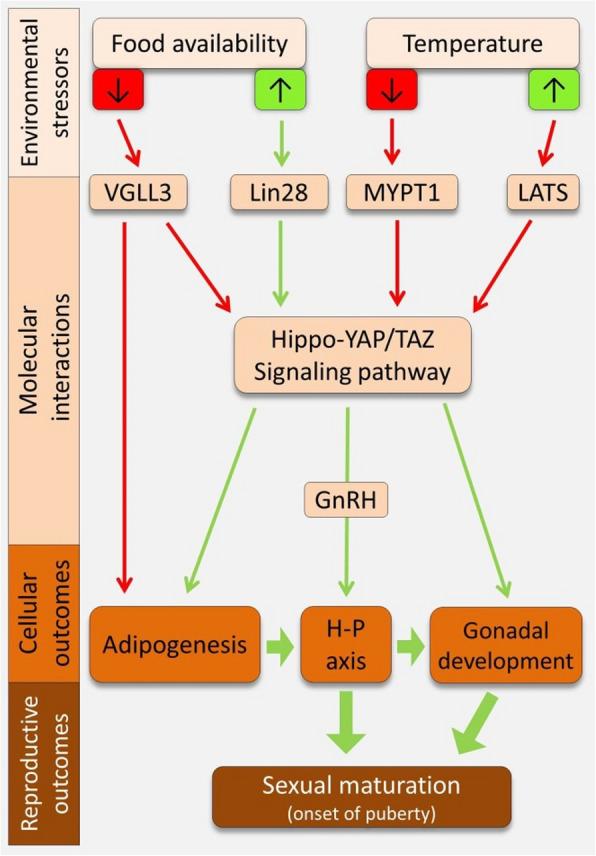
The pace of life (POL) is shaped by a complex interplay between genetic and environmental factors, influencing growth, maturation, and lifespan across species. The Hippo signaling pathway, a key regulator of organ size and cellular homeostasis, has emerged as a central integrator of environmental cues that modulate POL traits. In this review, we explore how the Hippo pathway links environmental factors-such as temperature fluctuations and dietary energy availability-to molecular mechanisms governing metabolic balance, hormonal signaling, and reproductive timing. Specifically, we highlight the regulatory interactions between the Hippo pathway and metabolic sensors (AMPK, mTOR, SIRT1 and DLK1-Notch), as well as hormonal signals (IGF-1, kisspeptin, leptin, cortisol, thyroid and sex steroids), which together orchestrate key life-history traits, including growth rates, lifespan and sexual maturation, with a particular emphasis on their role in reproductive timing. Furthermore, we consider its role as a potential coordinator of POL-related molecular processes, such as telomere dynamics and epigenetic mechanisms, within a broader regulatory network. By integrating insights from molecular biology and eco-evolutionary perspectives, we propose future directions to dissect the Hippo pathway's role in POL regulation across taxa. Understanding these interactions will provide new perspectives on how organisms adaptively adjust life-history strategies in response to environmental variability.
生活节奏(POL)由遗传和环境因素之间复杂的相互作用所塑造,影响着物种的生长、成熟和寿命。 Hippo信号通路作为器官大小和细胞稳态的关键调节因子,已成为调节POL特征的环境信号的核心整合者。在本综述中,我们探讨了Hippo通路如何将温度波动和饮食能量供应等环境因素与控制代谢平衡、激素信号和生殖时间的分子机制联系起来。具体而言,我们强调了Hippo通路与代谢传感器(AMPK、mTOR、SIRT1和DLK1-Notch)以及激素信号(IGF-1、 kisspeptin、瘦素、皮质醇、甲状腺激素和性类固醇)之间的调节相互作用,它们共同协调关键的生活史特征,包括生长速率、寿命和性成熟,特别强调它们在生殖时间中的作用。此外,我们认为它在更广泛的调控网络中作为POL相关分子过程(如端粒动态和表观遗传机制)的潜在协调者的作用。通过整合分子生物学和生态进化观点的见解,我们提出了未来的方向,以剖析Hippo通路在跨分类群的POL调节中的作用。了解这些相互作用将为生物体如何响应环境变化而适应性地调整生活史策略提供新的视角。


 Zotero 插件