
间接比较中调整变量的识别:弥漫性大B细胞淋巴瘤CAR-T疗法的快速回顾
Identification of Adjustment Variables in Indirect Comparisons: A Rapid Review of CAR-T Therapies for Diffuse Large B-Cell Lymphoma.
作者信息
Riou Sybille, Rungaldier Stefanie, Mahlich Jörg
机构信息
Miltenyi Biomedicine, Friedrich-Ebert-Straße 68, 51429 Bergisch Gladbach, Germany.
Düsseldorf Institute for Competition Economics (DICE), Heinrich-Heine-University Düsseldorf, Universitätsstraße 1, 40225 Düsseldorf, Germany.
出版信息
Cancers (Basel). 2025 Apr 15;17(8):1335. doi: 10.3390/cancers17081335.
: Chimeric antigen receptor T-cell (CAR-T) therapies have been approved by the U.S. Food and Drug Administration (FDA) and the European Medicines Agency (EMA) for the treatment of diffuse large B-cell lymphoma (DLBCL), primarily based on single-arm trials or indirect comparisons with stem cell transplantation. However, no direct head-to-head comparisons of CAR-T therapies have been conducted, largely due to their high cost. To assess their true value, indirect treatment comparisons (ITCs) are essential. These comparisons, however, are prone to confounding biases, which necessitate careful adjustments through the identification and measurement of relevant variables. : This study aims to identify the variables used for adjustment in ITCs of CAR-T therapies for DLBCL and examine the methodologies employed to select them. A rapid literature review was conducted in PubMed in September 2023, focusing on ITCs involving CAR-T therapies for DLBCL. The search was based on keywords categorized into three groups: techniques (ITCs and related terms), drugs (CAR-T therapies), and indication (DLBCL). : The rapid literature review identified 21 articles, of which 11 were selected for analysis. Exclusions were made for articles that did not identify confounders, were letters to editors, or addressed conditions other than DLBCL. Among the 11 selected publications, 10 did not clearly specify the methodology used to identify adjustment variables. A total of 25 potential confounders were identified across the studies, with substantial variability in the set of variables used, reflecting a lack of standardization in confounder selection. Commonly identified confounders included the number of prior treatment lines and Eastern Cooperative Oncology Group Performance Status (ECOG PS), although their inclusion as adjustment variables in ITCs was inconsistent, often due to missing data. : While the identified confounders are clinically relevant, the methodologies for selecting them remain unclear, resulting in significant variability across studies. Additionally, key variables commonly considered in health technology assessments (HTAs), such as age, sex, and disease severity, were inconsistently incorporated into ITCs. To improve the reliability and consistency of ITC outcomes, there is a pressing need for standardized methodologies for identifying and adjusting for confounders.
嵌合抗原受体T细胞(CAR-T)疗法已获得美国食品药品监督管理局(FDA)和欧洲药品管理局(EMA)批准,用于治疗弥漫性大B细胞淋巴瘤(DLBCL),主要基于单臂试验或与干细胞移植的间接比较。然而,尚未对CAR-T疗法进行直接的头对头比较,这主要是由于其成本高昂。为了评估其真正价值,间接治疗比较(ITC)至关重要。然而,这些比较容易受到混杂偏倚的影响,这就需要通过识别和测量相关变量进行仔细调整。
本研究旨在确定在DLBCL的CAR-T疗法ITC中用于调整的变量,并检查选择这些变量所采用的方法。2023年9月在PubMed上进行了快速文献综述,重点关注涉及DLBCL的CAR-T疗法的ITC。搜索基于分为三组的关键词:技术(ITC及相关术语)、药物(CAR-T疗法)和适应症(DLBCL)。
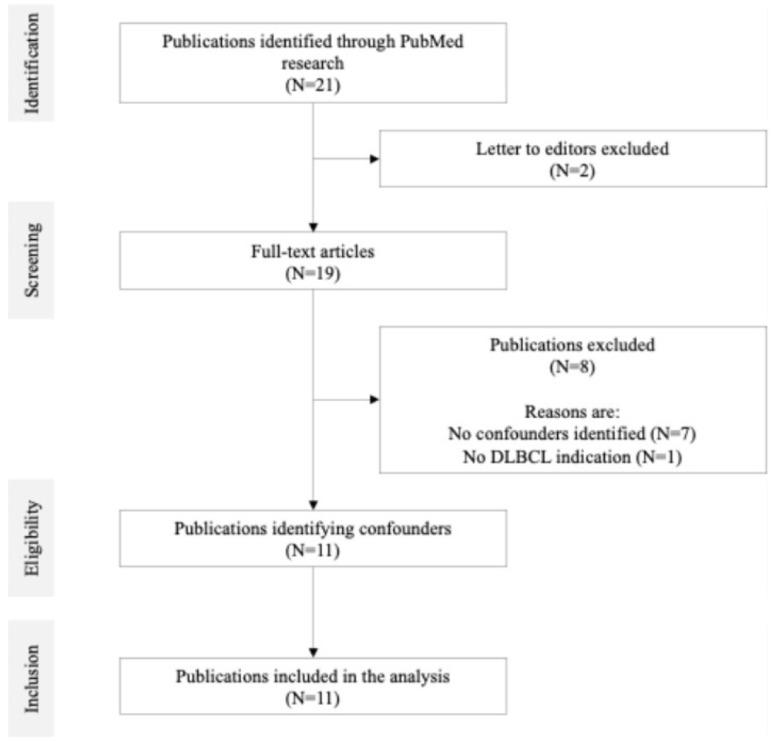
快速文献综述共识别出21篇文章,其中11篇被选作分析。排除未识别混杂因素、给编辑的信或涉及DLBCL以外疾病的文章。在11篇选定的出版物中,10篇未明确说明用于识别调整变量的方法。各项研究共识别出25个潜在混杂因素,所使用的变量集存在很大差异,这反映出混杂因素选择缺乏标准化。常见的混杂因素包括既往治疗线数和东部肿瘤协作组体能状态(ECOG PS),尽管它们作为ITC中的调整变量的纳入情况并不一致,通常是由于数据缺失。
虽然所识别出的混杂因素具有临床相关性,但选择这些因素的方法仍不明确,导致各项研究之间存在显著差异。此外,卫生技术评估(HTA)中通常考虑的关键变量,如年龄、性别和疾病严重程度,在ITC中的纳入情况也不一致。为了提高ITC结果的可靠性和一致性,迫切需要用于识别和调整混杂因素的标准化方法。

 Zotero 插件