
在确定2型糖尿病或糖尿病前期发病风险水平时,科尔多瓦方程在估算体脂方面的实用性。
Usefulness of the Córdoba Equation for Estimating Body Fat When Determining the Level of Risk of Developing Diabetes Type 2 or Prediabetes.
作者信息
Marina Arroyo Marta, Ramírez Gallegos Ignacio, Paublini Hernán, López-González Ángel Arturo, Tárraga López Pedro J, Martorell Sánchez Cristina, Sastre-Alzamora Tomás, Ramírez-Manent José Ignacio
机构信息
Research ADEMA SALUD Group, University Institute for Research in Health Sciences (IUNICS), 07010 Palma, Spain.
Faculty of Dentistry, ADEMA University School, 07010 Palma, Spain.
出版信息
Medicina (Kaunas). 2025 Mar 27;61(4):613. doi: 10.3390/medicina61040613.
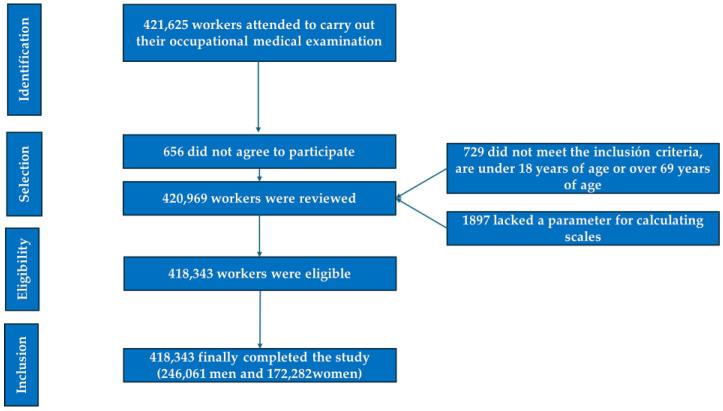
: Type 2 diabetes (T2D) and prediabetes represent major global health concerns, with obesity being a key risk factor. However, recent evidence suggests that the adipose tissue composition and distribution play a more critical role in metabolic dysfunction than the total body weight or body mass index (BMI). This study evaluates the predictive capacity of the Córdoba Equation for Estimating Body Fat (ECORE-BF) for identifying individuals at high risk of developing T2D and prediabetes. : A cross-sectional study was carried out involving 418,343 Spanish workers. Body fat percentage was estimated using the ECORE-BF equation, and diabetes risk was assessed using validated predictive models, including the Finnish Diabetes Risk Score (FINDRISC), QDiabetes score (QD-score), and others. The discriminatory power of ECORE-BF in predicting T2D and prediabetes was assessed using receiver operating characteristic (ROC) curve analysis. ECORE-BF showed a strong correlation with high-risk classifications across all diabetes risk scales. The area under the ROC curve (AUC) exceeded 0.95 for both men and women, demonstrating high predictive accuracy. Adipose tissue distribution, particularly visceral adiposity, is a central factor in metabolic dysfunction. ECORE-BF provides a cost-effective alternative for large-scale T2D and prediabetes risk assessment. Future research should explore the impact of visceral adipose tissue reduction on diabetes prevention and the integration of estimation scales into clinical and public health strategies.
2型糖尿病(T2D)和糖尿病前期是全球主要的健康问题,肥胖是一个关键风险因素。然而,最近的证据表明,脂肪组织的组成和分布在代谢功能障碍中所起的作用比总体重或体重指数(BMI)更为关键。本研究评估了科尔多瓦体脂估计方程(ECORE-BF)在识别有发展为T2D和糖尿病前期高风险个体方面的预测能力。:对418343名西班牙工人进行了一项横断面研究。使用ECORE-BF方程估计体脂百分比,并使用经过验证的预测模型评估糖尿病风险,包括芬兰糖尿病风险评分(FINDRISC)、Q糖尿病评分(QD评分)等。使用受试者工作特征(ROC)曲线分析评估ECORE-BF在预测T2D和糖尿病前期方面的鉴别能力。ECORE-BF在所有糖尿病风险量表中与高风险分类均显示出强相关性。男性和女性的ROC曲线下面积(AUC)均超过0.95,显示出较高的预测准确性。脂肪组织分布,尤其是内脏脂肪过多,是代谢功能障碍的核心因素。ECORE-BF为大规模T2D和糖尿病前期风险评估提供了一种经济有效的替代方法。未来的研究应探讨减少内脏脂肪组织对糖尿病预防的影响,以及将估计量表纳入临床和公共卫生策略。

 Zotero 插件