
滑膜葡萄糖及血清-滑膜葡萄糖比值可预测全膝关节置换术后急性感染的预后不良。
Synovial Glucose and Serum-to-Synovial Glucose Predict Failure After Acute Postoperative Infection in Total Knee Arthroplasty.
作者信息
Sabater-Martos Marta, Boadas Laia, Morata Laura, Soriano Alex, Martínez-Pastor Juan Carlos
机构信息
Orthopedic and Traumatology Department, Clínic Barcelona, Carrer Villarroel 170, 08036 Barcelona, Spain.
Department of Infectious Diseases, Clínic Barcelona, University of Barcelona, IDIBAPS (Institut d'Investigacions Biomèdiques Agustí-Pi Sunyer), Carrer Villarroel 170, 08036 Barcelona, Spain.
出版信息
J Clin Med. 2025 Apr 20;14(8):2841. doi: 10.3390/jcm14082841.
: The treatment of periprosthetic joint infection (PJI) involves various strategies, with debridement, antibiotic, and implant retention (DAIR) being a preferred method for acute infections due to its lower morbidity. However, DAIR success rates vary widely from 30% to 80%. This study investigates the predictive value of synovial glucose and the serum-to-synovial glucose ratio for DAIR outcomes in acute postoperative PJI following total knee arthroplasty (TKA). : This is a retrospective study of 32 DAIR cases, diagnosed with acute postoperative PJI after TKA. Synovial joint aspirations were performed on all patients. We collected all serological and synovial glucose levels. The serum-to-synovial glucose ratio was calculated. : Patients with synovial glucose levels below 44 mg/dL and a serum-to-synovial glucose ratio above 50% were identified as high risk for DAIR failure. High-risk patients exhibited a 31.3% failure rate, with half occurring within the first three months post-DAIR. No failures were observed in the low-risk group. Multivariate analysis did not find other significant predictors such as CRP levels, gender, or microbial cultures. : Low synovial glucose levels and high serum-to-synovial glucose ratios are predictive of unsuccessful outcomes following DAIR procedures. Patients exhibiting lower synovial concentrations experienced early treatment failure.
人工关节周围感染(PJI)的治疗涉及多种策略,清创、抗生素及植入物保留(DAIR)因其较低的发病率而成为急性感染的首选方法。然而,DAIR的成功率差异很大,从30%到80%不等。本研究调查了滑膜葡萄糖及血清与滑膜葡萄糖比值对全膝关节置换术(TKA)后急性术后PJI中DAIR结果的预测价值。
这是一项对32例DAIR病例的回顾性研究,这些病例被诊断为TKA术后急性PJI。对所有患者进行了滑膜关节穿刺抽吸。我们收集了所有血清学和滑膜葡萄糖水平。计算了血清与滑膜葡萄糖比值。
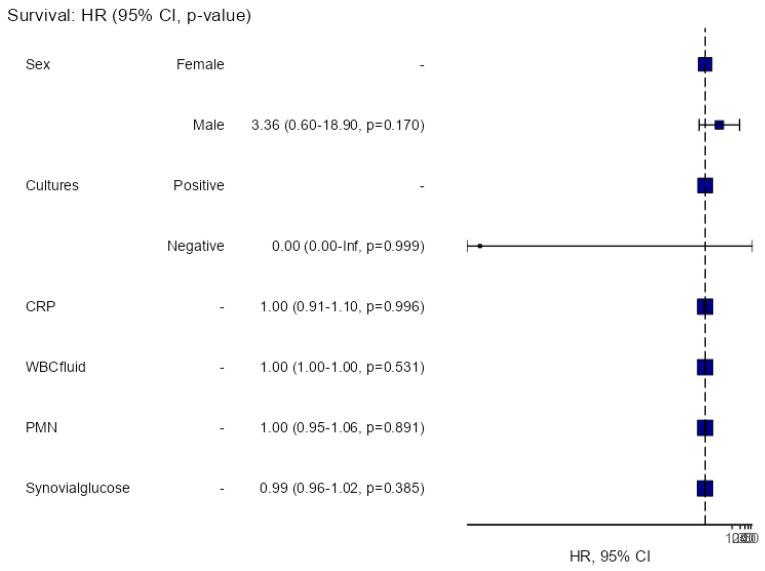
滑膜葡萄糖水平低于44mg/dL且血清与滑膜葡萄糖比值高于50%的患者被确定为DAIR失败的高危患者。高危患者的失败率为31.3%,其中一半发生在DAIR后的前三个月内。低危组未观察到失败病例。多变量分析未发现其他显著的预测因素,如CRP水平、性别或微生物培养结果。
滑膜葡萄糖水平低和血清与滑膜葡萄糖比值高可预测DAIR手术的不良结果。滑膜浓度较低的患者会出现早期治疗失败。


 Zotero 插件