
不同因素控制着导尿管细菌定植的长期和短期结果。
Different factors control long-term versus short-term outcomes for bacterial colonisation of a urinary catheter.
作者信息
Bull Freya, Tavaddod Sharareh, Bommer Nick, Perry Meghan, Brackley Chris A, Allen Rosalind J
机构信息
School of Physics and Astronomy, University of Edinburgh, Edinburgh, UK.
Department of Mathematics, University College London, London, UK.
出版信息
Nat Commun. 2025 Apr 26;16(1):3940. doi: 10.1038/s41467-025-59161-y.
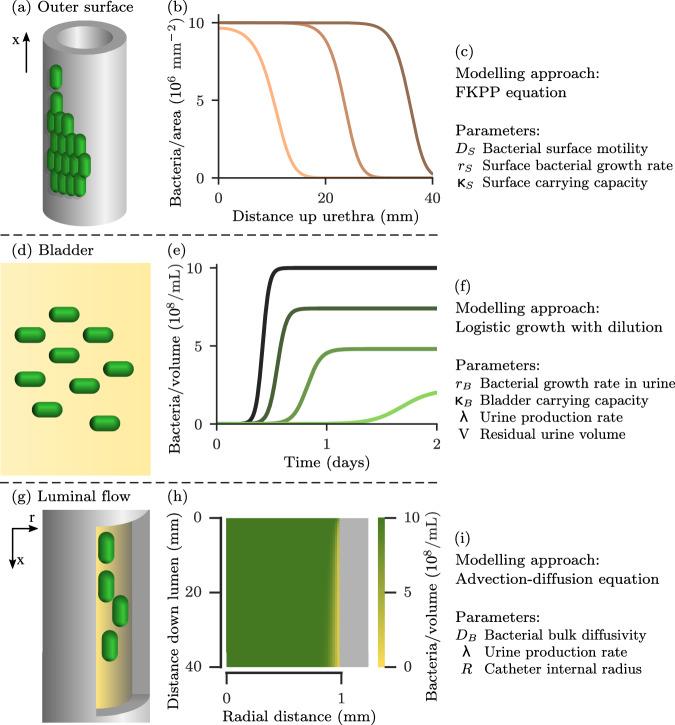
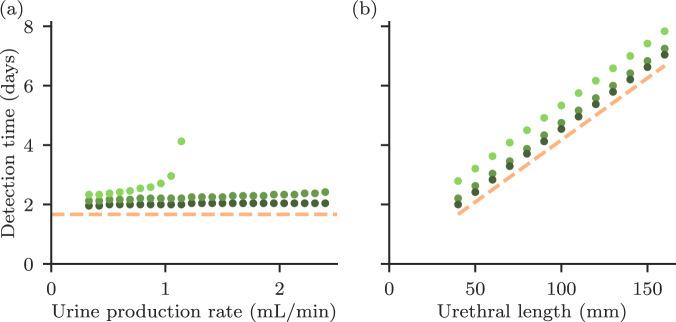
Urinary catheters are used extensively in hospitals and long-term care and they are highly prone to infection. Understanding the pathways by which bacteria colonise a urinary catheter could guide strategies to mitigate infection, but quantitative models for this colonisation process are lacking. Here we present a mathematical model for bacterial colonisation of a urinary catheter that integrates population dynamics and fluid dynamics. The model describes bacteria migrating up the outside surface of the catheter, spreading into the bladder and being swept through the catheter lumen. Computer simulations of the model reveal that clinical outcomes for long-term versus short-term catheterisation are controlled by different factors: the rate of urine production by the kidneys as opposed to urethral length, catheter surface properties and bacterial motility. Our work may help explain variable susceptibility to catheter-associated urinary tract infection (CAUTI) among individuals and the mixed success of antimicrobial surface coatings. Our model suggests that for long-term catheterised patients, increasing fluid intake or reducing residual urine volume in the bladder may help prevent infection, while antimicrobial surface coatings are predicted to be effective only for short-term catheterised patients. Therefore, different catheter management strategies could be rationally targeted to long-term vs short-term catheterised patients.
导尿管在医院和长期护理机构中被广泛使用,且极易引发感染。了解细菌在导尿管上定植的途径有助于制定减轻感染的策略,但目前缺乏针对这一定植过程的定量模型。在此,我们提出了一个整合种群动态和流体动力学的导尿管细菌定植数学模型。该模型描述了细菌沿导尿管外表面向上迁移、扩散至膀胱并被冲刷通过导尿管内腔的过程。对该模型的计算机模拟显示,长期与短期导尿的临床结果受不同因素控制:肾脏的产尿速率与尿道长度、导尿管表面特性及细菌运动性的情况相反。我们的研究可能有助于解释个体间导尿管相关尿路感染(CAUTI)易感性的差异以及抗菌表面涂层效果不一的原因。我们的模型表明,对于长期导尿患者,增加液体摄入量或减少膀胱残余尿量可能有助于预防感染,而预计抗菌表面涂层仅对短期导尿患者有效。因此,针对长期和短期导尿患者可合理采用不同的导尿管管理策略。



 Zotero 插件