
靶向MYC:肿瘤学中的多维调控与治疗策略
Targeting MYC: Multidimensional regulation and therapeutic strategies in oncology.
作者信息
Duan Yingying, Liu Zhaoshuo, Wang Qilin, Zhang Junyou, Liu Jiaxin, Zhang Ziyi, Li Chunyan
机构信息
School of Engineering Medicine, Beihang University, Beijing 100191, China.
School of Biological Science and Medical Engineering, Beihang University, Beijing 100191, China.
出版信息
Genes Dis. 2024 Sep 16;12(4):101435. doi: 10.1016/j.gendis.2024.101435. eCollection 2025 Jul.
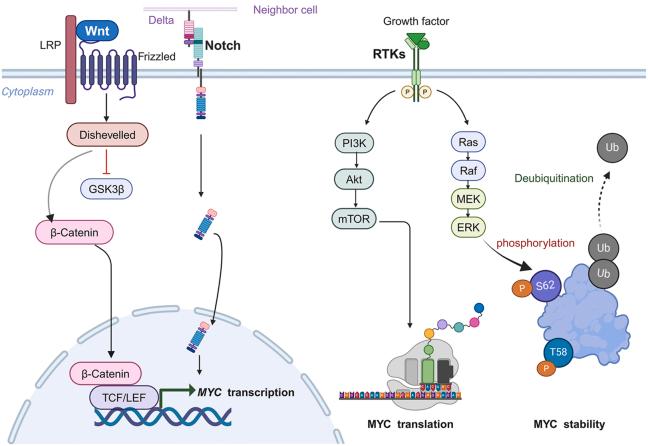
MYC is dysregulated in approximately 70% of human cancers, strongly suggesting its essential function in cancer. MYC regulates many biological processes, such as cell cycle, metabolism, cellular senescence, apoptosis, angiogenesis, and immune escape. MYC plays a central role in carcinogenesis and is a key regulator of tumor development and drug resistance. Therefore, MYC is one of the most alluring therapeutic targets for developing cancer drugs. Although the search for direct inhibitors of MYC is challenging, MYC cannot simply be assumed to be undruggable. Targeting the MYC-MAX complex has been an effective method for directly targeting MYC. Alternatively, indirect targeting of MYC represents a more pragmatic therapeutic approach, mainly including inhibition of the transcriptional or translational processes of MYC, destabilization of the MYC protein, and blocking genes that are synthetically lethal with MYC overexpression. In this review, we delineate the multifaceted roles of MYC in cancer progression, highlighting a spectrum of therapeutic strategies and inhibitors for cancer therapy that target MYC, either directly or indirectly.
MYC在大约70%的人类癌症中表达失调,这强烈表明其在癌症中具有重要功能。MYC调节许多生物学过程,如细胞周期、代谢、细胞衰老、凋亡、血管生成和免疫逃逸。MYC在致癌过程中起核心作用,是肿瘤发展和耐药性的关键调节因子。因此,MYC是开发癌症药物最具吸引力的治疗靶点之一。尽管寻找MYC的直接抑制剂具有挑战性,但不能简单地认为MYC是不可成药的。靶向MYC-MAX复合物一直是直接靶向MYC的有效方法。或者,间接靶向MYC代表了一种更务实的治疗方法,主要包括抑制MYC的转录或翻译过程、使MYC蛋白不稳定以及阻断与MYC过表达合成致死的基因。在这篇综述中,我们阐述了MYC在癌症进展中的多方面作用,重点介绍了一系列直接或间接靶向MYC的癌症治疗策略和抑制剂。



 Zotero 插件