
美国成年人中非高密度脂蛋白胆固醇与高密度脂蛋白胆固醇比值与非酒精性脂肪性肝病及肝脂肪变性的关联:来自2017 - 2020年美国国家健康与营养检查调查(NHANES)的见解
Association of the non-high-density lipoprotein cholesterol to high-density lipoprotein cholesterol ratio with non-alcoholic fatty liver disease and hepatic steatosis in United States adults: insights from NHANES 2017-2020.
作者信息
Song Zhen, Gu Hai-Qi, Xu Cheng
机构信息
Yancheng Binhai Hospital of Traditional Chinese Medicine, Yancheng, China.
Nanjing University of Chinese Medicine, Nanjing, China.
出版信息
Front Nutr. 2025 Apr 11;12:1540903. doi: 10.3389/fnut.2025.1540903. eCollection 2025.
OBJECTIVE
This study aimed to investigate the association between the non-high-density lipoprotein cholesterol to high-density lipoprotein cholesterol ratio (NHHR) and NAFLD, as well as its relationship with hepatic steatosis and liver fibrosis, in a nationally representative sample of U.S. adults.
METHODS
This cross-sectional study analyzed data from 3,529 participants from the National Health and Nutrition Examination Survey in 2017-2020. Multivariable logistic regression and subgroup analyses were used to assess the association between NHHR and NAFLD. Multivariate linear regression was employed to evaluate the relationship between NHHR and hepatic steatosis (controlled attenuation parameter) and liver fibrosis (liver stiffness measurement). Nonlinear relationships were explored through fitted smoothing curves and threshold effect analysis. Receiver operating curve (ROC) analysis was performed to compare the diagnostic performance of NHHR with body mass index (BMI), high-density lipoprotein cholesterol (HDL-C), and total cholesterol (TC).
RESULTS
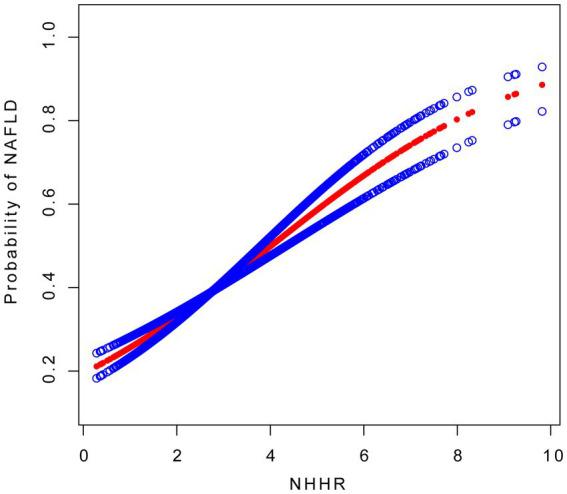
The study included 3,529 participants (mean age: 51.34 years, 95% CI: 49.97, 52.72), with 53.53% male. NHHR showed a significant positive association with NAFLD after adjusting for confounders (OR: 1.33, 95% CI: 1.24, 1.42). Subgroup analysis indicated a stronger association in females and individuals with normal weight. A nonlinear relationship was identified, with a significant positive association below an inflection point of 4 (OR: 1.52, 95% CI: 1.38, 1.68). NHHR was positively associated with hepatic steatosis but not with liver fibrosis. For NAFLD diagnosis, NHHR achieved an area under the curve (AUC) of 0.66, outperforming TC (AUC = 0.51) but indicating lower accuracy than BMI (AUC = 0.77) and HDL-C (AUC = 0.68).
CONCLUSION
NHHR is positively associated with NAFLD and hepatic steatosis in U.S. population, highlighting the important role of lipid control in the prevention and clinical management of NAFLD.
目的
本研究旨在在美国成年人的全国代表性样本中,调查非高密度脂蛋白胆固醇与高密度脂蛋白胆固醇比值(NHHR)与非酒精性脂肪性肝病(NAFLD)之间的关联,以及其与肝脂肪变性和肝纤维化的关系。
方法
这项横断面研究分析了2017 - 2020年美国国家健康和营养检查调查中3529名参与者的数据。采用多变量逻辑回归和亚组分析来评估NHHR与NAFLD之间的关联。采用多元线性回归来评估NHHR与肝脂肪变性(受控衰减参数)和肝纤维化(肝脏硬度测量)之间的关系。通过拟合平滑曲线和阈值效应分析探索非线性关系。进行受试者工作特征曲线(ROC)分析,以比较NHHR与体重指数(BMI)、高密度脂蛋白胆固醇(HDL-C)和总胆固醇(TC)的诊断性能。
结果
该研究纳入了3529名参与者(平均年龄:51.34岁,95%可信区间:49.97,52.72),其中男性占53.53%。在调整混杂因素后,NHHR与NAFLD呈显著正相关(比值比:1.33,95%可信区间:1.24,1.42)。亚组分析表明,在女性和体重正常的个体中关联更强。确定了一种非线性关系,在拐点4以下呈显著正相关(比值比:1.52,95%可信区间:1.38,1.68)。NHHR与肝脂肪变性呈正相关,但与肝纤维化无关。对于NAFLD诊断,NHHR的曲线下面积(AUC)为0.66,优于TC(AUC = 0.51),但准确性低于BMI(AUC = 0.77)和HDL-C(AUC = 0.68)。
结论
在美国人群中,NHHR与NAFLD和肝脂肪变性呈正相关,突出了脂质控制在NAFLD预防和临床管理中的重要作用。


 Zotero 插件