
中国氢燃料电池技术的成本轨迹。
Cost trajectory of hydrogen fuel cell technology in China.
作者信息
Wang Xue, Fan Li-Wei, Zhang Hongyan, Zhou Peng
机构信息
School of Economics and Management & Institute of Energy Economics and Policy, China University of Petroleum (East China), Qingdao 266580, China.
Institute of Energy Economics and Policy, China University of Petroleum (East China), Qingdao 266580, China.
出版信息
iScience. 2025 Apr 6;28(5):112359. doi: 10.1016/j.isci.2025.112359. eCollection 2025 May 16.
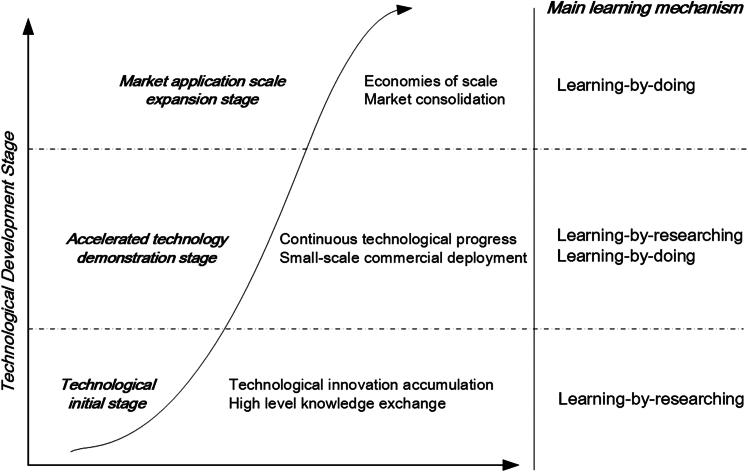
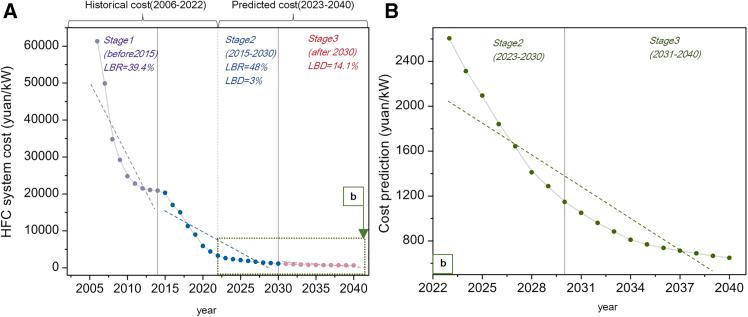
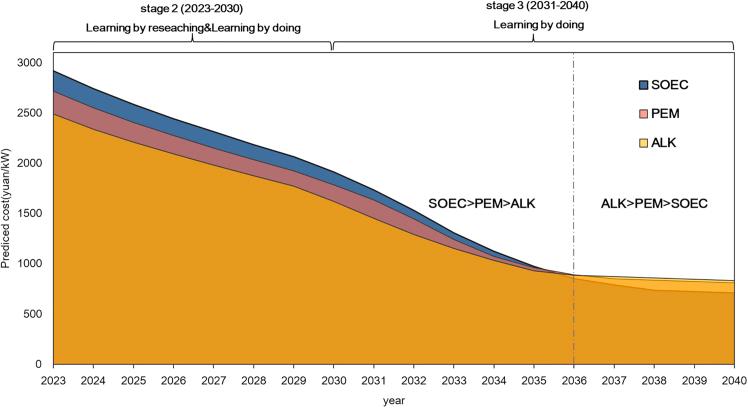
Reducing the cost of hydrogen fuel cell technology is crucial in propelling the hydrogen economy and achieving decarbonized energy systems. This study identifies the hydrogen fuel cell cost trajectory through a multi-stage learning curve model, highlighting technology learning mechanisms across different stages. Findings show that innovation and production contribute to cost reduction, and the learning by researching holds a more significant role presently, while the learning by doing takes precedence in the long term, achieving a 14% learning rate. The cost predictions imply that the system cost of hydrogen fuel cell is expected to fall below 1,000 yuan/kW after 2031. Moreover, the scenario analyses highlight the conducive role of various hydrogen production technologies and the evolution of cost influencing factors on cost reduction. Our research provides critical insights into the evolving dynamics of technological learning and cost trajectory in the hydrogen fuel cell industry, with significant implications for policy-making.
降低氢燃料电池技术成本对于推动氢能经济和实现能源系统脱碳至关重要。本研究通过多阶段学习曲线模型确定了氢燃料电池成本轨迹,突出了不同阶段的技术学习机制。研究结果表明,创新和生产有助于成本降低,目前研发学习发挥着更重要的作用,而从长期来看干中学占主导地位,学习率达到14%。成本预测表明,2031年后氢燃料电池系统成本预计将降至1000元/千瓦以下。此外,情景分析突出了各种制氢技术的促进作用以及成本影响因素演变对成本降低的作用。我们的研究为氢燃料电池行业技术学习和成本轨迹的动态演变提供了关键见解,对政策制定具有重要意义。





 Zotero 插件