
突尼斯南部两种啮齿动物——冈氏栉趾鼠(啮齿目,栉趾鼠科)和肥尾心颅跳鼠(啮齿目,鼠科)中刚地弓形虫的分子和血清学检测
Molecular and Serological Detection of Toxoplasma gondii in Two Species of Rodents: Ctenodactylus gundi (Rodentia, Ctenodactylidae) and Psammomys obesus (Rodentia, Muridae) From South Tunisia.
作者信息
Bouaicha Faten, Amairia Safa, Amdouni Yosra, Elati Khawla, Bensmida Boubaker, Rekik Mourad, Gharbi Mohamed
机构信息
Laboratory of Parasitology, National School of Veterinary Medicine of Sidi Thabet, University of Manouba, Sidi Thabet, Tunisia.
Centre Hospitalier Universitaire Vétérinaire-Animaux de production, École Nationale Vétérinaire d'Alfort, Maisons Alfort, France.
出版信息
Vet Med Sci. 2025 May;11(3):e70371. doi: 10.1002/vms3.70371.
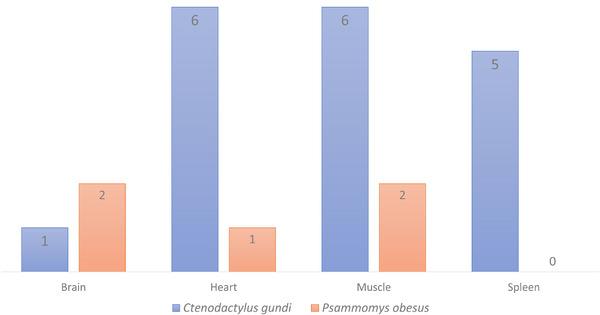
The molecular and serological prevalence of Toxoplasma gondii infection was investigated among rodents living in desertic areas in the Tataouine district, in the south of Tunisia. A total number of 43 rodents were captured from four sites classified as arid and Saharan climatic zones. Sera, hearts, spleens and brains were collected from each rodent. Sera were tested for the presence of anti-T. gondii IgG by the ELISA technique. PCR was used to detect T. gondii DNA from different tissues. Two rodent species were identified as Ctenodactylus gundi (Rodentia, Ctenodactylidae) (N = 28; 65%) and Psammomys obesus (Rodentia, Muridae) (N = 15; 35%). The overall molecular prevalence of T. gondii was 39% (17/43). Infection prevalences were higher in C. gundi (53.6%; 15/28) compared to P. obesus (13.3%; 2/15). In both species, the brain was the most infected organ (p = 0.02). No significant difference was recorded for the two rodent species according to gender and sampling sites (p > 0.05). The overall seroprevalence was up to 34.9% (15/43). It was higher in C. gundi (43%; 12/28) compared to P. obesus (20; 3/15) (p = 0.02). These results highlight a high infection level of T. gondii in desertic rodents. More investigations are required to understand the role of other desertic mammals and to identify the genotype circulating in the Tunisian Sahara.
在突尼斯南部塔塔温地区的沙漠地带生活的啮齿动物中,对刚地弓形虫感染的分子和血清学流行情况进行了调查。从四个被归类为干旱和撒哈拉气候区的地点共捕获了43只啮齿动物。从每只啮齿动物身上采集血清、心脏、脾脏和大脑。通过酶联免疫吸附测定(ELISA)技术检测血清中抗刚地弓形虫IgG的存在。采用聚合酶链反应(PCR)从不同组织中检测刚地弓形虫DNA。鉴定出两种啮齿动物,分别为冈氏栉趾鼠(啮齿目,栉趾鼠科)(N = 28;65%)和肥尾沙鼠(啮齿目,鼠科)(N = 15;35%)。刚地弓形虫的总体分子流行率为39%(17/43)。冈氏栉趾鼠的感染率(53.6%;15/28)高于肥尾沙鼠(13.3%;2/15)。在这两个物种中,大脑是感染最严重的器官(p = 0.02)。根据性别和采样地点,两种啮齿动物之间未记录到显著差异(p > 0.05)。总体血清阳性率高达34.9%(15/43)。冈氏栉趾鼠的血清阳性率(43%;12/28)高于肥尾沙鼠(20%;3/15)(p = 0.02)。这些结果突出了沙漠啮齿动物中刚地弓形虫的高感染水平。需要进行更多调查,以了解其他沙漠哺乳动物的作用,并确定在突尼斯撒哈拉地区传播的基因型。

 Zotero 插件