
采用凝集聚合酶链反应(ADAP)技术检测全血中的胰岛自身抗体灵敏且适用于一般人群筛查项目。
Detection of Islet Autoantibodies in Whole Blood by Antibody Detection by Agglutination-PCR (ADAP) Technology Is Sensitive and Suitable for General Population Screening Programs.
作者信息
Oron Tal, Cortez Felipe de Jesus, Shtaif Biana, Robinson Peter V, Yackobovitch-Gavan Michal, Tandel Devangkumar, Seftel David, Phillip Moshe, Tsai Cheng-Ting, Gat-Yablonski Galia
机构信息
The Jesse Z and Sara Lea Shafer Institute for Endocrinology and Diabetes, National Center for Childhood Diabetes, Schneider Children's Medical Center of Israel, Petach Tikva, Israel.
Faculty of Medicine, Tel Aviv University, Tel Aviv, Israel.
出版信息
Pediatr Diabetes. 2024 Mar 14;2024:4238394. doi: 10.1155/2024/4238394. eCollection 2024.
BACKGROUND
Detection of type 1 diabetes (T1D) at the preclinical stage is possible by detecting islet autoantibodies (IAs) years before the appearance of symptomatic diabetes. The Antibody Detection Israeli Research is a general population screening program searching for children with multiple IAs who are at risk of developing T1D. IAs are measured in capillary or venous whole blood (WB) samples using the novel ultrasensitive antibody detection by agglutination-PCR (ADAP) technology.
OBJECTIVE
To assess the accuracy and reliability of the ADAP assay in venous and capillary WB.
MATERIALS AND METHODS
In total, 50 children with T1D and 50 healthy controls participated in the study. Venous and capillary blood samples were drawn from participants with T1D, while only venous blood was drawn from the controls. The ADAP assay in venous and capillary blood was compared to the currently used assays in their ability to detect glutamic acid decarboxylase (GADA), islet antigen-2 (IA-2A), and insulin autoantibodies (IAAs).
RESULTS
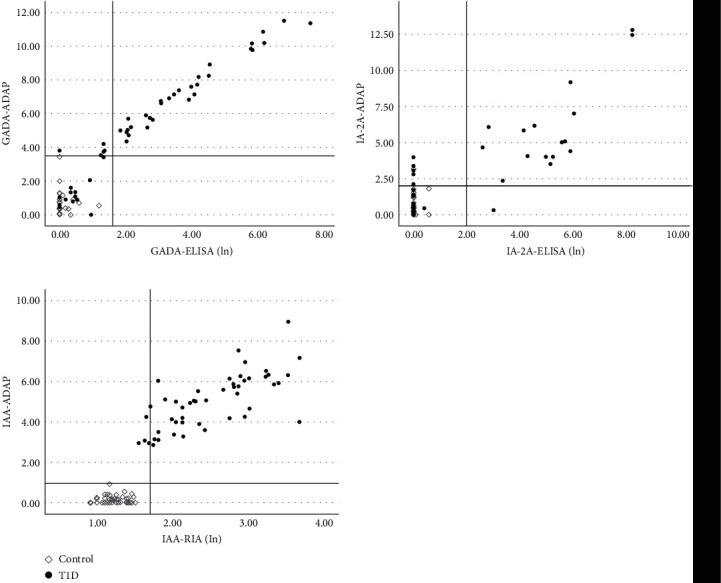
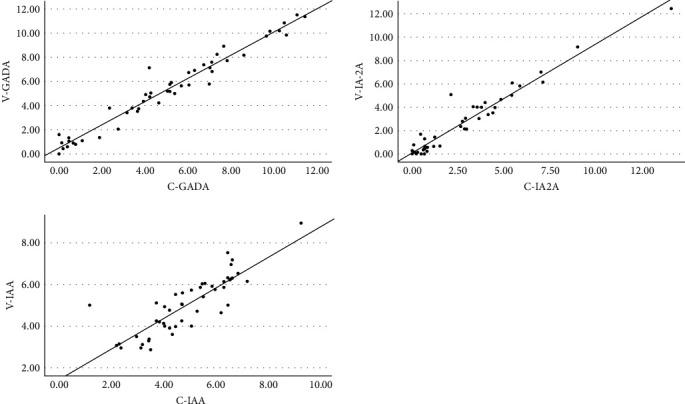
The area under the curve using the receiver operating characteristic curves was comparable between the ADAP assay in WB and standard enzyme-linked immunosorbent assay (ELISA)/radioimmunoassay (RIA) for all three IAs GADA 0.946 (95% CI: 0.900-0.991) vs. 0.949 (0.906-0.992), =0.873; IA-2A 0.747 (0.649-0.844) vs. 0.666 (0.587-0.744), =0.106; IAA 1.000 (1.000-1.000) vs. 1.000 (1.000-1.000), =1.000. The correlation between the levels of IA in venous and capillary WB using ADAP was = 0.958 ( < 0.01), = 0.943 ( < 0.01), and = 0.711 ( < 0.01) for GADA, IA-2A, and IAA, respectively. IA levels in venous and capillary WB using ADAP were comparable without a proportional bias in Bland-Altman's plots of agreement, suggesting the two methods may be used interchangeably.
CONCLUSIONS
The ADAP assay is reliable in detecting IA in venous and capillary WB samples with comparable performance to standard RIA and ELISA. These findings open avenues for widespread use of the ADAP assay in future general population screening programs to detect children at risk of developing T1D.
背景
在临床症状性糖尿病出现前数年,通过检测胰岛自身抗体(IA)可在临床前期阶段检测出1型糖尿病(T1D)。以色列抗体检测研究是一项针对普通人群的筛查项目,旨在寻找有多种IA且有患T1D风险的儿童。使用新型超灵敏凝集聚合酶链反应抗体检测(ADAP)技术,在毛细血管或静脉全血(WB)样本中检测IA。
目的
评估ADAP检测法在静脉和毛细血管全血中的准确性和可靠性。
材料与方法
共有50名T1D患儿和50名健康对照者参与本研究。从T1D患儿中采集静脉血和毛细血管血样本,而对照者仅采集静脉血。将静脉血和毛细血管血中的ADAP检测法与目前使用的检测法在检测谷氨酸脱羧酶(GADA)、胰岛抗原2(IA-2A)和胰岛素自身抗体(IAA)的能力方面进行比较。
结果
使用受试者工作特征曲线,对于所有三种IA,WB中的ADAP检测法与标准酶联免疫吸附测定(ELISA)/放射免疫测定(RIA)的曲线下面积具有可比性:GADA为0.946(95%可信区间:0.900 - 0.991)对0.949(0.906 - 0.992),P = 0.873;IA-2A为0.747(0.649 - 0.844)对0.666(0.587 - 0.744),P = 0.106;IAA为1.000(1.000 - 1.000)对1.000(1.000 - 1.000),P = 1.000。使用ADAP检测法,静脉和毛细血管全血中IA水平的相关性分别为:GADA的r = 0.958(P < 0.01),IA-2A的r = 0.943(P < 0.01),IAA的r = 0.711(P < 0.01)。在一致性的布兰德 - 奥特曼图中,使用ADAP检测法的静脉和毛细血管全血中的IA水平具有可比性,且无比例偏差,这表明两种方法可互换使用。
结论
ADAP检测法在检测静脉和毛细血管全血样本中的IA方面可靠,其性能与标准RIA和ELISA相当。这些发现为ADAP检测法在未来普通人群筛查项目中广泛用于检测有患T1D风险的儿童开辟了道路。


 Zotero 插件