
从分子设计到临床转化:癌症免疫治疗中的双靶点嵌合抗原受体T细胞策略
From molecular design to clinical translation: dual-targeted CAR-T strategies in cancer immunotherapy.
作者信息
Wang Zhenrong, Wang Mengyi, Wang Mengting, Zhou Ruijie, Deng Xiaotong, Ouyang Xin, Chu Minghui, Wei Xinyu, Yang Lei, Liu Jinbiao, Xu Yao
机构信息
Institute of Biology and Medicine, College of Life Science and Health, Wuhan University of Science and Technology, Wuhan, Hubei 430081, China.
People's Hospital of Jingyang County, Xianyang, Shaanxi, 713700, China.
出版信息
Int J Biol Sci. 2025 Mar 31;21(6):2676-2691. doi: 10.7150/ijbs.108036. eCollection 2025.
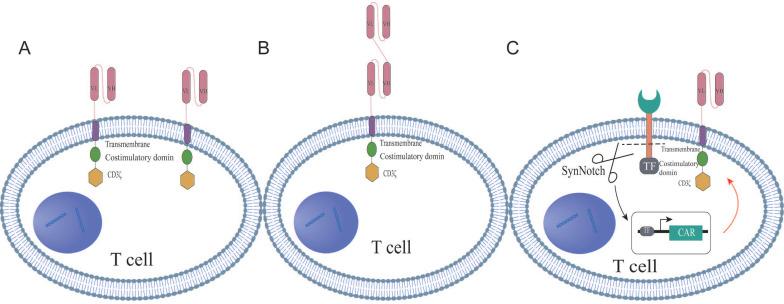
The pathogenesis of tumors involves various abnormalities at both the cellular and genetic levels. Chimeric antigen receptor (CAR)-T cell immunotherapy has emerged as a transformative treatment strategy that effectively addresses these challenges. While CAR-T therapy has shown remarkable success in treating hematological malignancies, limitations have been identified, particularly in single antigen-targeting CAR-T therapies. These limitations include antigenic mutation or loss, reduced efficacy against leukemia, and poor results in solid tumors due to factors like low CAR-T cell persistence, limited tumor infiltration, rapid cell exhaustion, the suppressive tumor microenvironment, and heterogeneous tumor antigen expression. In recent years, multi-antigen targeted CAR-T therapies have garnered significant attention for their potential to prevent tumor relapse and progression. This review outlines the fundamental design of dual CAR structures and summarizes the major advancements in both preclinical studies and clinical trials of dual-targeted CAR-T cell therapy, categorized by cancer type. Additionally, it discusses the challenges associated with dual-targeted CAR-T therapy and the strategies to enhance its efficacy and applicability in treating both hematologic and solid tumors. In conclusion, the progress in dual-targeted CAR-T cell therapy presents a promising therapeutic avenue for multiple malignancies, offering insights into future modifications of immunotherapy to advance the field.
肿瘤的发病机制涉及细胞和基因水平的各种异常。嵌合抗原受体(CAR)-T细胞免疫疗法已成为一种变革性的治疗策略,有效应对了这些挑战。虽然CAR-T疗法在治疗血液系统恶性肿瘤方面取得了显著成功,但也发现了一些局限性,特别是在单抗原靶向CAR-T疗法中。这些局限性包括抗原突变或丢失、对白血病疗效降低,以及在实体瘤中效果不佳,原因包括CAR-T细胞持久性低、肿瘤浸润有限、细胞快速耗竭、肿瘤微环境抑制以及肿瘤抗原表达异质性等因素。近年来,多抗原靶向CAR-T疗法因其预防肿瘤复发和进展的潜力而备受关注。本综述概述了双CAR结构的基本设计,并按癌症类型总结了双靶点CAR-T细胞疗法在临床前研究和临床试验中的主要进展。此外,还讨论了双靶点CAR-T疗法相关的挑战以及提高其在治疗血液系统和实体瘤方面疗效和适用性的策略。总之,双靶点CAR-T细胞疗法的进展为多种恶性肿瘤提供了一条有前景的治疗途径,为未来免疫疗法的改进以推动该领域发展提供了见解。


 Zotero 插件