
认知功能衰退中的白细胞端粒损耗:与APOE基因分型及心血管危险因素的关联
Leukocyte telomere attrition in cognitive decline: associations with APOE genotype and cardiovascular risk factors.
作者信息
Barros Alexandre Guimarães de Almeida, Soares Thayana Oliveira, Lage Ariane Flávia Almeida, Cintra Marco Túlio Gualberto, de Paula Jonas Jardim, Malheiro Olívio Brito, Falcão Antonio Eiras, Nogueira Christiano Altamiro Coli, de Carvalho Leandro Braz, Romano Silva Marco Aurélio, de Miranda Debora Marques, Viana Bernardo de Mattos, Rosa Daniela Valadão Freitas, Bicalho Maria Aparecida Camargos
机构信息
Medical School of Universidade Federal de Minas Gerais, Belo Horizonte, Brazil.
Hospital da Unimed Contorno Unimed-BH, Belo Horizonte, Brazil.
出版信息
Front Aging Neurosci. 2025 Apr 15;17:1557016. doi: 10.3389/fnagi.2025.1557016. eCollection 2025.
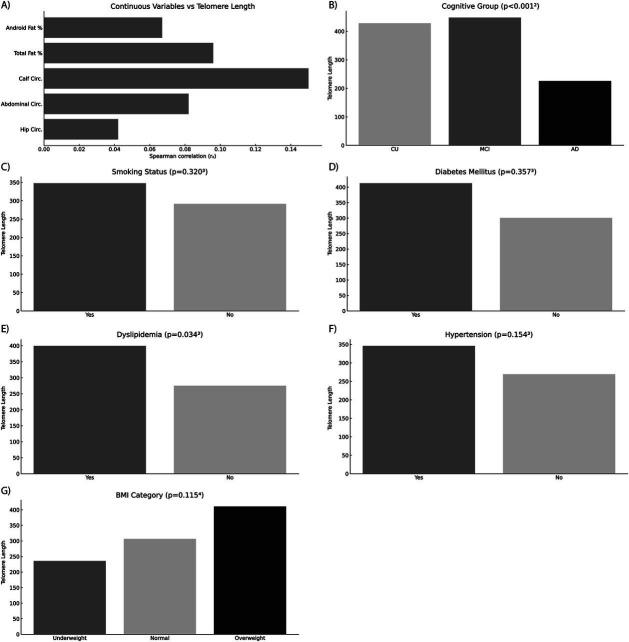
Telomere shortening represents a fundamental mechanism of cellular aging potentially implicated in neurodegenerative processes. This study investigated the complex associations among leukocyte telomere length, cardiovascular risk profiles, and APOE polymorphisms in age-related cognitive decline. Through a cross-sectional analysis of 90 participants stratified by cognitive status into three groups: cognitively unimpaired (CU), mild cognitive impairment (MCI), and Alzheimer's Disease (AD), we quantified relative telomere length using quantitative PCR, performed APOE genotyping and assessed cardiovascular risk factors. Quantitative analysis revealed significantly reduced telomere length in the AD group compared to CU and MCI groups. Multivariate regression analysis identified cognitive status as an independent predictor of telomere length ( = -0.468, < 0.001). APOE ε4 carrier status showed higher prevalence in AD subjects as expected. Cardiovascular risk factors demonstrated no significant correlation with telomere length across cognitive groups. Our findings establish a robust association between telomere shortening and advanced cognitive impairment in AD, suggesting potential utility as a neurodegenerative biomarker. This relationship appears independent of traditional cardiovascular risk factors, highlighting the complexity of cellular aging mechanisms in neurodegeneration.
端粒缩短是细胞衰老的一种基本机制,可能与神经退行性过程有关。本研究调查了白细胞端粒长度、心血管风险概况和载脂蛋白E(APOE)基因多态性在年龄相关性认知衰退中的复杂关联。通过对90名参与者进行横断面分析,根据认知状态将其分为三组:认知未受损(CU)、轻度认知障碍(MCI)和阿尔茨海默病(AD),我们使用定量聚合酶链反应(PCR)对相对端粒长度进行了量化,进行了APOE基因分型,并评估了心血管危险因素。定量分析显示,与CU组和MCI组相比,AD组的端粒长度显著缩短。多变量回归分析确定认知状态是端粒长度的独立预测因素(β = -0.468,P < 0.001)。正如预期的那样,APOE ε4携带者状态在AD受试者中的患病率更高。心血管危险因素在各认知组中与端粒长度均无显著相关性。我们的研究结果确立了端粒缩短与AD中晚期认知障碍之间的密切关联,表明其作为神经退行性生物标志物的潜在效用。这种关系似乎独立于传统心血管危险因素,突出了神经退行性变中细胞衰老机制的复杂性。


 Zotero 插件