
脂肪细胞衍生的……调节卵子发生。 (原文中“Adipocyte-Derived”后有多个逗号未给出完整内容,只能按现有内容翻译到这种程度)
Adipocyte-Derived , , , and Regulate Oogenesis.
作者信息
Simmons Chad, Williams Isaiah H, Bradshaw Tancia W, Armstrong Alissa Richmond
机构信息
Department of Biological Sciences, College of Arts and Sciences, University of South Carolina, Columbia, SC 29208, USA.
出版信息
Biomolecules. 2025 Apr 1;15(4):513. doi: 10.3390/biom15040513.
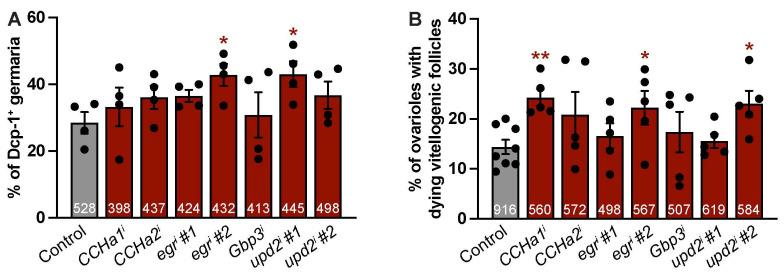
In addition to energy storage, adipose tissue communication to other organs plays a key role in regulating organismal physiology. While the link between adipose tissue dysfunction and pathophysiology, including diabetes, chronic inflammation, and infertility, is clear, the molecular mechanisms that underlie these associations have not been fully described. We use as a model to better understand how adipose tissue communicates to the ovary. In this study, we utilized robust genetic toolkit to examine the role of five adipokines known to control larval growth during development, , , , , and in regulating oogenesis. We show that the adult fat body expresses these "larval" adipokines. Our data indicate that ovarian germline stem cell maintenance does not require these adipokines. However, adipocyte-derived , , , and influence early and late germline survival as well as ovulation. Thus, this work uncovers several adipokines that mediate fat-to-ovary communication.
除了能量储存外,脂肪组织与其他器官的通讯在调节机体生理方面起着关键作用。虽然脂肪组织功能障碍与病理生理学(包括糖尿病、慢性炎症和不孕症)之间的联系很明显,但这些关联背后的分子机制尚未得到充分描述。我们使用[具体模型]来更好地理解脂肪组织如何与卵巢进行通讯。在本研究中,我们利用强大的遗传工具包来研究已知在发育过程中控制幼虫生长的五种脂肪因子,即[脂肪因子名称1]、[脂肪因子名称2]、[脂肪因子名称3]、[脂肪因子名称4]和[脂肪因子名称5]在调节卵子发生中的作用。我们发现成年脂肪体表达这些“幼虫期”脂肪因子。我们的数据表明,卵巢生殖系干细胞的维持不需要这些脂肪因子。然而,脂肪细胞衍生的[脂肪因子名称1]、[脂肪因子名称2]、[脂肪因子名称3]和[脂肪因子名称4]会影响生殖系早期和晚期的存活以及排卵。因此,这项工作揭示了几种介导脂肪与卵巢通讯的脂肪因子。


 Zotero 插件