
颞下颌关节紊乱症中咀嚼肌活动与心率及血氧饱和度的短期观察
Short-Term Observation of Heart Rate and Oxygen Saturation in Relation to Masticatory Muscle Activity in Temporomandibular Disorders.
作者信息
Zieliński Grzegorz, Ginszt Michał, Wójcicki Marcin, Szkutnik Jacek, Litko-Rola Monika, Gawda Piotr
机构信息
Department of Sports Medicine, Medical University of Lublin, 20-093 Lublin, Poland.
Department of Rehabilitation and Physiotherapy, Medical University of Lublin, 20-093 Lublin, Poland.
出版信息
Brain Sci. 2025 Mar 31;15(4):361. doi: 10.3390/brainsci15040361.
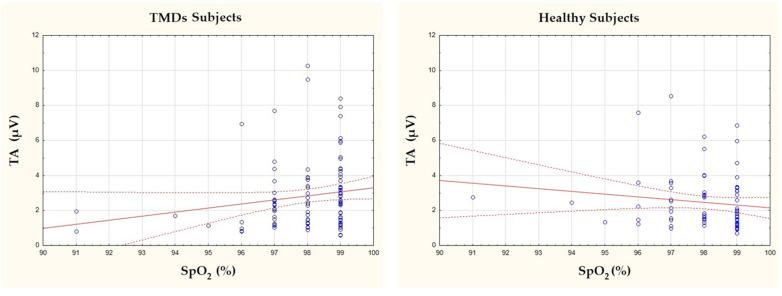
(1) Background: The present study was designed to analyze the relationship between masticatory muscle activity, oxygen body saturation, and heart rate in patients with temporomandibular disorders (TMDs). (2) Methods: A total of 104 individuals with a painful form of TMDs were included in the study, consisting of 72 women and 32 men, with an average age of 24 ± 3 years. The control group included 77 individuals, comprising 44 women and 33 men, with an average age of 24 ± 3 years. An electromyographic study was conducted at rest, focusing on the temporalis (TA) and masseter muscles, alongside an oxygen saturation and heart rate analysis using a pulse oximeter. (3) Results: Analysis of the correlations between oxygen saturation and the studied muscles revealed a positive correlation between the resting activity of the TA and oxygen saturation, with a small effect size in the TMDs group. This positive correlation suggests increased muscle oxygenation is associated with higher resting activity in TMDs patients. (4) Conclusions: This study indicates that oxygen body saturation is associated with increased resting activity in the temporalis muscles of individuals with TMDs. Increased muscle tension in TMDs patients may impact the metabolism of the temporalis muscle, leading to higher energy and oxygen demands. This could be linked to hypermetabolism and an increased energy burden in these muscles at rest.
(1) 背景:本研究旨在分析颞下颌关节紊乱病(TMDs)患者咀嚼肌活动、血氧饱和度和心率之间的关系。(2) 方法:本研究共纳入104例疼痛型TMDs患者,其中女性72例,男性32例,平均年龄24±3岁。对照组包括77例个体,其中女性44例,男性33例,平均年龄24±3岁。静息状态下进行肌电图研究,重点关注颞肌(TA)和咬肌,同时使用脉搏血氧仪进行血氧饱和度和心率分析。(3) 结果:血氧饱和度与所研究肌肉之间的相关性分析显示,TMDs组中TA静息活动与血氧饱和度呈正相关,效应量较小。这种正相关表明TMDs患者肌肉氧合增加与更高的静息活动相关。(4) 结论:本研究表明,TMDs患者的血氧饱和度与颞肌静息活动增加有关。TMDs患者肌肉张力增加可能会影响颞肌的代谢,导致更高的能量和氧气需求。这可能与这些肌肉在静息状态下的代谢亢进和能量负担增加有关。

 Zotero 插件