
头颈部鳞状细胞癌的嵌合抗原受体T细胞(CAR-T)疗法的进展与挑战
Advances and challenges in CAR-T cell therapy for head and neck squamous cell carcinoma.
作者信息
Saeidpour Masouleh Sahand, Nasiri Kamyar, Ostovar Ravari Ava, Saligheh Rad Mona, Kiani Kiarash, Sharifi Sultani Ali, Nejati Seyedeh Tabasom, Nabi Afjadi Mohsen
机构信息
Department of Medical Biotechnologies, University of Siena, Siena, Italy.
Faculty of Dentistry, Islamic Azad University of Medical Sciences, Tehran, Iran.
出版信息
Biomark Res. 2025 May 1;13(1):69. doi: 10.1186/s40364-025-00783-1.
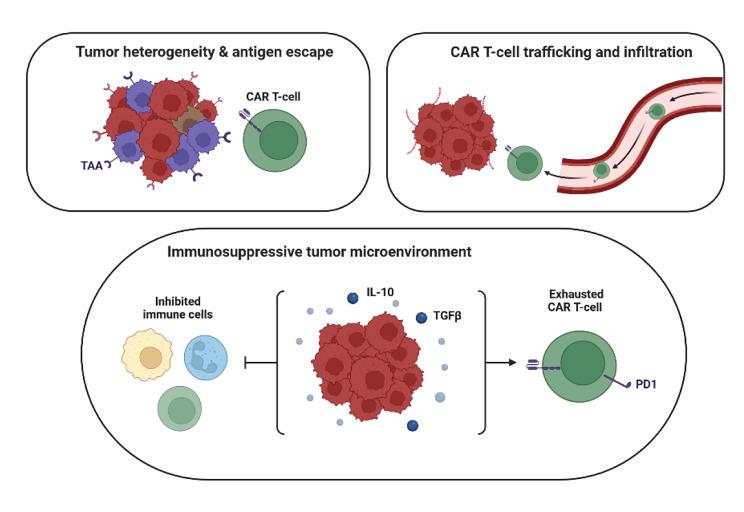
Head and neck squamous cell carcinoma (HNSCC) remains among the most aggressive malignancies with limited treatment options, especially in recurrent and metastatic cases. Despite advances in surgery, radiotherapy, chemotherapy, and immune checkpoint inhibitors, survival rates remain suboptimal due to tumor heterogeneity, immune evasion, and treatment resistance. In recent years, Chimeric Antigen Receptor (CAR) T-cell therapy has revolutionized hematologic cancer treatment by genetically modifying T cells to target tumor-specific antigens like CD19, CD70, BCMA, EGFR, and HER2, leading to high remission rates. Its success is attributed to precise antigen recognition, sustained immune response, and long-term immunological memory, though challenges like cytokine release syndrome and antigen loss remain. Notably, its translation to solid tumors, including HNSCC, faces significant challenges, such as tumor microenvironment (TME)-induced immunosuppression, antigen heterogeneity, and limited CAR T-cell infiltration. To address these barriers, several tumor-associated antigens (TAAs), including EGFR, HER2 (ErbB2), B7-H3, CD44v6, CD70, CD98, and MUC1, have been identified as potential CAR T-cell targets in HNSCC. Moreover, innovative approaches, such as dual-targeted CAR T-cells, armored CARs, and CRISPR-engineered modifications, aim to enhance efficacy and overcome resistance. Notably, combination therapies integrating CAR T-cells with immune checkpoint inhibitors (e.g., PD-1/CTLA-4 blockade) and TGF-β-resistant CAR T designs are being explored to improve therapeutic outcomes. This review aimed to elucidate the current landscape of CAR T-cell therapy in HNSCC, by exploring its mechanisms, targeted antigens, challenges, emerging strategies, and future therapeutic potential.
头颈部鳞状细胞癌(HNSCC)仍然是侵袭性最强的恶性肿瘤之一,治疗选择有限,尤其是在复发和转移病例中。尽管手术、放疗、化疗和免疫检查点抑制剂取得了进展,但由于肿瘤异质性、免疫逃逸和治疗耐药性,生存率仍然不尽人意。近年来,嵌合抗原受体(CAR)T细胞疗法通过对T细胞进行基因改造,使其靶向肿瘤特异性抗原,如CD19、CD70、BCMA、EGFR和HER2,从而彻底改变了血液系统癌症的治疗方式,缓解率很高。其成功归因于精确的抗原识别、持续的免疫反应和长期的免疫记忆,尽管诸如细胞因子释放综合征和抗原丢失等挑战依然存在。值得注意的是,将其应用于包括HNSCC在内的实体瘤面临重大挑战,如肿瘤微环境(TME)诱导的免疫抑制、抗原异质性和CAR T细胞浸润受限。为了克服这些障碍,包括EGFR、HER2(ErbB2)、B7-H3、CD44v6、CD70、CD98和MUC1在内的几种肿瘤相关抗原(TAAs)已被确定为HNSCC中潜在的CAR T细胞靶点。此外,双靶点CAR T细胞、武装CAR和CRISPR工程修饰等创新方法旨在提高疗效并克服耐药性。值得注意的是,正在探索将CAR T细胞与免疫检查点抑制剂(如PD-1/CTLA-4阻断)和抗TGF-β的CAR T设计相结合的联合疗法,以改善治疗效果。本综述旨在通过探讨CAR T细胞疗法在HNSCC中的机制、靶向抗原、挑战、新兴策略和未来治疗潜力,阐明其当前的发展态势。
 Zotero 插件