
体育锻炼对老年人日常生活活动的影响:基于倾向得分匹配和双重差分法的实证分析
Influence of physical exercise on activities of daily living in older adults: an empirical analysis based on propensity score matching and difference-in-differences.
作者信息
Ma Xiaoni, Li Xiaotian, Che Li, Dong Jie
机构信息
Graduate School, Capital University of Physical Education and Sports, Beijing, China.
School of Recreation and Community Sport, Capital University of Physical Education and Sports, Beijing, China.
出版信息
Front Public Health. 2025 Apr 17;13:1463348. doi: 10.3389/fpubh.2025.1463348. eCollection 2025.
BACKGROUND
Activities of Daily Living (ADL) are crucial for assessing older adult's ability to live independently. Physical exercise has a positive impact on ADL. During the COVID-19 pandemic, the reduction of social interaction and the limited use of exercise facilities led some older adults to reduce regular exercise and show more sedentary behavior. This study aimed to examine the influence of physical exercise on the Activities of Daily Living (ADL) among older adults during the COVID-19 pandemic.
METHODS
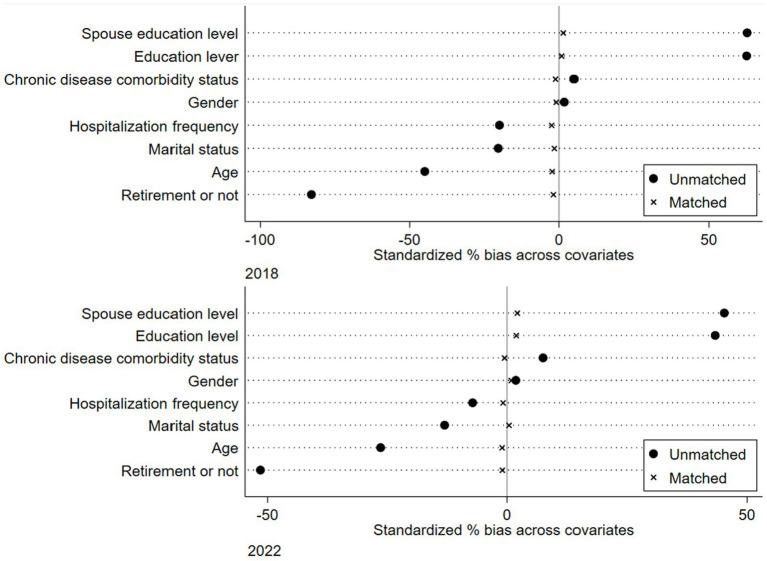
Using the China Longitudinal Aging Social Survey (CLASS) data, propensity score matching (PSM) was performed on the sample, with the interaction between participation in physical exercise and observation year as the core independent variables, and instrumental activities of daily life (IADL) and basic activities of daily life (BADL) as the dependent variables for difference-in-differences (DID) regression analysis. Verify age heterogeneity through grouped regression, and use mediation effect analysis to examine the role of retirement.
RESULTS
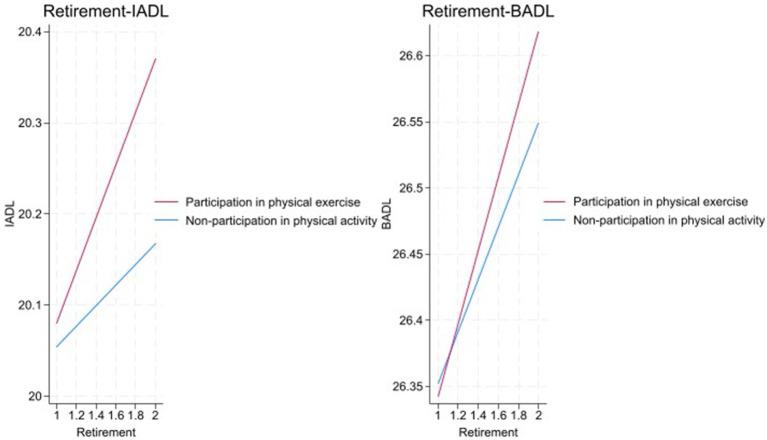
In the context of COVID-19, participation in physical exercise had a negative impact on the IADL and BADL of older adults. The IADL and BADL of the older adults who participated in physical exercise were 0.189 and 0.119 units lower than those who did not participate in physical exercise. This negative impact also varied by age, for older adults aged 75 years and above, participation in physical exercise exerted a significant positive impact on both IADL and BADL. In contrast, among those under 75 years of age, no significant effects of physical exercise on IADL or BADL were detected. The analysis further revealed retirement status emerged as a significant masking variable that amplifies observed differences in ADL outcomes when controlled analytically.
CONCLUSION
During the pandemic, physical exercise still has a positive impact on the IADL and BADL of the older adults. The older adults aged 75 and above are more reliant on physical exercise to improve their IADL and BADL. Due to the survivor effect, the relative negative effect of retirement on the IADL and BADL of the older adults who engage in physical exercise is more pronounced.
背景
日常生活活动能力(ADL)对于评估老年人独立生活能力至关重要。体育锻炼对ADL有积极影响。在新冠疫情期间,社交互动减少以及运动设施使用受限导致一些老年人减少了常规锻炼并表现出更多久坐行为。本研究旨在探讨新冠疫情期间体育锻炼对老年人日常生活活动能力(ADL)的影响。
方法
利用中国老年社会追踪调查(CLASS)数据,对样本进行倾向得分匹配(PSM),以参与体育锻炼与观察年份之间的交互作用作为核心自变量,以日常生活工具性活动(IADL)和日常生活基本活动(BADL)作为因变量进行双重差分(DID)回归分析。通过分组回归验证年龄异质性,并使用中介效应分析来检验退休的作用。
结果
在新冠疫情背景下,参与体育锻炼对老年人的IADL和BADL有负面影响。参与体育锻炼的老年人的IADL和BADL分别比未参与体育锻炼的老年人低0.189和0.119个单位。这种负面影响也因年龄而异,对于75岁及以上的老年人,参与体育锻炼对IADL和BADL均有显著的积极影响。相比之下,在75岁以下的人群中,未检测到体育锻炼对IADL或BADL有显著影响。分析进一步表明,退休状态是一个显著的掩盖变量,在进行分析控制时会放大观察到的ADL结果差异。
结论
在疫情期间,体育锻炼对老年人的IADL和BADL仍有积极影响。75岁及以上的老年人更依赖体育锻炼来改善他们的IADL和BADL。由于幸存者效应,退休对参与体育锻炼的老年人的IADL和BADL的相对负面影响更为明显。
 Zotero 插件